

Ecotest BDPN-07 Neutron Radiation Detection Module
Pros
- Thermal and fast neutrons
- SNM-56 He-3 counter
- Energies from 0.025 eV
- Quick warm-up
- Moderators included
Cons
- Requires a compatible MKS control unit
- Additional moderator is heavy
- Regular verification is mandatory
What is the BDPN-07 and who is it for?
The BDPN-07 is a remote neutron radiation detection module (essentially a “neutron head”) that connects to a compatible control unit or dosimeter and provides two key capabilities: locating neutron sources and measuring thermal and fast neutron flux density.
This equipment is for people handling real radiation monitoring tasks at industrial facilities, in laboratories, in CBRN and radiation safety services, at entry and exit checkpoints, and at sites where “gamma is always present” but neutrons also need to be detected and counted.
Why neutrons are tricky and how the BDPN-07 “catches” them
Neutrons don't glow or ionize the air as obviously as gamma radiation does. That's why the BDPN-07 uses an SNM-56 gas-discharge counter filled with helium-3 (He-3), which operates in corona discharge mode. A high voltage of about 1500 V is generated inside the module, but there are no exposed dangerous contacts on the outside: the module connects to the control unit by cable.
Moderators are used in the design to increase and “even out” sensitivity to neutrons of different energies. That's why the kit looks like a “cylinder + another substantial housing” rather than a tiny keychain-sized sensor.

Moderators: the main design concept and the main reason not to cut corners
The BDPN-07 has three mechanically interchangeable “configurations”:
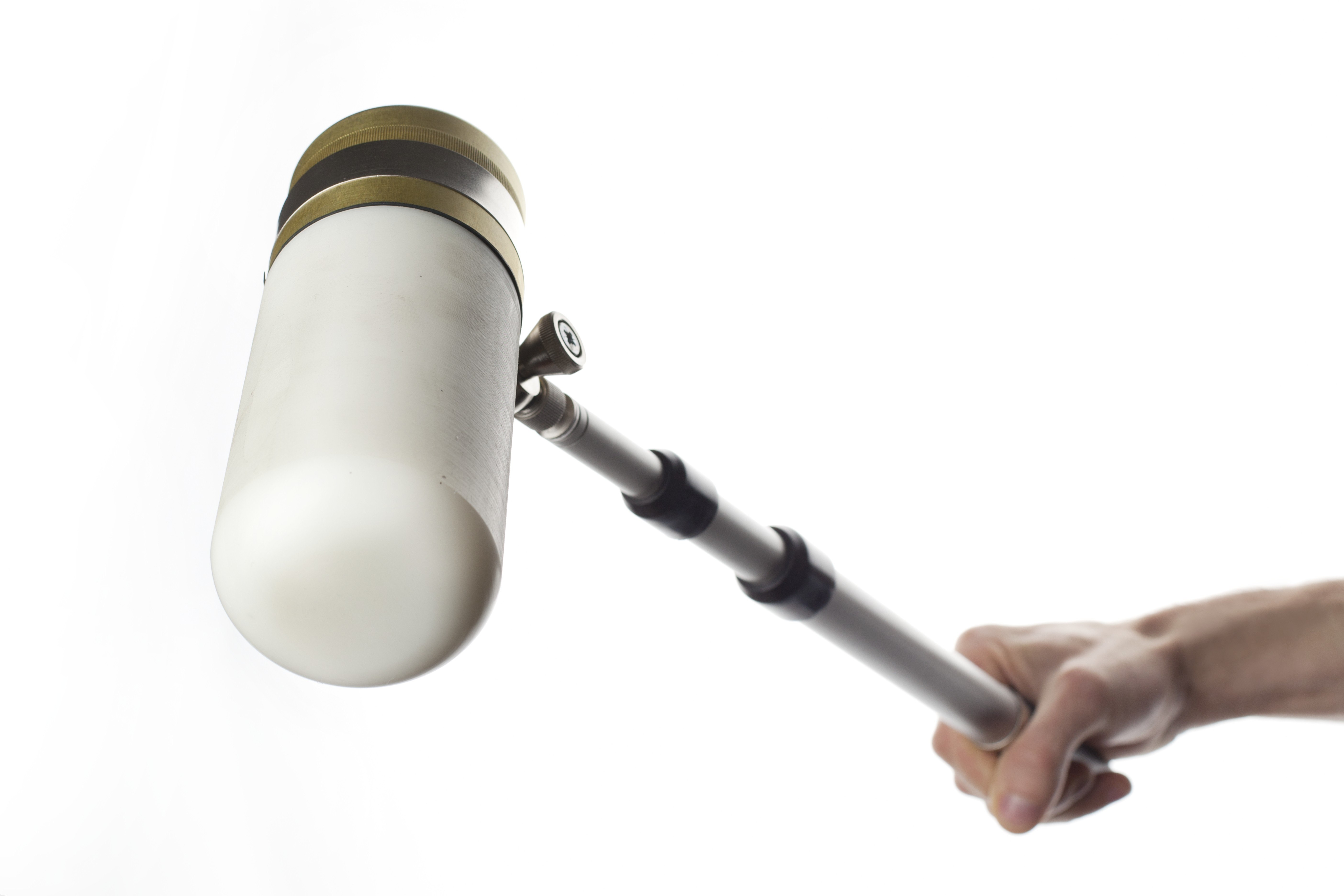
- Main moderator (a polyethylene “cup” with a wall about 20 mm thick): the working configuration for locating sources and measuring thermal neutrons.
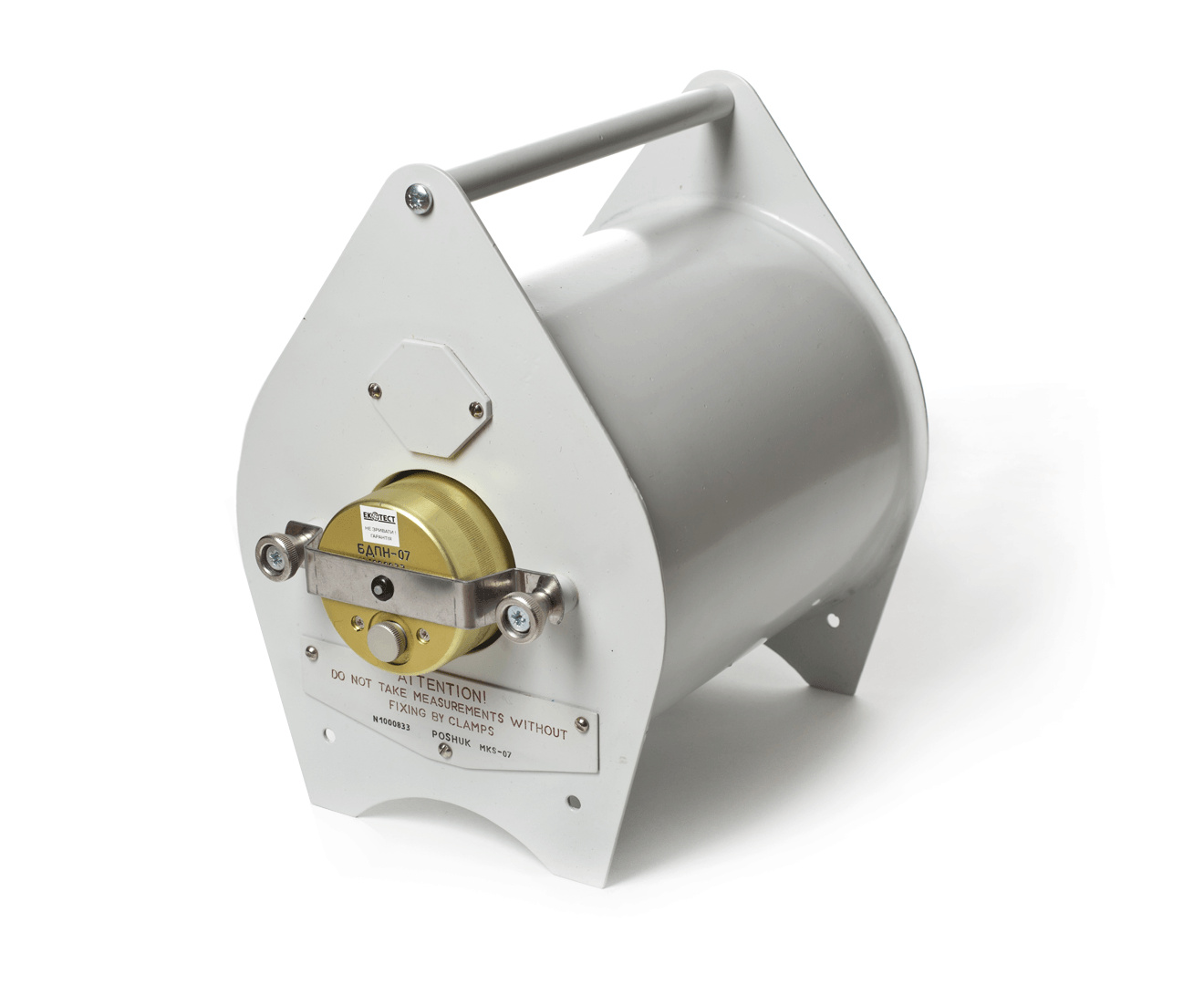
- Additional moderator: a separate housing with a handle, filled with paraffin (forming an additional layer about 60 mm thick). It is required for measuring fast neutrons.
- Protective cap: installed in place of the main moderator to protect the detector from mechanical damage and environmental conditions.
An important detail from the manual: when using the additional moderator, the module must be clamped in it. This isn't just a design quirk: the clamp also presses a button that switches the calibration coefficients on the control unit. Simply put, “not clamped” means “not measuring the right thing.”
How it's used in the field: a quick, plain-English guide
A typical workflow looks like this:
- Connect the BDPN-07 by cable to a compatible control unit (for example, the MKS-07 “Poshuk” or MKS-U).
- For searching and thermal neutron measurements, use the main moderator; for hard-to-reach places, a clamp for a telescopic pole helps (the mounting angle is adjustable).
- For fast neutrons, insert the module (with the main moderator) into the additional moderator and tighten the fasteners securely.
- Warm-up time is up to 1 min.
A normal characteristic of the He-3 counter is that small readings may appear on the display even without a neutron source (this is the counter's “intrinsic background”). It doesn't mean the unit is broken or “detecting outer space”; this is normal behavior for this class of detector.
Ranges to know before buying
The BDPN-07 operates over a neutron energy range from 0.025 eV to 14 MeV. Its measurement ranges are:
- thermal neutrons: 10…105 n/(cm2·min);
- fast neutrons: 50…105 n/(cm2·min).
Error is specified by formulas (when calibrated against Pu-Be, with a confidence level of 0.95). This is normal for neutron dosimetry: accuracy depends on the flux level, geometry and source spectrum, not just “magic in the sensor.”
Dimensions and “the weight that turns you into a tripod”
The module itself with the main moderator is light enough for handheld use: up to 0.8 kg (dimensions approximately Ø76 × 195 mm). The additional moderator is another story, though: up to 8 kg and dimensions of 215 × 295 × 270 mm. It's not designed to fit in your pocket; it's designed to measure fast neutrons correctly.
Resistance to environmental conditions and gamma background
The module is designed to operate at temperatures from -25…+55 °C, in high humidity (without condensation) and at atmospheric pressures typical of industrial conditions. Resistance to shocks and magnetic fields is also specified.
Another useful detail: it can operate in a gamma background of up to 104 µR/h (that's 10 mR/h, approximately ≈90 µSv/h for γ) without introducing additional error into neutron flux measurements. This matters where neutrons often occur alongside gamma radiation.
What to check before buying, especially if the kit is secondhand
- Check that both moderators, the protective cap and the pole clamp are present.
- Check the condition of the threads and seals, and the integrity of the housing and connector.
- Check whether a connecting cable is included and compatible with your control unit.
- Check the date of the last verification or calibration, and where you'll have it done next time.
For an original document covering all operating modes and requirements, look for “BDPN-07 Operating manual” on the ECOTEST GROUP website or open the PDF manual describing the moderators and verification procedures.
Bottom line
The BDPN-07 is the right tool when you need more than an “impression of radiation”: it provides concrete neutron data for searching, locating and measuring thermal and fast components, using moderators based on sound engineering principles. The key is to have a compatible control unit and not overlook the kit's mechanical setup (clamp and moderators), because neutrons don't forgive mistakes; they simply don't show them.