BROM ORP-169E ORP Meter
Pros
- Range up to ±1999 mV
- Simple “dip and read” operation
- HOLD freezes the reading
- ATC from 0–50 °C
- Compact, with a waterproof claim
Cons
- Calibration requires a screwdriver
- No measurement log
- AG13 batteries are not available everywhere
What is ORP and why use this meter?
The BROM ORP-169E is a pocket ORP meter (ORP/Redox meter) that measures oxidation-reduction potential in millivolts (mV). Simply put, it tells you how oxidizing or reducing a medium is. Positive values generally indicate a more oxidizing medium, while negative values indicate a more reducing one.
ORP is often used as a quick indicator of water conditions at home and in technical systems: pools and spas (to check disinfection effectiveness), aquariums, hydroponics, water treatment and filtration, and various process solutions. An important distinction: ORP is not a measure of “how much chlorine is present in mg/L.” It is an overall indicator affected by pH, temperature, impurities, and other factors.
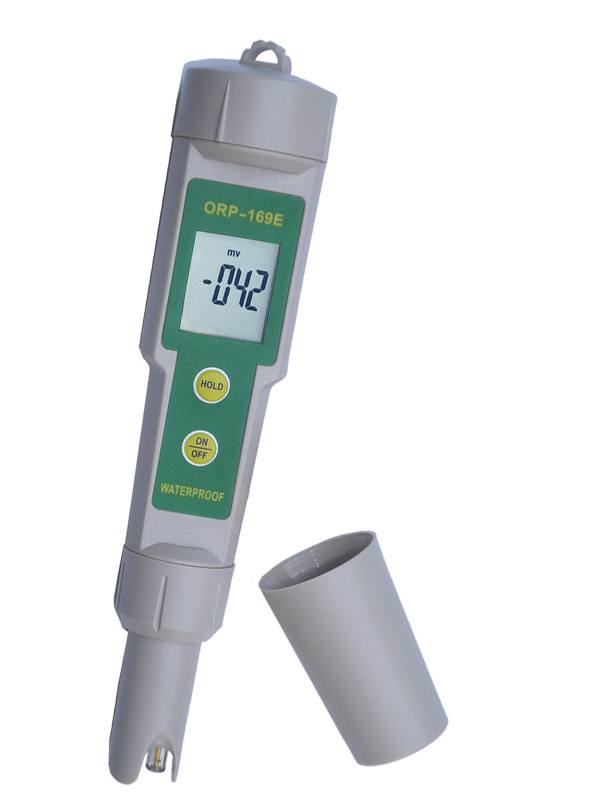
Design and controls: minimal buttons, maximum usefulness
It has a classic pen-type tester design, with a long body, an electrode at the bottom, and a display at the top. The front panel has two key buttons: ON/OFF (power on/off) and HOLD (freeze the reading on the screen so you can record it at your own pace).
The body is marked WATERPROOF, which is convenient when working near water or in the field. But even a “waterproof” device should not be dropped into a bucket and forgotten: after measuring, it is best to rinse the electrode with clean water and replace the cap.
How to measure ORP properly: a quick guide
1) Remove the protective cap.
2) Turn on the meter using the ON/OFF button.
3) Immerse the electrode in the sample. Gently stir the liquid to avoid “dead zones” near the electrode.
4) Wait for the reading to stabilize (usually tens of seconds, depending on the water).
5) If needed, press HOLD to freeze the reading on the display.
6) After measuring, rinse the electrode, replace the cap, and turn off the meter.
Accuracy, resolution, and range: what they mean in practice
The BROM ORP-169E measures within a range of ±1999 mV, with a resolution of 1 mV and a stated accuracy of ±5 mV. For household water monitoring, this is a practical working level: you can see trends and changes after filtration, chemical treatment, aeration, ozonation, and more.
The meter also claims automatic temperature compensation from 0–50 °C. This is useful because temperature affects electrochemical processes and reading stability.
Calibration: set it up once for greater peace of mind
The meter uses manual 1-point calibration (via an adjustment screw/trimmer). The process is straightforward: take an appropriate ORP calibration solution (use the solution and value recommended for your specific method or instructions), immerse the electrode, and adjust the reading to the reference value. It is not as “clean” as a digital menu, but it works and does not depend on firmware.
A practical tip: calibration makes sense if you truly rely on the numbers rather than rough estimates, or if the meter has been unused for a long time or used in dirty media. For everyday home monitoring, periodic checks in a reference solution are often sufficient.
Who is the BROM ORP-169E for?
A good fit if you need a simple pocket ORP meter for regular measurements and tracking changes (after replacing cartridges, dosing chemicals, adjusting a disinfection system, checking aquarium or hydroponic water, and so on).
Not the best choice if you need continuous 24/7 monitoring, measurement logs, integration with automated systems, or laboratory accuracy “down to the last millivolt” with metrological verification to meet regulations.
Conclusion
The BROM ORP-169E is a straightforward “field” tool with a large 4-digit display, a HOLD button, a ±1999 mV range, and manual 1-point calibration. If you need an honest, simple ORP tester without inflated promises, this fits the bill.