DOSIRAD LR115
Delivery and payment
Choose your city or town to see the price with delivery there and when you can get it.
Pickup points
- Branch
- Parcel locker
Pros
- Passive, requires no power
- High sensitivity to α-particles
- High-contrast tracks are easy to read
- Detachable sensitive layer
- Sheets can be cut to suit the task
Cons
- Requires chemical etching
- Sensitive to scratches and creases
- Does not provide immediate results
DOSIRAD LR115 film counts invisible tracks
DOSIRAD LR115 is a solid-state nuclear track detector, a special film for detecting ionizing radiation. It has no display, battery, or “Measure” button: a particle leaves hidden damage in the sensitive layer, and the result becomes visible only after laboratory processing. This makes LR115 a tool for specialists, research laboratories, and dosimetric monitoring systems, not a household dosimeter ready to use out of the box.
The film is primarily intended for detecting α-particles, particularly in studies of radon and its decay products, alpha autoradiography, radiation monitoring of materials, and scientific experiments. With an appropriate method, LR115 Type 2 is also used to detect fast neutrons.
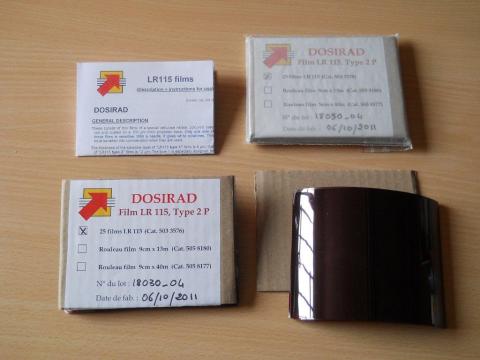
Construction: the red layer is the working side
LR115 Type 2 film consists of a transparent 100 µm thick polyester substrate and a 12 µm thick dark red sensitive layer of cellulose nitrate. Only one side of the sheet is sensitive. It is easy to recognize by its distinctive red coating, but it is also the side that needs the most careful handling.
Mechanical friction, heavy pressure, bending, dust, adhesive tape, markers, solvents, and detergents can damage the surface or affect the result. Careful handling matters: an accidental scratch can turn into an extra “track” after etching.
How the measurement is produced
During exposure, α-particles create latent tracks in the cellulose nitrate: localized areas where the material has been altered. These are invisible to the naked eye. After treatment with an alkaline solution, the damaged areas are etched faster than the undamaged surface and become microscopic holes.
For LR115 Type 2, the recommended etching procedure uses a 10% NaOH solution at 60 °C for 75–100 minutes. After rinsing, the tracks are counted optically under a microscope, either manually or automatically. The detachable sensitive layer of this version is also suitable for spark counting; it should be removed only after processing and while the film is still wet.
More than just a film for radon
The best-known use of LR115 is long-term measurement of radon in air using a diffusion chamber or another holder. The film accumulates tracks over a set period, after which a laboratory etches it and converts the track density into concentration or exposure using the calibration of the specific measurement system.
LR115 Type 2 is also used for alpha autoradiography, helping reveal the distribution of α-active substances on a sample's surface. For neutron studies, it is important to choose the right method, exposure geometry, and, if needed, converter screen. The film itself does not replace the holder, calibration source, or readout procedure.
Storage and practical considerations
The film should be handled with cotton gloves and stored in a dry, clean place. For long-term storage exceeding 12 months, a temperature below 10 °C and relative humidity no higher than 50% are recommended. If the material has been stored in a cool place, allow it several hours to acclimate to room temperature before use.
DOSIRAD LR115 comes in 9 × 12 cm sheets that can be cut into samples of the required size as needed. A pack of 10 sheets is enough for a series of exposures, control samples, and repeat experiments. This is a consumable for precision tasks: simple in form, but demanding careful handling.