
Flus ET-176
Delivery and payment
Choose your city or town to see the price with delivery there and when you can get it.
Pickup points
- Branch
- Parcel locker
Pros
- PDF report with a measurement graph
- Wide temperature range
- Flexible data logging interval
- Memory for 25 000 records
- Compact housing weighing 36 g
Cons
- Stated battery life starts at 60 hours
- Data export only in PDF format
- No remote access to data
Flus ET-176: when estimating the temperature isn't enough
The Flus ET-176 is a compact USB temperature and relative humidity data logger. Unlike a standard thermohygrometer, it doesn't just display current readings; it also stores them along with the measurement time. This is useful when you need a recorded history of conditions rather than having to guess whether a warehouse, cold room, archive, greenhouse, or shipment in transit has overheated.
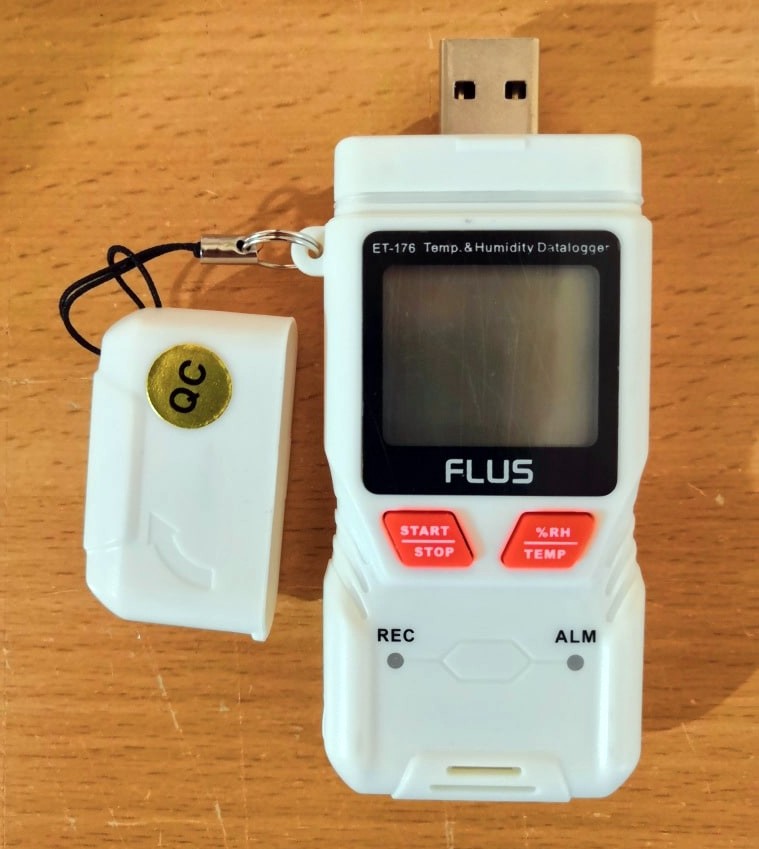
The device measures temperatures from -40 to +70 °C and humidity from 0–100 %RH. A full-size USB plug is hidden under the cover, so you can connect it directly to a computer without a cable and get a ready-made PDF report. This is especially practical when you need a document with a graph rather than another file you'll have to tidy up manually.

Measurements for warehouses, transportation, and indoor spaces
The ET-176 is most accurate in the common "room temperature" range: temperature accuracy is ±1 °C from -10 to +50 °C, and humidity accuracy is ±3 %RH from 45–75 %RH. Outside these ranges, the margin of error increases to ±2 °C and ±5 %RH, respectively. Resolution is 0.1 °C and 0.1 %RH, sufficient for monitoring indoor conditions and the storage of materials, food, or equipment.
It's important not to confuse the measurement range with the device's operating conditions. The logger can record -40 °C, but the manufacturer recommends operating it at temperatures from -20 to +60 °C and humidity from 10–90 %RH. For long-term placement in a freezer or a very humid environment, consider a specialized model with suitable protection.
25 000 records and an adjustable interval
The internal memory holds 25 000 sets of temperature and humidity measurements. The logging interval can be set from 1 second to 24 hours, letting you capture a detailed picture of a short shipment or monitor conditions over time in a storeroom, archive, or server room.
For reference, at a 1-minute interval, the memory will last approximately 17 days; at 15 minutes, approximately 260 days. However, plan the actual length of a standalone session with the battery in mind: the stated CR2032 battery life starts at 60 hours with the recording and alarm LED indicators active.
PDF reports without manually creating graphs
Before starting, use a PC to set the logging frequency, start time, logging mode, and alarm thresholds. After the session, connect the ET-176 to a computer's USB port to generate a PDF document with a summary, graph, and detailed list of readings. For basic monitoring, this is more convenient than spreadsheets: you can immediately send the report to a colleague, add it to your documentation, or print it.
However, this is not a tool for in-depth spreadsheet analysis: the basic version of the ET-176 works with PDF only and does not export CSV files. The device also enters stop mode after the data is read; old data must be cleared before a new logging cycle. It's not difficult, but it's worth remembering this step in advance.
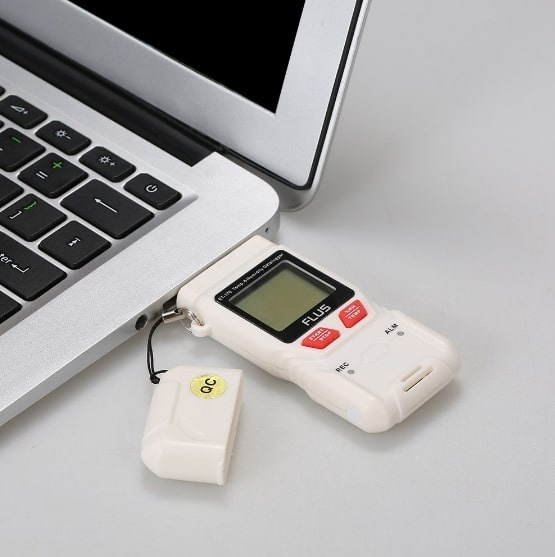
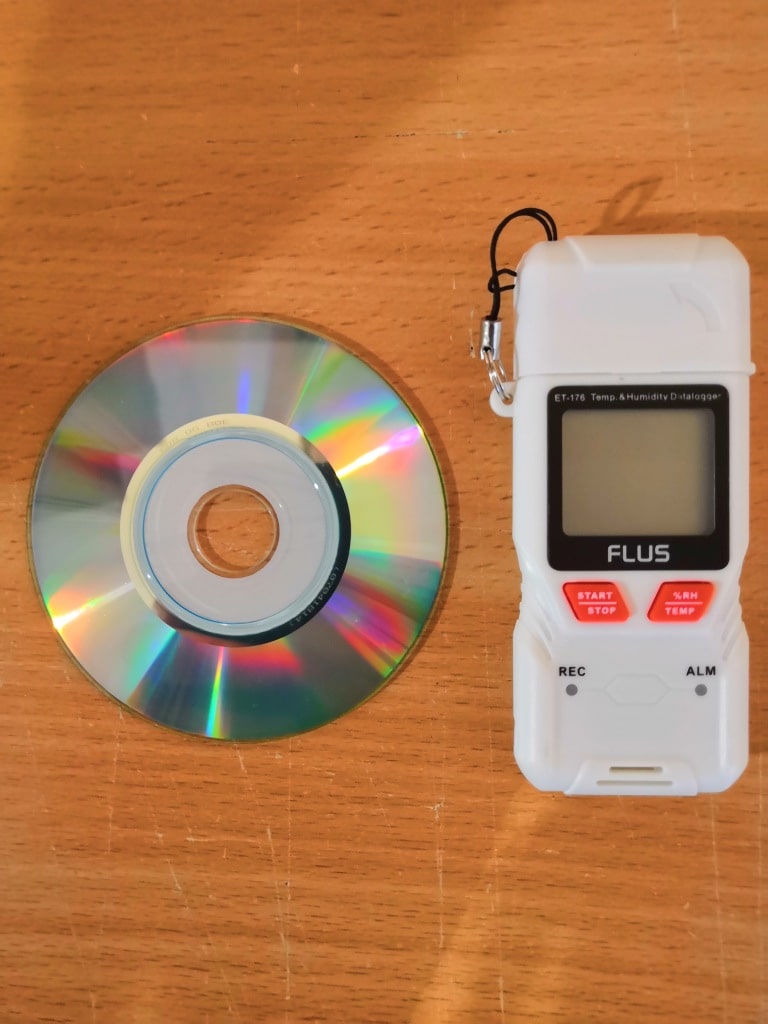
Simple controls without extra buttons
The housing has two main buttons: START/STOP to start and stop logging, and %RH/TEMP to switch between humidity and temperature. To start or stop logging, hold the button for about three seconds, making it harder to accidentally stop logging while the device is in your pocket.
The large LCD shows the selected parameter, logging status, battery level, and status indicators. Separate REC and ALM indicators show active logging and readings outside the set limits. If the measurement range is exceeded, OL appears on the screen.
Who is the Flus ET-176 for?
This is a good choice for periodic temperature and humidity monitoring in small warehouses, archives, libraries, laboratories, greenhouses, and utility rooms, as well as during short shipments. It's particularly useful where a simple standalone measurement log and PDF report are needed without cloud services, subscriptions, or complex software.
The Flus ET-176 won't replace a networked monitoring system with online alerts, but it does its specific job well: quietly collecting data, displaying an on-site alarm, and turning measurements into a clear report. It's a small device for situations where saying "it was hot somewhere" isn't proof.