Tachometers
How to choose
A tachometer is useful when you need to quickly and clearly check the rotational speed or surface movement without complicated setup. If you work with shafts, rollers, or conveyors, choosing the right model depends primarily on the measurement approach, the units you need, and everyday ease of use.
Contact or non-contact measurement
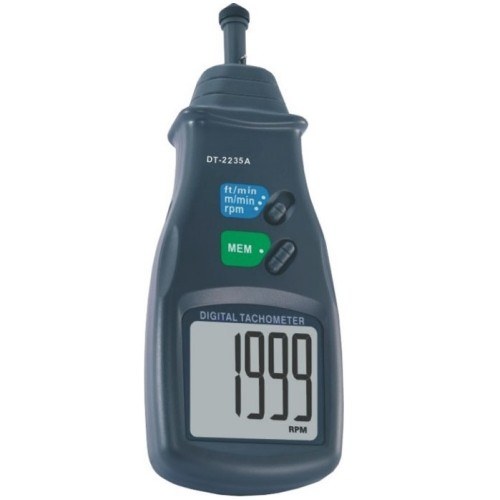
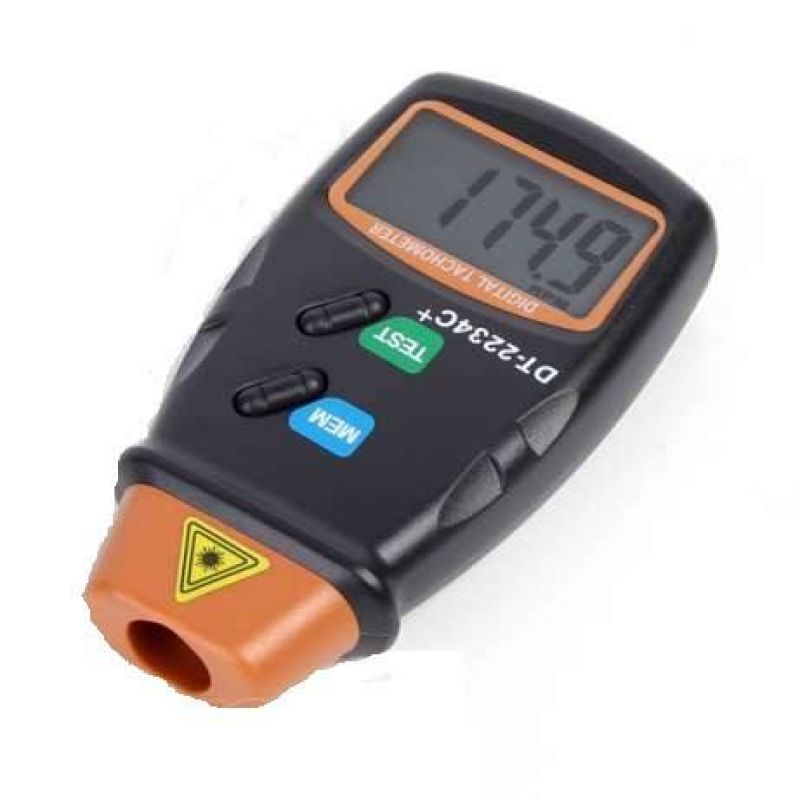
First, decide how you will take measurements. The catalog includes contact and non-contact tachometers, with measurement modes including non-contact laser mode, contact mode with a wheel for linear speed, and contact mode using tips or adapters. This matters because different tasks require different measurement approaches.
A non-contact option is convenient when you do not want to touch a moving part or when access to it is limited. A contact model is suitable when you need to measure not only rotational speed but also the linear speed of a surface, such as rollers or belts. If versatility is important to you, look for models whose measurement modes cover both rotation and surface measurement.
Available products also include optical sensor technology and non-contact measurement as a separately specified measurement method. For laser measurement, also check the recommended reading distance if it is listed in the specifications of a particular model.
What parameters the device measures
Not all tachometers are equally useful for different tasks, so check exactly what the device can measure. Parameters in this category include rotational speed, rotation speed, and linear speed. If you need to monitor surface movement rather than only shaft rotation, this is especially important.
Supported measurement units also affect convenience. The catalog includes RPM, m/min, and ft/min, so it is worth choosing a format that is easier for you to work with without constant conversions. For service work with shafts, models focused on RPM are suitable, while m/min or ft/min units are useful for rollers, conveyors, and checking surface speed.
The intended use of the products specifically mentions shafts, rollers, surface speed measurement, and conveyors. This is a good guide if you are buying a tachometer for a specific type of equipment rather than simply a general-purpose device.
Accuracy, resolution, and update speed
If it is important to do more than see an approximate value and instead obtain a stable, correct result, look at the accuracy specification and resolution specifications. This category includes accuracy of ±(0.05% + 1 digit), as well as RPM resolution of 0.1 RPM or 1 RPM depending on the range. This means a device may be more convenient either for more precise monitoring at lower values or for general checking over a wider range.
For linear speed measurement, a resolution of 0.01 or 0.1 is specified depending on the range, so a finer display increment is useful for slower processes. The catalog also includes a time base of 6 MHz, a sampling time of 0.8 s, and a response time of 0.5 s. In practice, this matters when speed changes quickly and you need to understand how often the reading updates and how promptly the device responds.
If you do not need to select measurement limits manually, check whether auto range selection is available. This function simplifies use, especially when you need to measure different components at different speeds.
Easy-to-read measurements and memory
For everyday work, it is important how easy it is to read data from the screen. Products in this category use an LCD display, and available specifications include a 5-digit display and digit height of 18 mm. If the device is often used at arm's length or while moving, large, clear characters make work noticeably easier.
Backlight and audible alerts can be useful, especially if you need to work in a darker room or want an additional signal during measurement. For repeated checks, pay attention to measurement memory functions: the catalog includes MAX, MIN, last value, and data logging. One model also specifies memory for up to 96 records, which can be convenient for recording results without constantly writing them down manually.
Power, battery life, and operating conditions
Since the catalog includes devices powered by replaceable batteries, it is worth checking right away which battery size is more convenient for you. Available options include 9 V and AA batteries, and the number of batteries may vary between models. If you need a tachometer for off-site work, it is more convenient to assess in advance how easy it will be to find replacement power sources.
A low battery indicator and auto power-off are also important for practical use. These functions help you avoid missing the time to replace the battery and save power between measurements. Specifications may also list current consumption, and one model in the catalog specifies 45 mA.
If the device will be used not only in a workshop but also in changing conditions, review the permitted operating temperatures, storage temperature, operating humidity, pressure, and IP rating if these details are provided. For non-contact models, a Laser Class II marking can also be useful because it indicates that the device uses laser indication.
Tips
- For shafts and parts that should not be touched, a non-contact tachometer is more convenient.
- If you need to measure not only rotational speed but also the speed of a belt or roller, check for a contact mode for linear speed.
- For regular inspection measurements, MAX, MIN, and record-saving functions are useful so you do not have to write everything down manually.
- Before buying, compare the supported measurement units with the units you use for records in production or service work.
- If you work in the field or off-site, pay attention to the battery type and the availability of a low battery indicator.