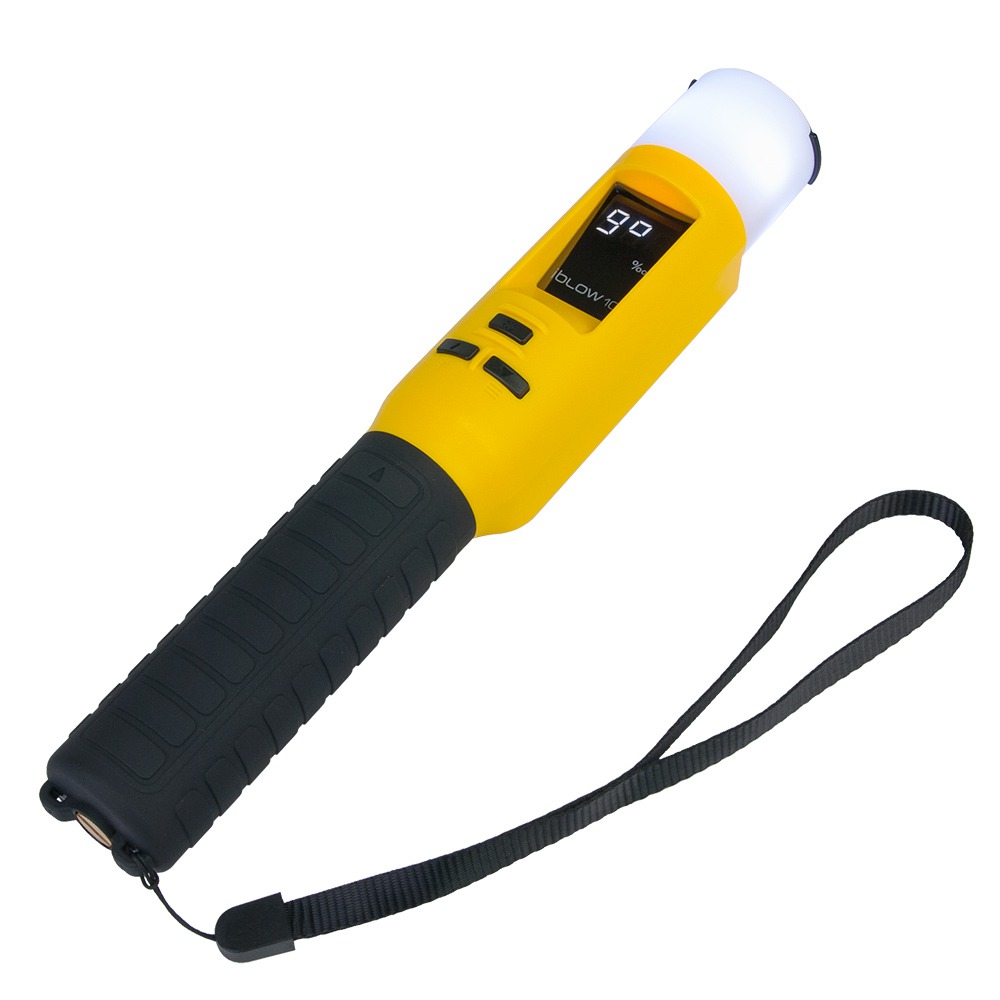
Lion AlcoBlow
Delivery and payment
Choose your city or town to see the price with delivery there and when you can get it.
Pickup points
- Branch
- Parcel locker
Pros
- Fuel cell sensor
- Active and passive modes
- No mouthpieces, no contact
- Very fast screening of large numbers of people
- Metrological verification (for reporting)
Cons
- Does not display an exact number
- Uses AA batteries, not a rechargeable battery
- Housing is not waterproof
What is Lion AlcoBlow, and why do security teams and businesses love it?
Lion AlcoBlow is a threshold breathalyzer for screening that uses an electrochemical (fuel cell) sensor. Its job is not to “measure alcohol levels to two decimal places in per mille,” but to quickly identify people with alcohol in their breath, literally in a matter of seconds and without lines of people waiting for mouthpieces.
Everything here is designed for high-volume screening: two buttons, two indicators, a clear signal, and little chance of someone “pressing the wrong button.”

Indicators: Zero / Low / High, no math required and fast results
AlcoBlow displays the result using color (three levels). This is a key feature: instead of making you read fine print on a display, it gives you a clear decision: “OK / needs checking / stop.”
Approximate BrAC ranges (breath alcohol concentration):
- GREEN (Zero–Low): 0.00–0.04 mg/L
- AMBER (Medium): 0.05–0.09 mg/L
- RED (High): 0.10+ mg/L
For reference, the documentation also provides the equivalent in %BAC (which is easy to convert to per mille: 0.010% = 0.10‰). But remember: this is a screener, not an evidential “reference instrument in your pocket.”
Two operating modes: active (more accurate) and passive (when participation is not possible)
Active mode is the primary and most reliable option: the person breathes into the cone, and the device checks the minimum flow and time conditions, takes a sample, and analyzes it.
Passive mode (the PASSIVE button) is for when a person cannot or does not want to breathe out normally, or when you need to check the surrounding air. Typical uses include an unconscious patient or checking the contents of a container or the vapor above a drink. It is convenient, but less reliable on average than an active breath sample.


Speed and battery life: ideal for checkpoints, entrances, and testing everyone
AlcoBlow's strength is its speed. The device has no heater, so it requires no warm-up. Results appear quickly (within a few seconds), and one set of 4×AA batteries typically lasts for thousands of tests (at least around 5000 tests with new batteries).
It also has auto power-off to avoid draining the batteries in your pocket, plus audible alerts that are useful when testing amid the noise of turnstiles or an entrance area.
Metrological verification: what it provides and who really needs it
The label “with metrological verification” indicates that the device is formally approved for use in situations where documentation matters: businesses, occupational safety, internal procedures, audits, and inspections. Verification usually has a validity period (often 12 months, depending on the rules and the body performing it), so keep the certificate and track the date of the next verification.
The manufacturer also recommends annual service/calibration and, for commercial use, regular annual confirmation of accuracy.
How to get the most reliable result (and avoid frustration with the device)
- After eating, drinking, or using mouthwash, wait 15–20 min before testing.
- Hold the device steady; in active mode, hold the cone approximately 2–3 cm in front of the mouth.
- Use passive mode as a “plan B”: it is useful, but more sensitive to conditions and air currents.
- If the level was very high, give the sensor a little time to recover before the next test.
Who is it best for?
Yes, if you need fast, high-volume testing, minimal consumables, contactless screening, a clear “traffic light” display, and metrological verification.
Probably not if you expect exact numerical values like “0.23‰” on a screen. In that case, consider professional measuring breathalyzers with numerical results and a measurement log.