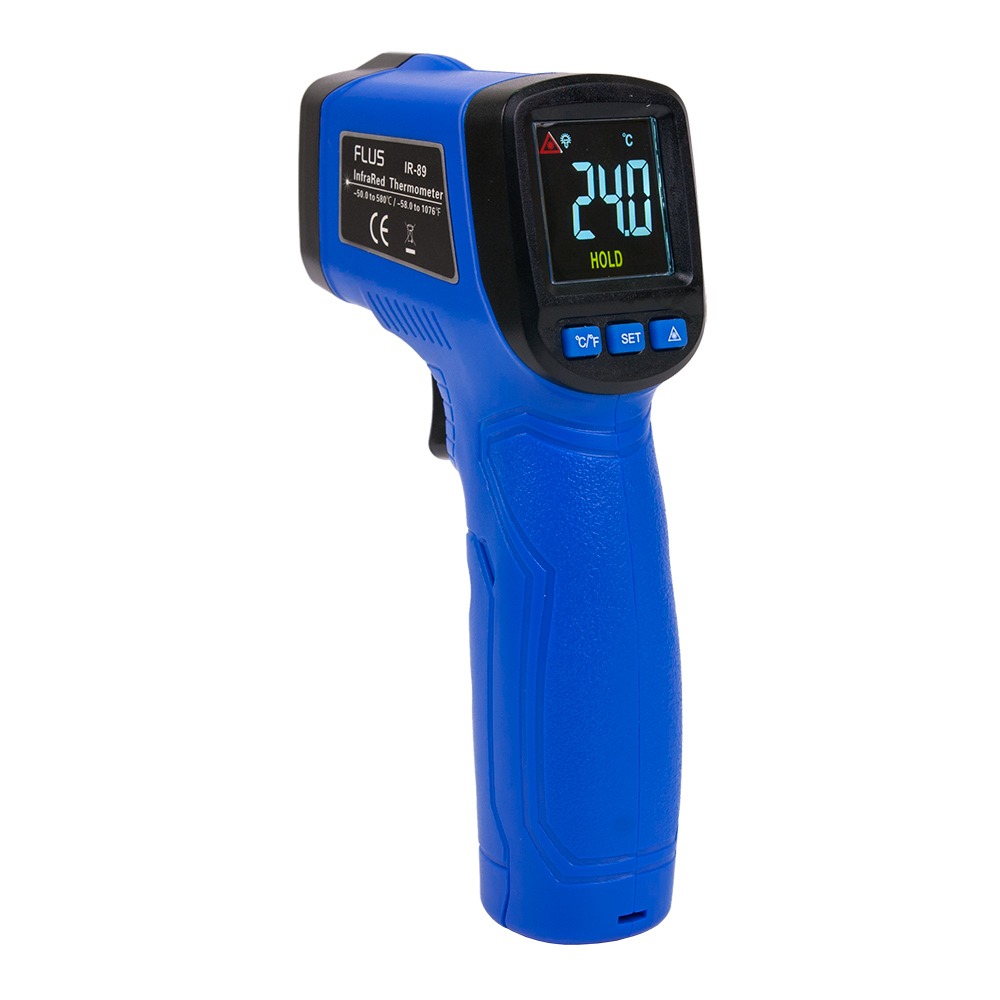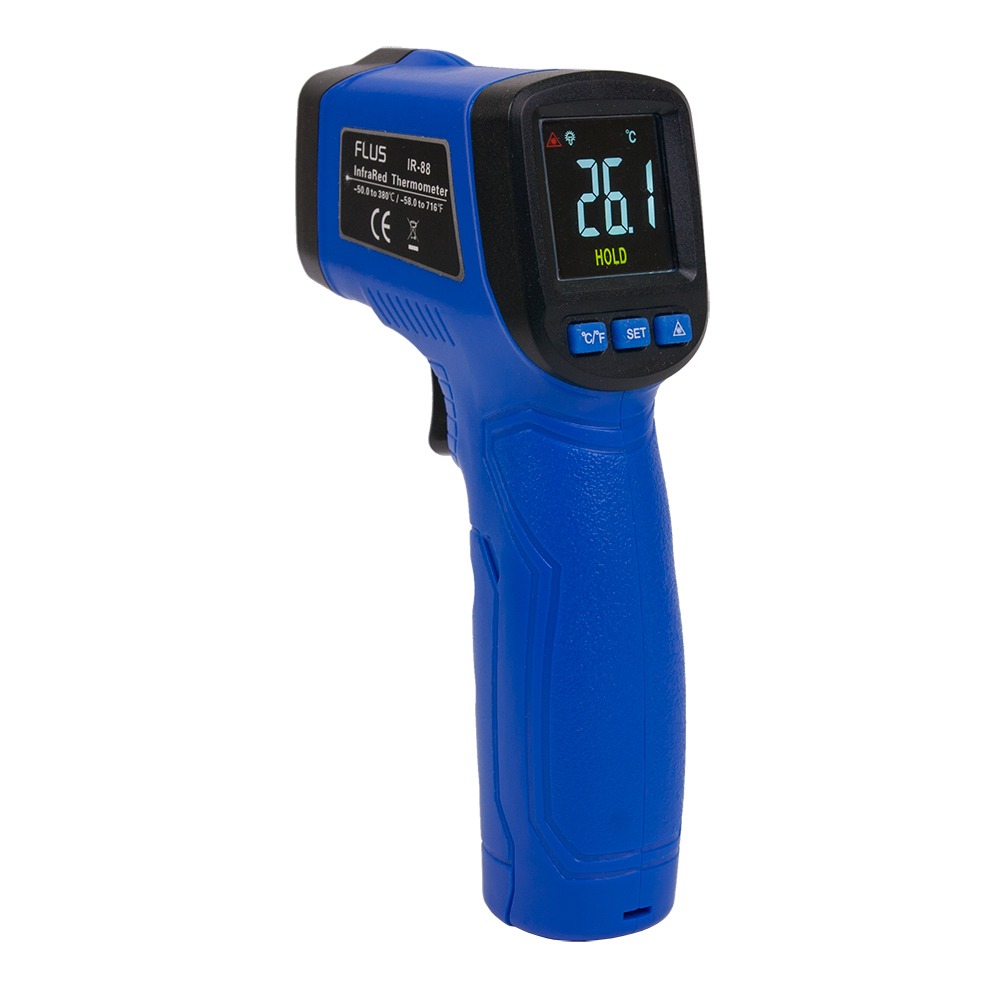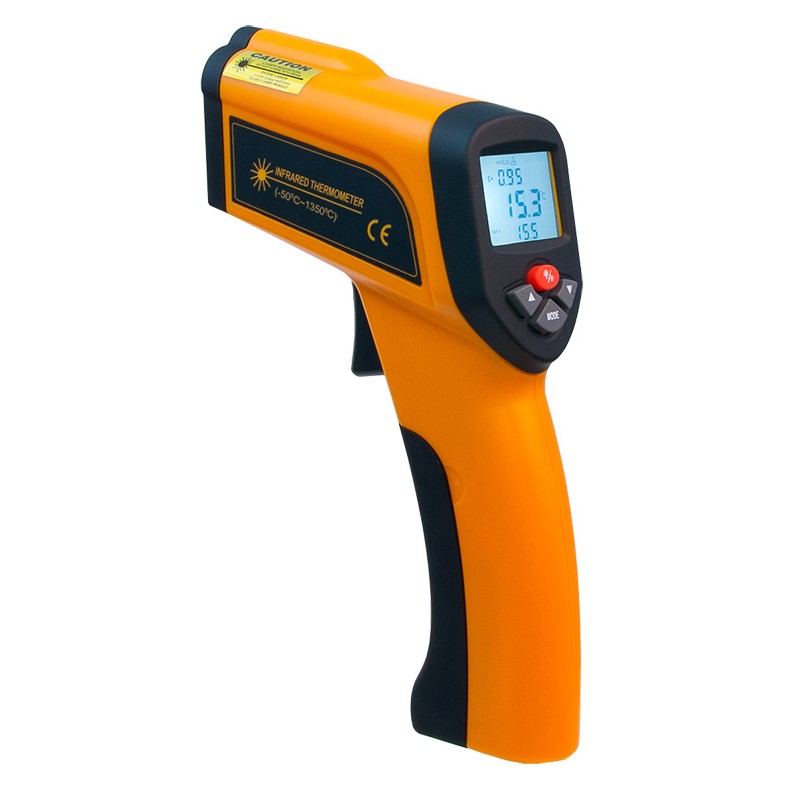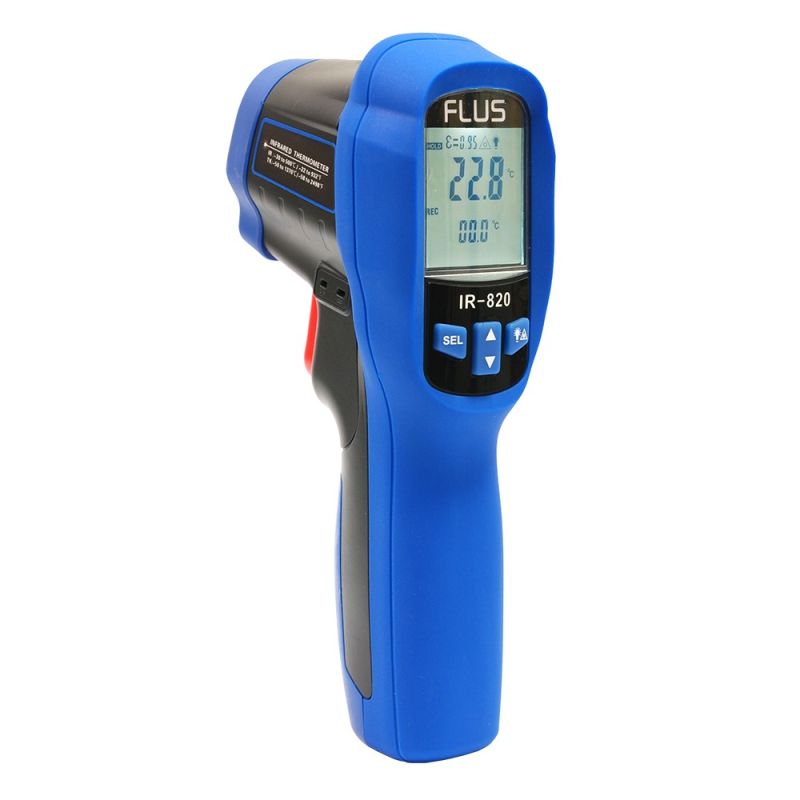
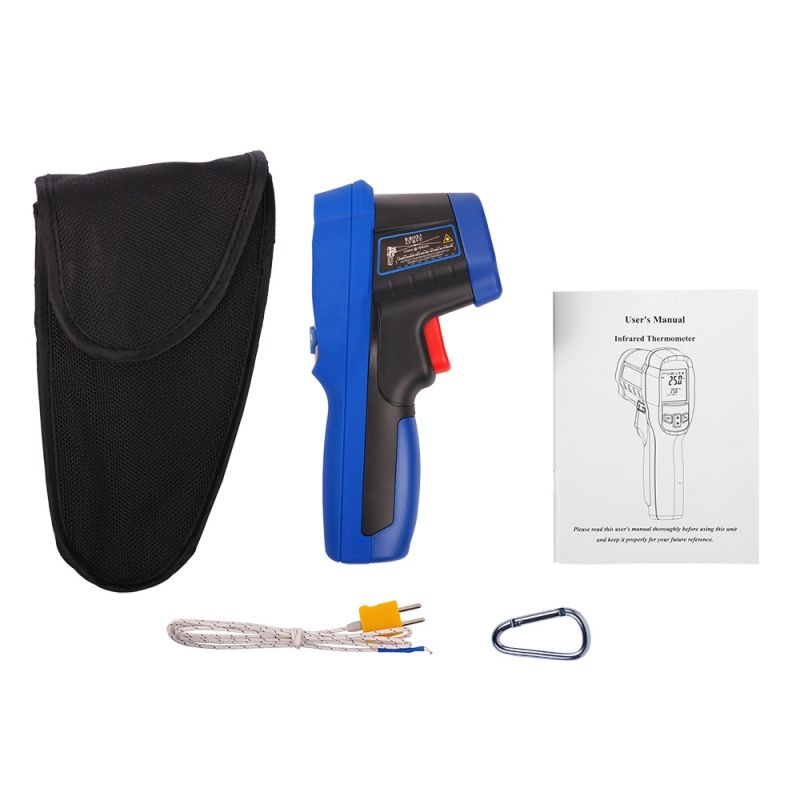
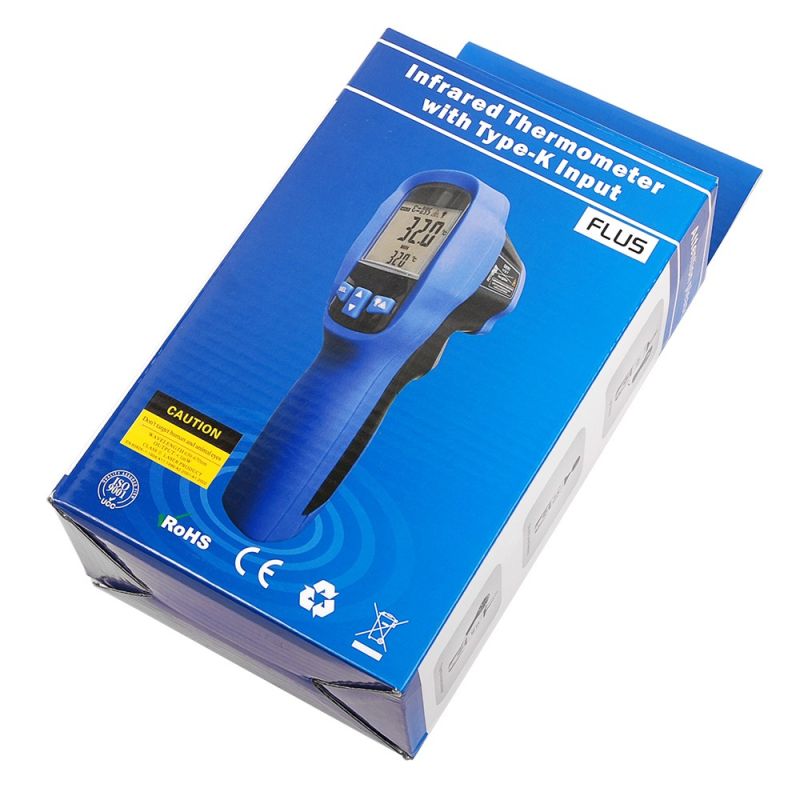
Flus IR-820
Delivery and payment
Choose your city or town to see the price with delivery there and when you can get it.
Pickup points
- Branch
- Parcel locker
Pros
- 2-in-1: IR + thermocouple
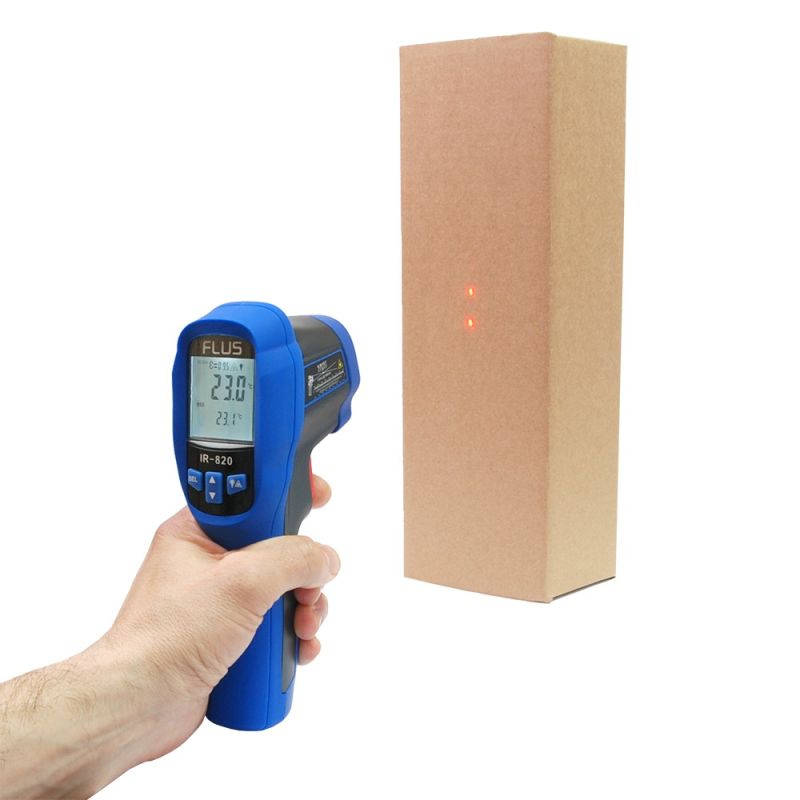
- Dual-beam laser
- Memory for 12 readings
- Adjustable emissivity from 0.10–1.00
- MAX/MIN/AVG/DIF and alarms
Cons
- Not ideal for shiny metals
- No USB/PC connection
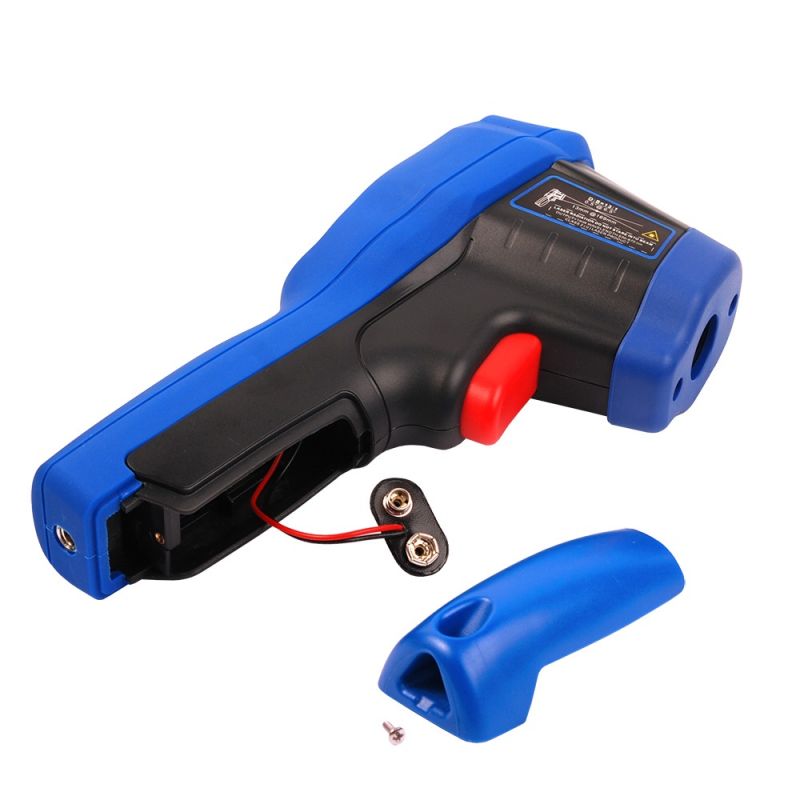
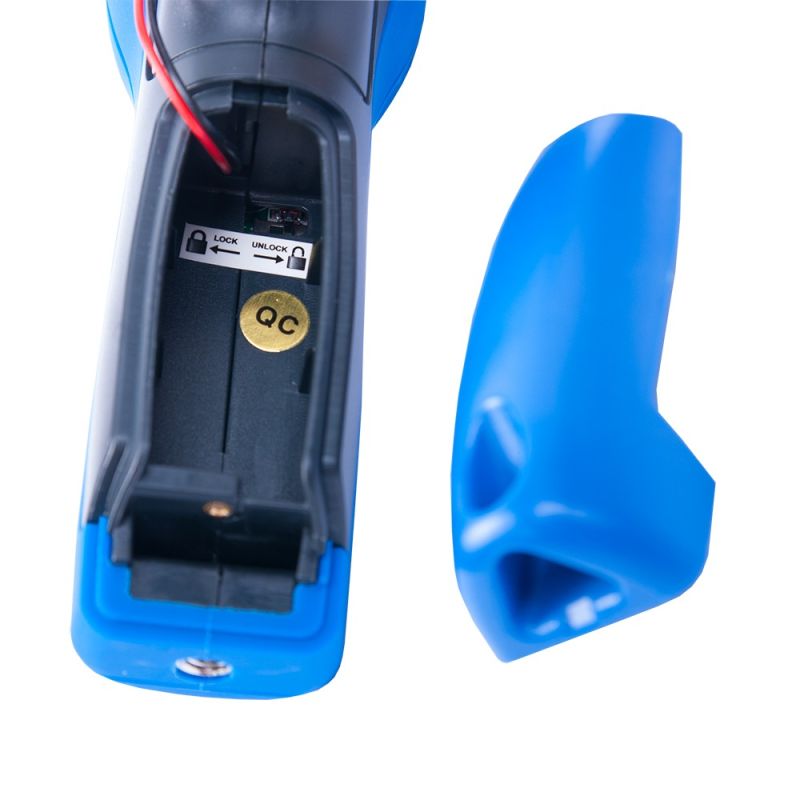
- Requires a 9 V battery
FLUS IR-820 Pyrometer: no guesswork required
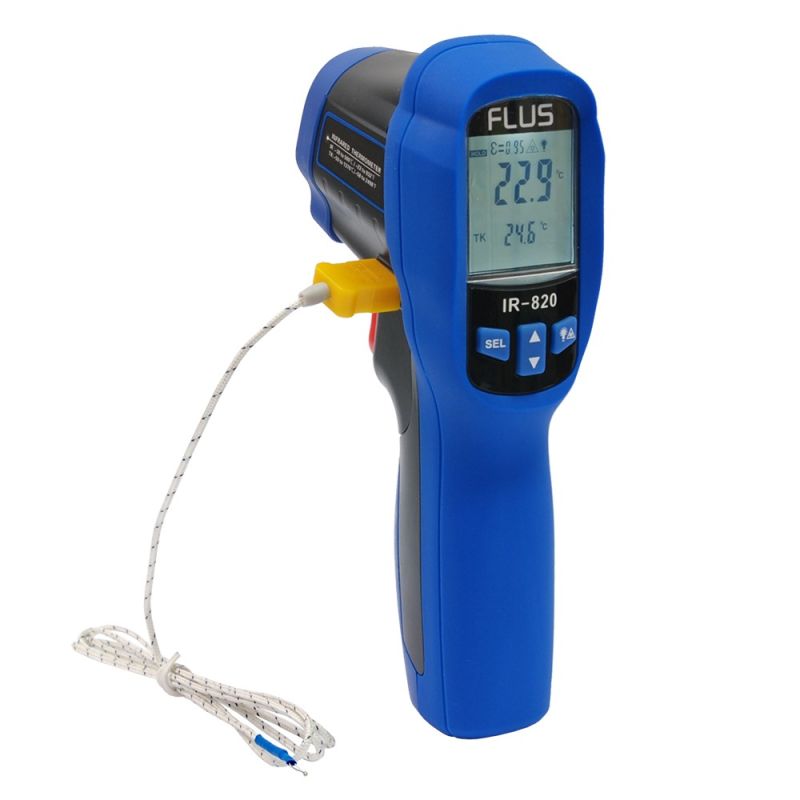
The FLUS IR-820 is a temperature gun that does two things: it quickly measures surfaces without contact using an infrared sensor, and takes contact readings with a K-type thermocouple. In practice, that means you can use the IR channel for quick screening and the thermocouple to check or refine readings where the optics might be unreliable.

Non-contact measurements: when “point and press” really works
The FLUS IR-820 has an IR measurement range of -50 to +500 °C. Response is fast (about 0.25 s), with a resolution of 0.1 °C. That makes it handy for quick checks of electrical panels and terminals, bearings and gearboxes, pipelines, radiators, heaters, molds, ovens at moderate temperatures, engine surfaces, and more.
One important detail is the 13:1 distance-to-spot ratio (D:S). Simply put, the farther away you stand, the larger the spot over which the device averages its reading. For example, at 13 cm you measure a spot of approximately 1 cm; at 1.3 m, the spot is about 10 cm. If the target is small (a contact, chip, or thin tube), move closer or the reading will include the surrounding area.
Dual-beam laser: more than just a visual feature
The IR-820 has a dual-beam laser targeting system. This is useful because you cannot see infrared radiation, and the two beams give you a better indication of the boundaries of the measurement area, especially when aiming at a specific spot on hot equipment.
Emissivity (ε) 0.10–1.00: the key professional feature
Adjustable emissivity is what separates a basic IR thermometer from a tool for serious work. Different materials and surfaces (matte or glossy, painted or polished, black or light-colored) emit heat differently, so readings can fluctuate without the right ε setting.
A practical tip: if you are unsure about a surface, check the same spot with the thermocouple and adjust ε until the IR channel gives the same reading. This quickly helps the device match the task at hand.
K-type thermocouple: for air, liquids, and measurements inside rather than on the surface
The contact channel (TK) is more than an afterthought. It comes in handy when you need to:
— measure air temperature at an inlet or outlet, in ventilation systems, or near a radiator;
— measure liquids (with a suitable probe);
— check heat in a hard-to-reach spot where the IR channel cannot easily see;
— verify an IR reading on difficult surfaces.
The stated thermocouple range extends up to +1370 °C, but remember that the actual limit is often determined by the probe itself. The included thermocouple typically has a lower limit than industrial high-temperature probes.
Memory, calculations, and limit monitoring: small features that save time
The FLUS IR-820 can store 12 readings, which is handy for inspection rounds and quick logging. It also displays MAX/MIN/AVG and DIF (difference), and offers data hold (HOLD), display backlighting, and automatic shutoff.
Another useful feature is the Hi/Lo alarm: set upper and lower limits, and the device sounds an alarm when a reading falls outside them. For repeated checks, it can make the job much less tiring.

Who it suits and who it doesn't
This is a good working tool for electricians, HVAC and service technicians, workshops, manufacturing, on-site energy audits, automotive work, and household tasks involving heating, water heaters, ovens, and radiators. Don't treat the IR-820 as an absolute authority on shiny or mirror-like surfaces without preparation: adjust ε, use the thermocouple, or apply a matte marker such as heat-resistant black tape and measure that instead.
Bottom line
The FLUS IR-820 offers a useful combination: quickly find a problem with the IR channel, then confirm it with the thermocouple. Memory for 12 readings, a dual-beam laser, a solid 13:1 distance-to-spot ratio, and limit monitoring make it a practical device for everyday work, not a toy.