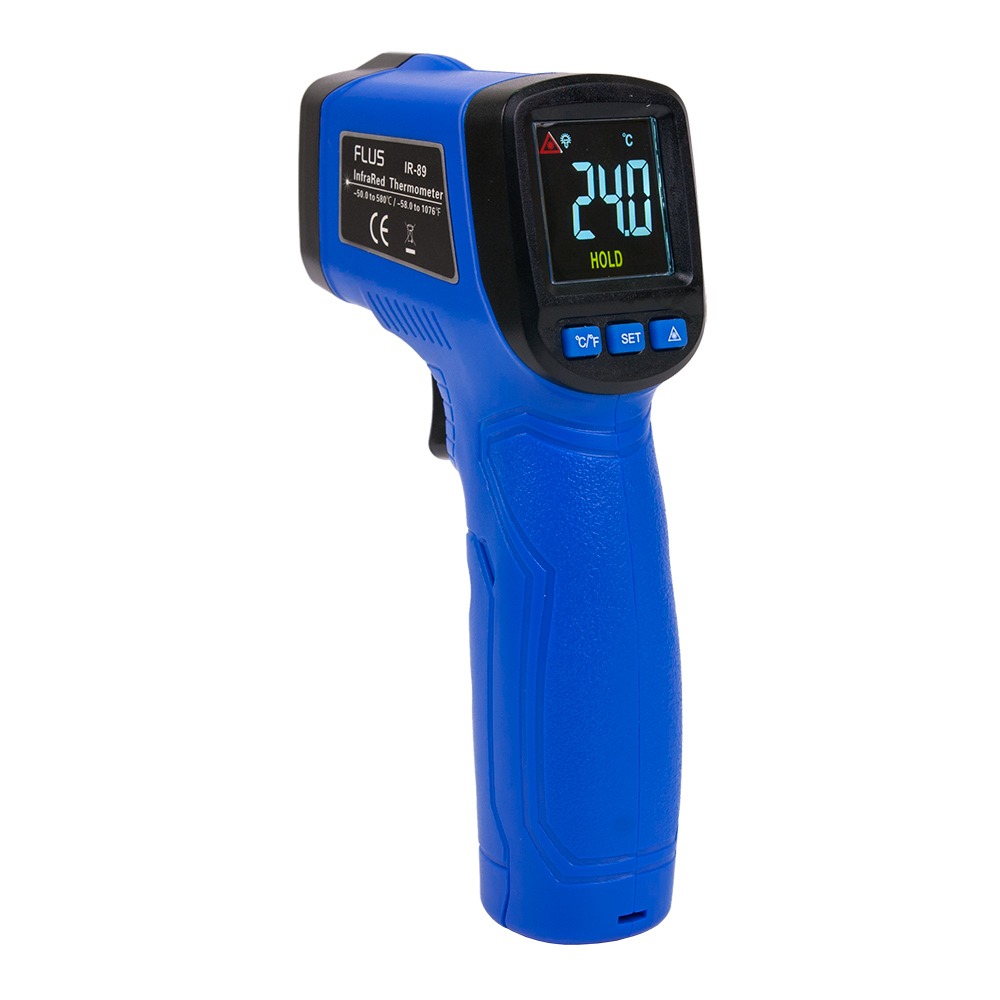
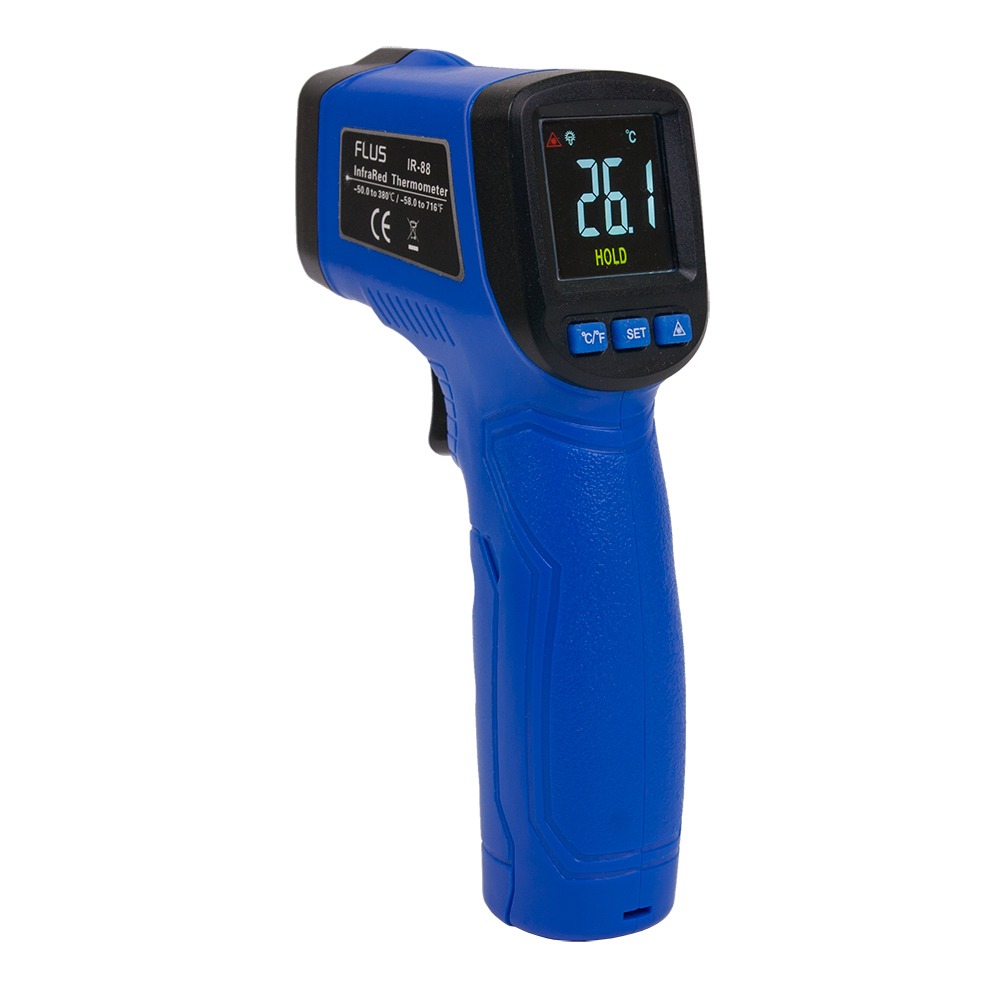
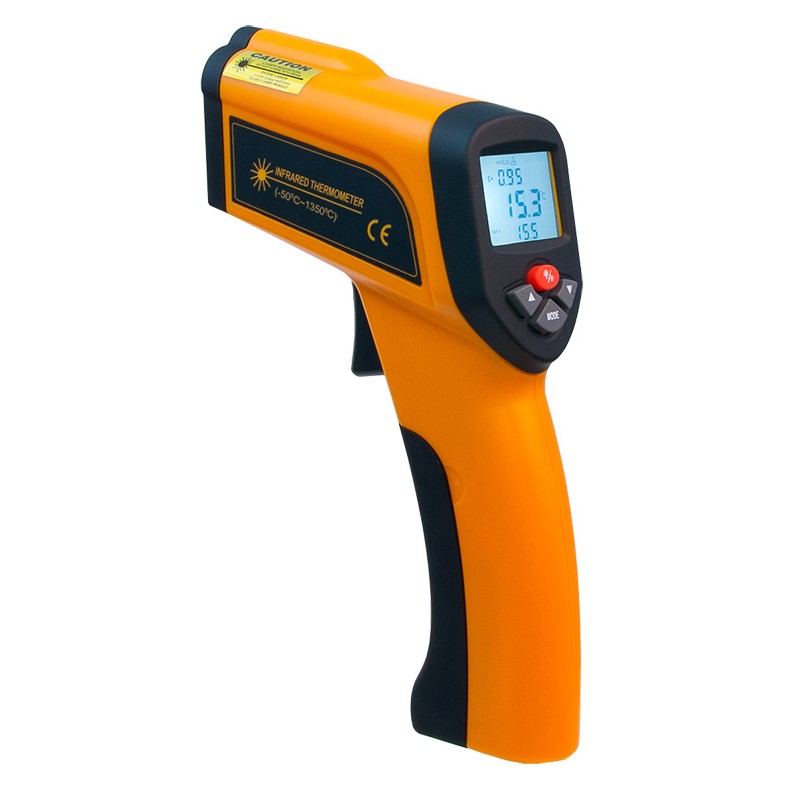
Flus IR-822
Delivery and payment
Choose your city or town to see the price with delivery there and when you can get it.
Pickup points
- Branch
- Parcel locker
Pros
- Up to 1050 °C in IR mode
- Type K thermocouple (contact)
- 30:1 optics, 2 lasers
- MAX/MIN/AVG/DIF, memory for 12 readings
- Fast 0.25 s response
Cons
- Shiny metal can distort readings
- Powered by a 9V battery
- Emissivity needs adjustment
Flus IR-822: measuring hot surfaces without the hassle
The Flus IR-822 is a high-temperature, pistol-style pyrometer that combines two methods: non-contact infrared surface temperature measurement and contact measurement using a type K thermocouple. At home it saves time, in the workshop it saves nerves, and in production it can save your fingers too.
The IR channel provides quick checks from a distance, while the thermocouple lets you verify results where the IR method can be unreliable (glare, uncertain emissivity, thin parts, complex surfaces).

Two measurement modes: IR and type K thermocouple
In non-contact mode, the device measures surface temperatures from -50 to +1050 °C. Readings update quickly (measurement time is about 0.25 s), making it easy to scan several points and find overheating.
The contact channel (type K thermocouple) measures from -50 to +1370 °C. One important detail: the maximum temperature depends not only on the device but also on the specific thermocouple. The included sensor may have a lower operating limit than the channel's specified range, and that is normal. If you regularly need contact measurements at 800–1200 °C, choose a thermocouple suited to the job (material, sheath, length, and tip type).
30:1 optics and dual-beam laser: how to avoid measuring the wrong area
The key figure for any pyrometer is its distance-to-spot ratio (D:S). For the Flus IR-822, it is 30:1. The principle is simple: the farther away you are, the larger the spot the device sees, and the easier it is to inadvertently include unwanted areas.
For a quick estimate, at 30 cm the spot will be approximately 1 cm, and at 3 m it will be approximately 10 cm. If the object is smaller than the spot, the device will average the temperature across the entire area, including the background.
The dual-beam laser does not measure temperature; it is only a pointer for aiming. The two beams help you better understand the boundaries of the area you are measuring.
Emissivity (ε): the No. 1 reason IR pyrometers give misleading readings
An IR thermometer reads thermal radiation from a surface, not temperature directly. That is why shiny, polished, mirror-like materials (aluminum, stainless steel, chrome) often produce low or unstable readings. The Flus IR-822 has adjustable emissivity from 0.10–1.00, one of its most useful professional features.
Practical tips for measuring tricky surfaces:
- A matte black surface is almost always well suited to IR measurement.
- For shiny metal, a piece of matte heat-resistant tape or a thin layer of matte paint can help; take the measurement on that surface.
- When in doubt, check the IR reading against the thermocouple on the same area.
Memory, statistics, and alerts: useful when tracking down overheating
The device can display MAX, MIN, AVG, and DIF, and also has HOLD (data hold) and internal memory for 12 measurements. This is useful for diagnostics, such as quickly comparing a hot spot and a normal spot on a bearing, motor, connection, or terminal.
An audible alert sounds when readings go outside the set range, which is useful when monitoring a process without constantly watching the display. There is also auto power-off (typically after 30 s of inactivity), a backlit screen, and a low-battery indicator.
Where the Flus IR-822 really comes in handy
- Diagnosing overheating in bearings, gearboxes, and belt drives.
- Electrical work: terminals, circuit breakers, busbars, contacts, and connections.
- Automotive: exhaust systems, radiators, brake discs, and components under load.
- Furnaces, heaters, molds, and high-temperature surfaces.
- Contact measurements with a thermocouple where IR readings are uncertain.
Quick guide before your first measurements
- Check that the object is larger than the measurement spot (D:S 30:1).
- Set the emissivity for the material or make the surface matte.
- For shiny or reflective surfaces, verify readings with the thermocouple.
- Do not measure through glass or transparent screens: the IR channel will not read the intended surface.
- At very high temperatures, use the device in short sessions rather than heating it near a furnace for minutes at a time.
In short, the Flus IR-822 is a high-temperature workhorse: quickly find a problem with the IR channel, then confirm or rule it out with the thermocouple. If you need temperatures above 1000 °C and do not want to gamble on emissivity, having both methods in one device is a practical solution.