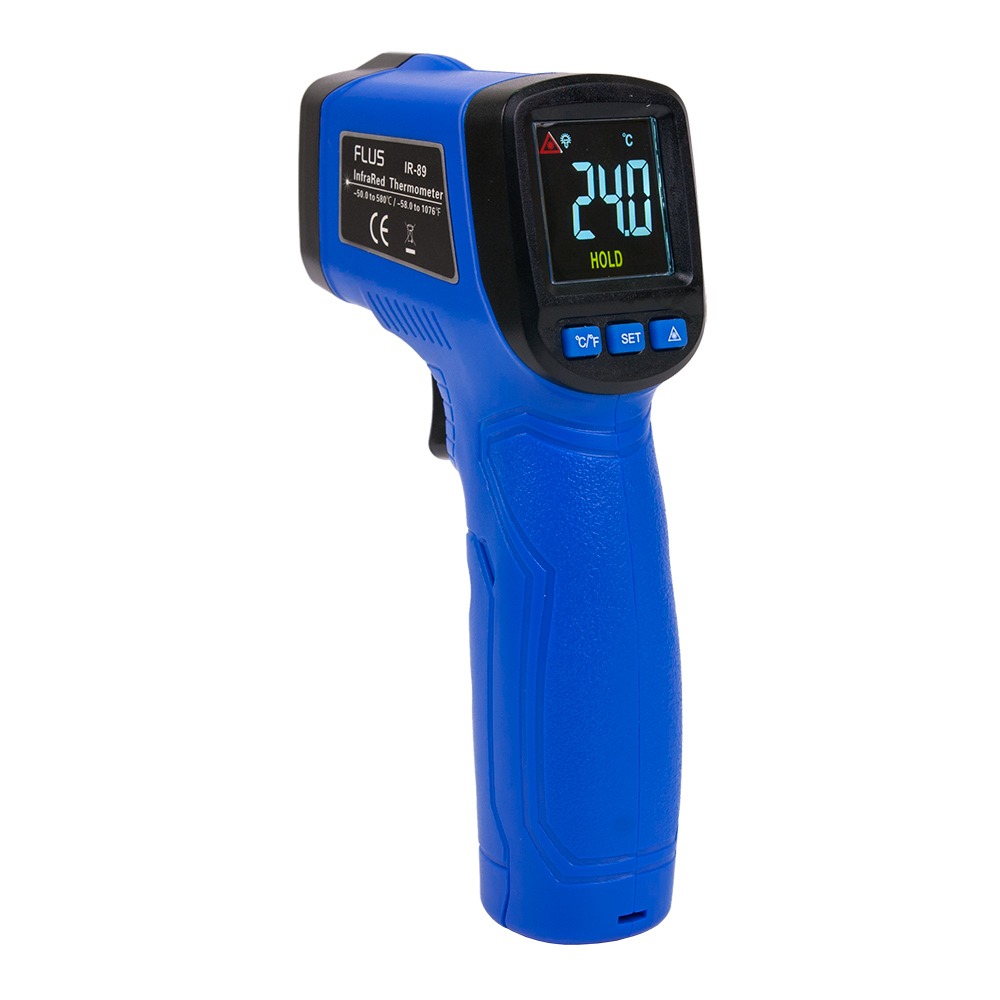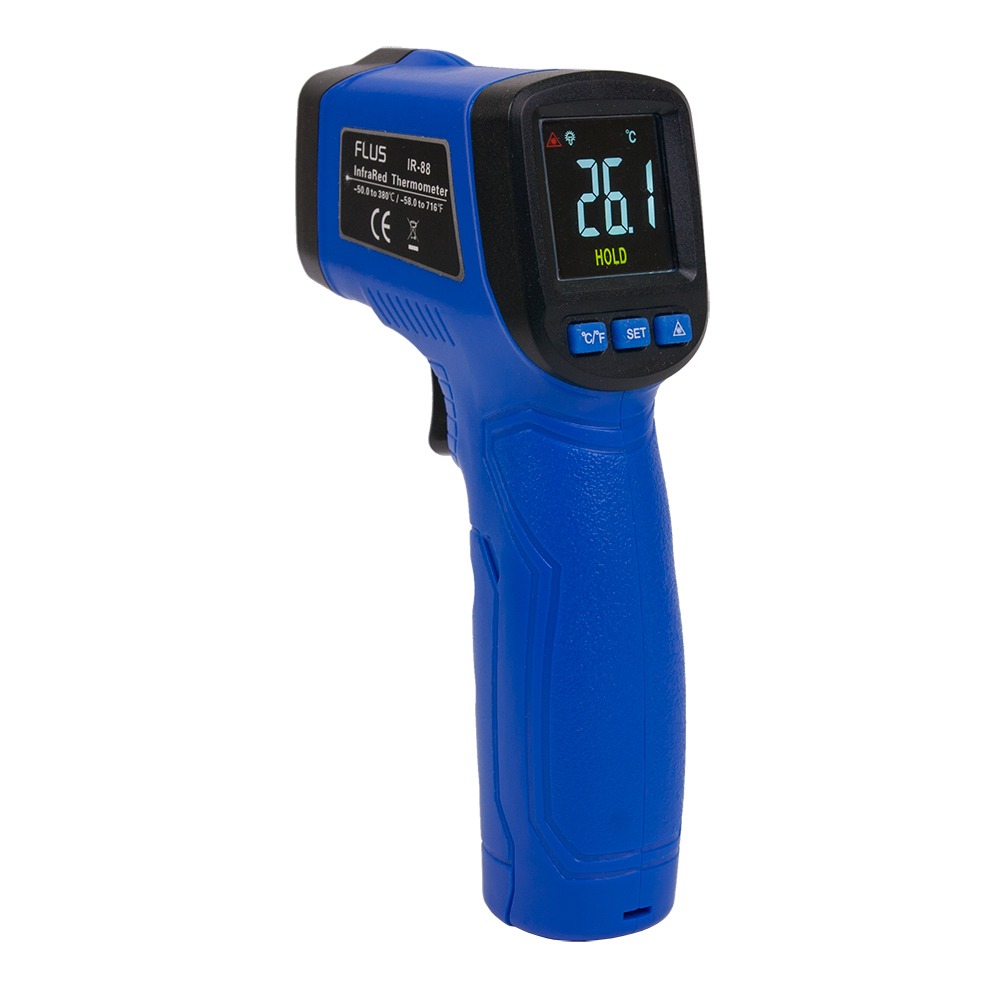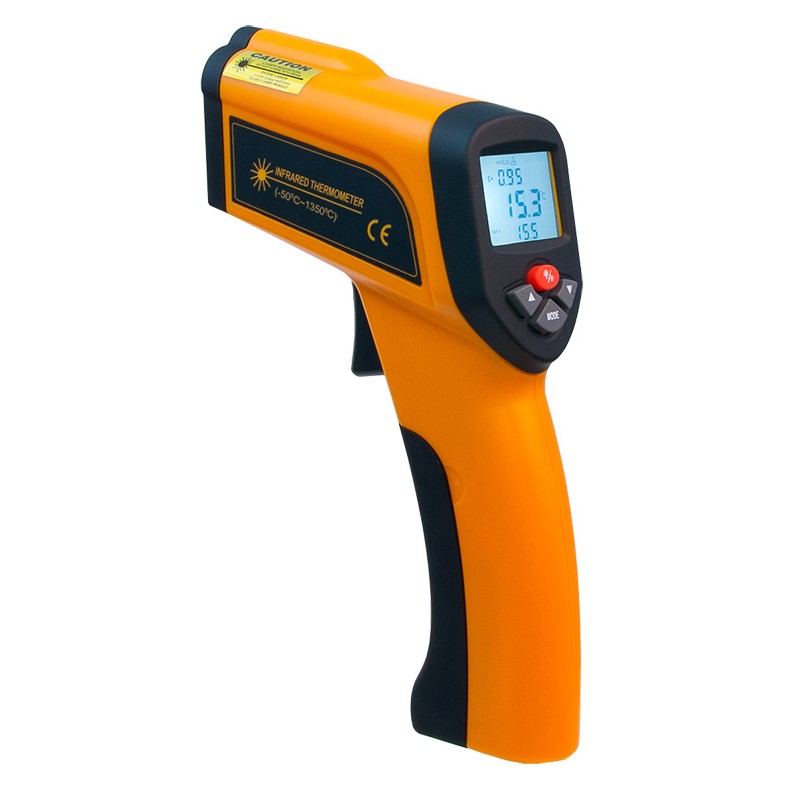
Flus IR-826
Delivery and payment
Choose your city or town to see the price with delivery there and when you can get it.
Pickup points
- Branch
- Parcel locker
Pros
- Adjustable emissivity 0.1–1.0
- Fast response < 0.5 s
- Comfortable pistol grip
- MAX/MIN for finding overheated areas
- Screen backlight and laser
Cons
- Surface temperature only
- Upper limit of 350°C
- Auto power-off after 20 s
FLUS IR-826: a “temperature radar” for home and everyday tasks
The FLUS IR-826 is a non-contact infrared pyrometer, also known as a “temperature gun.” Instead of touching the object, it reads IR radiation and displays the surface temperature. It’s useful when an object is hot or cold, moving, electrically energized, or simply awkward to reach with a probe.
Its measurement range is practical for home and service work: -30…350°C. That covers heating radiators, pipes, refrigerator compressors, bearings, electrical panels, ovens, frying pans and heated floors. Molten metal and the “hell of a blast furnace” are another story.

Keys to accuracy: emissivity and the measurement “spot”
There are two important factors to understand with pyrometers, and the IR-826 gives you the tools to handle them.
1) Emissivity (ε) and why it’s adjustable here
Emissivity (ε) describes how well a surface “emits” heat in the IR range. Matte or painted surfaces generally measure well, while reflections from shiny metal can throw a pyrometer off.
On the FLUS IR-826, ε is adjustable from 0.1…1.0, so you can match it to the material and get more reliable readings than with models that have a fixed ε.
Practical tip: if you’re measuring shiny metal and getting wildly inaccurate readings, apply a piece of matte black electrical tape, let it reach the temperature of the part, and measure the tape instead (or measure a matte painted area). This is often more accurate than guessing the emissivity of a mirror-like surface.
2) Distance-to-spot ratio D:S = 12:1: how to measure the right area
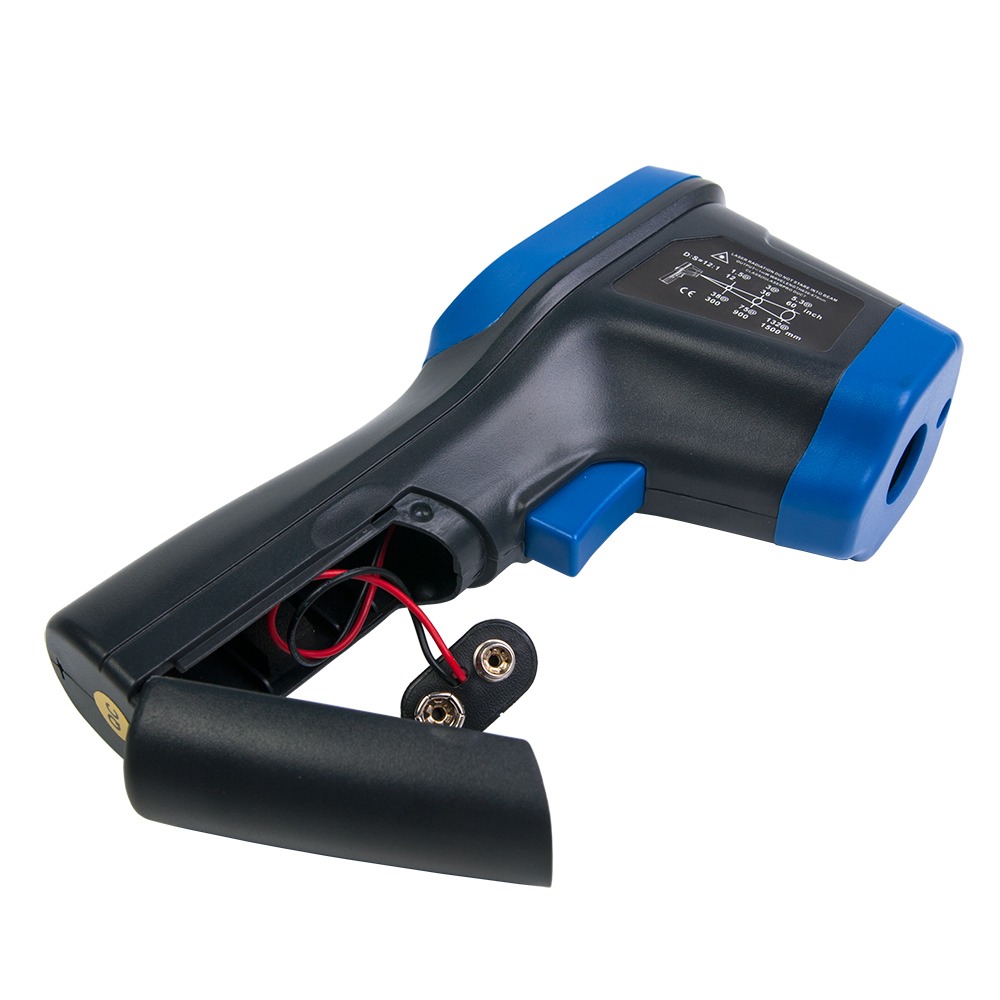
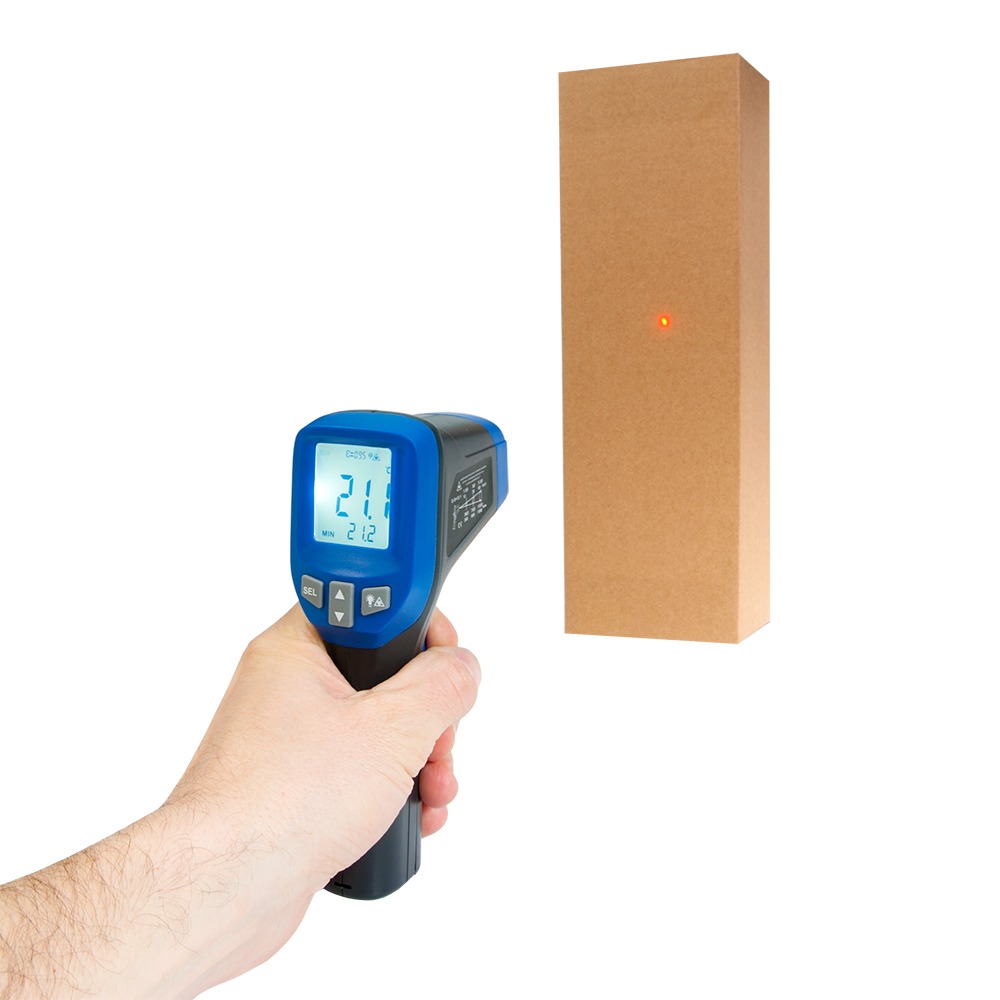
D:S = 12:1 means the device measures not the laser point, but an area (spot) that grows with distance. Approximately:
- 12 cm from the object → spot ≈ 1 cm
- 24 cm → ≈ 2 cm
- 120 cm → ≈ 10 cm
For a useful result, the target must be larger than the spot (ideally, noticeably larger). Otherwise, the device will blend the object’s temperature with that of the surrounding background.
Easy to use: aim quickly, get answers quickly
The IR-826 has a fast response time of < 500 ms, so you can scan a surface and find hot or cold spots without pausing. The laser pointer (Class 2) is purely for aiming, not the measurement point. There’s also an LCD backlight, a small feature that makes a difference in electrical panels, basements and boiler rooms.
A useful diagnostic feature is MAX/MIN recording. It comes in handy when you’re not just measuring temperature but looking for a problem: an overheated contact or bearing, an area with poor insulation, a suspicious spot on the floor and so on.
Auto power-off after 20 seconds of inactivity saves battery power, but it can be annoying if you work by measuring, writing down the result, then measuring again. You can either get used to it or keep your finger on the trigger more often.
Where the FLUS IR-826 is especially useful
- Electrical work: finding overheated circuit breakers, terminals, connectors and busbars (from a safe distance).
- Auto/workshop: bearings, brake discs (take care with shiny surfaces), engine components and radiators.
- HVAC/home: heating radiators, pipes, boilers, refrigeration equipment and localized heat loss.
- Kitchen: checking the surface of a frying pan, grill or pizza stone (within 350°C).

What’s in the box and how it’s powered
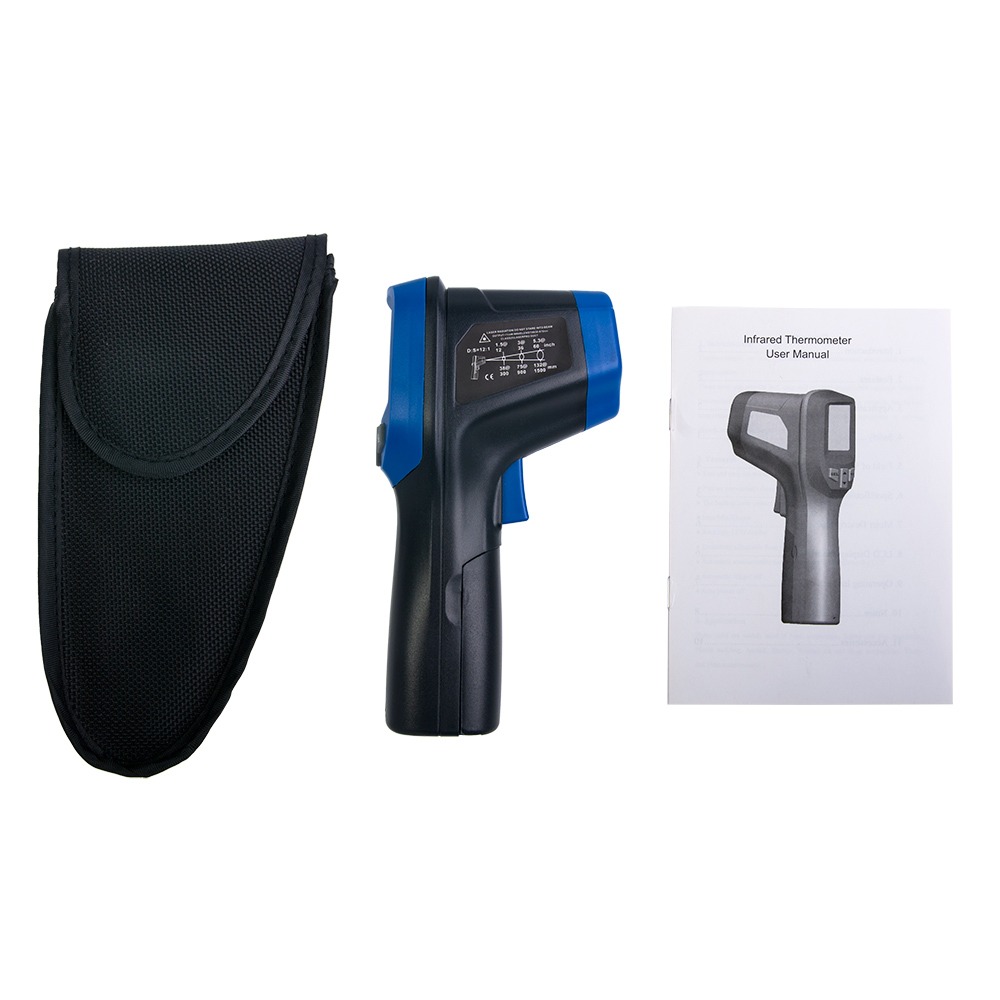
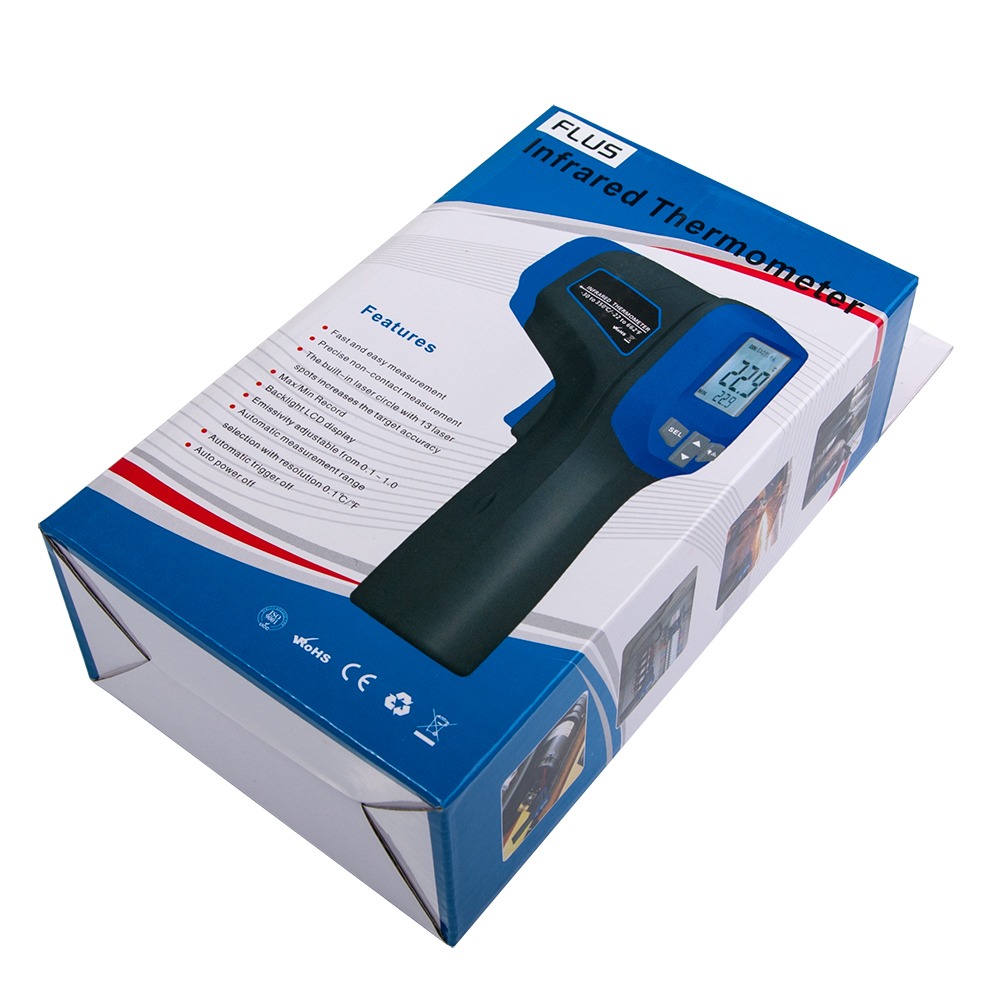
It runs on a 9 V battery (Krona type). The package usually includes the pyrometer, a battery, instructions and a carrying case or bag, so you can put it straight into your tool bag without worrying about scratching the lens.


Who it’s not for
This is not a medical thermometer or a substitute for a contact sensor where “laboratory” accuracy at a specific point is required. It’s also not intended for high-temperature processes above 350°C, such as firing kilns, metallurgy or some pizza ovens running at maximum temperature. But as a tool for service work and home use, the IR-826 handles a wide range of everyday needs without the extra cost of unnecessarily huge measurement ranges.
For detailed technical specifications, see the manufacturer’s page: FLUS IR-826 (official description).