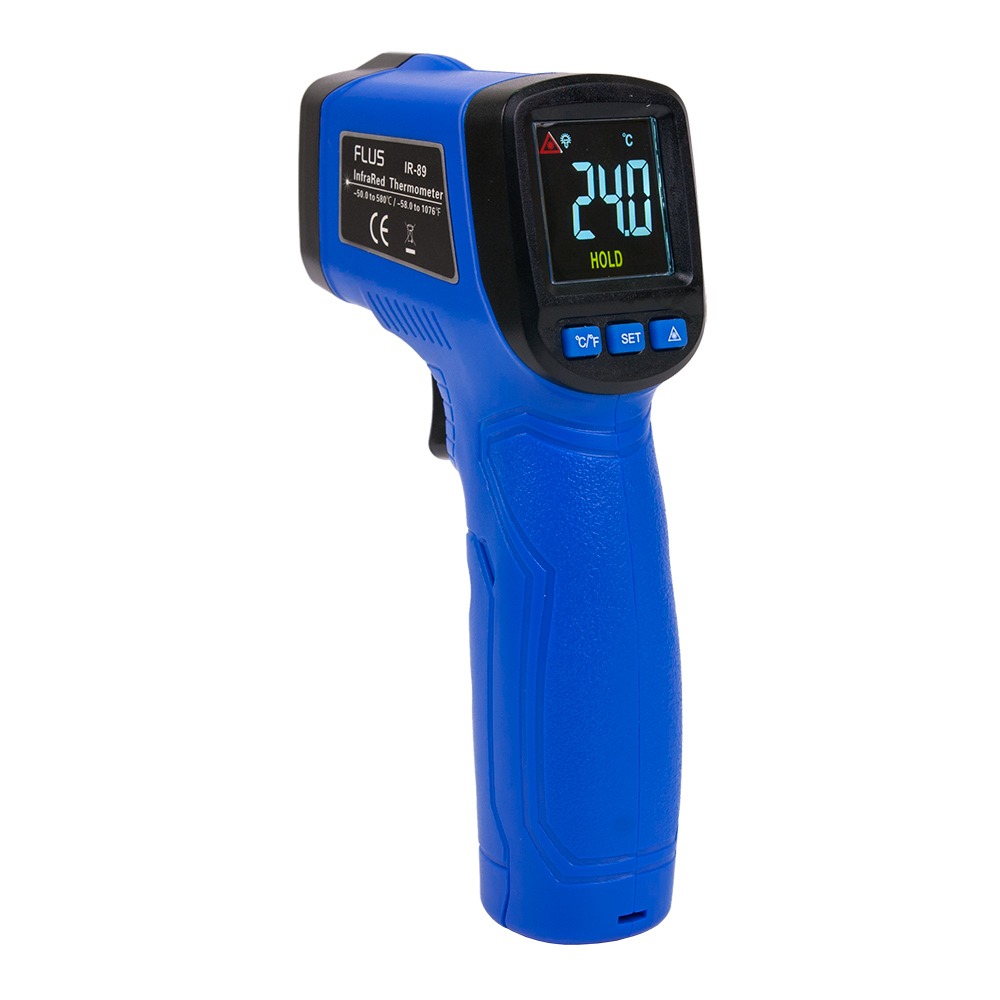
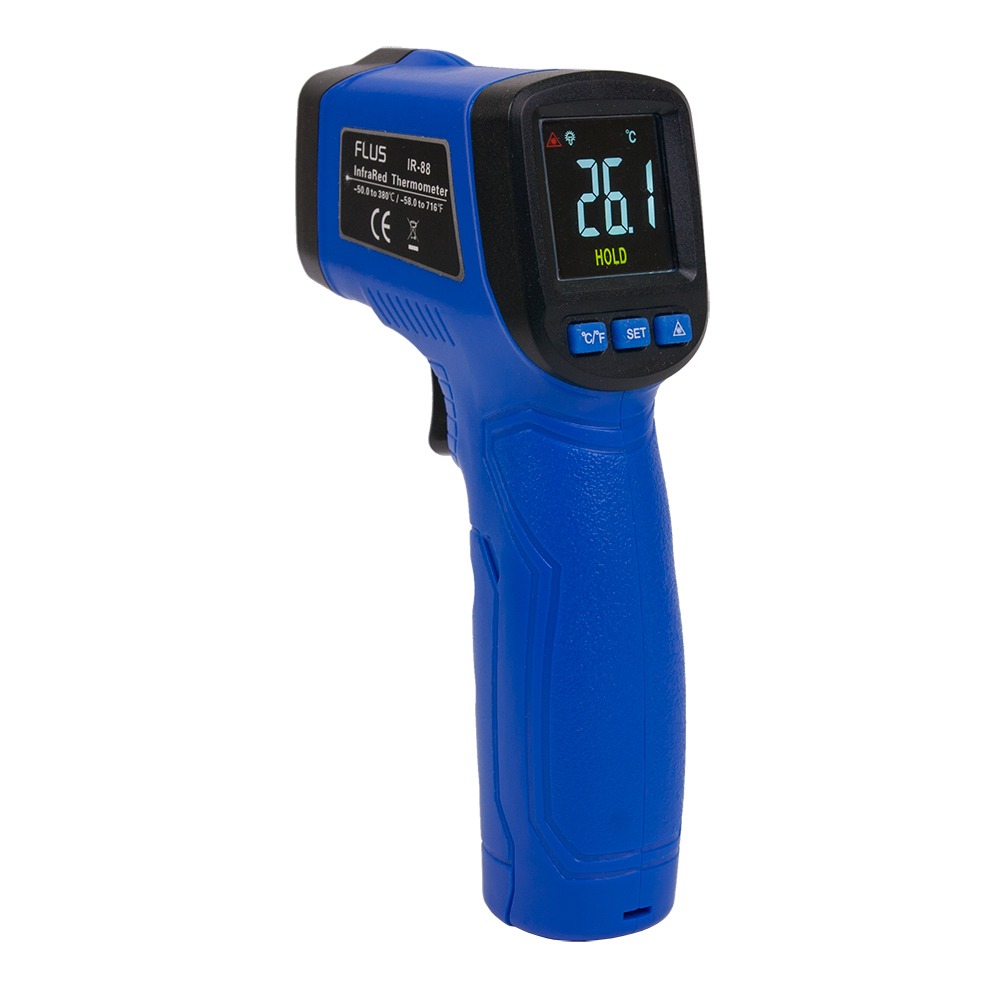
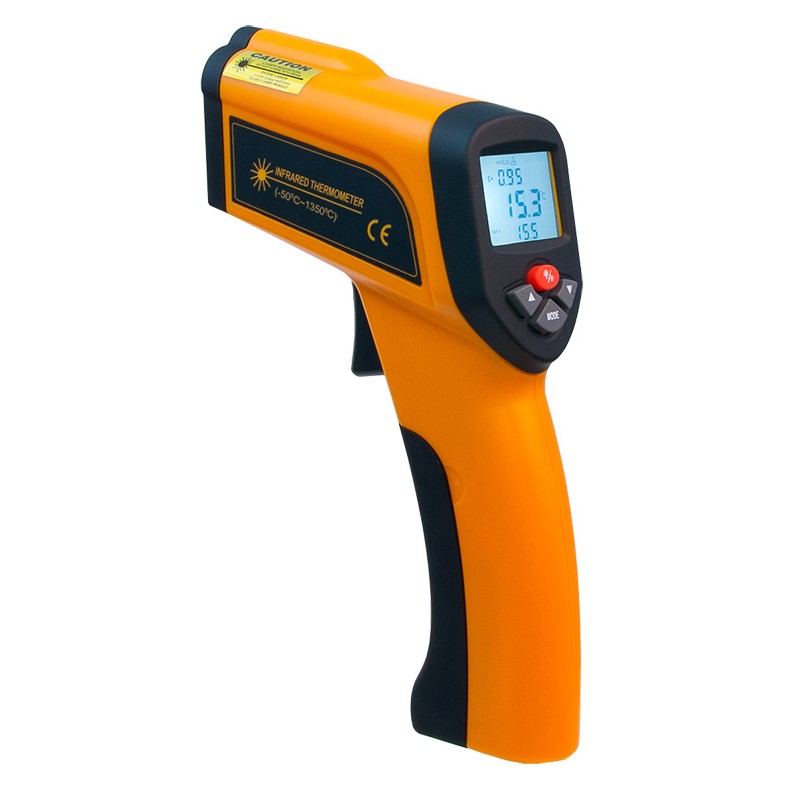
Flus IR-827
Delivery and payment
Choose your city or town to see the price with delivery there and when you can get it.
Pickup points
- Branch
- Parcel locker
Pros
- Range of -30…+550 °C
- 12:1 distance-to-spot ratio
- Adjustable emissivity from 0.1–1.0
- Fast response time of up to 0.5 s
- Backlight and Min/Max display
Cons
- Powered by a 9 V battery
- Laser shows the center, not the spot
- Shiny metal gives misleading readings without preparation
Flus IR-827: a “temperature gun” without the fuss
The Flus IR-827 is a non-contact infrared pyrometer (also commonly called an IR thermometer or “temperature gun”). Aim it at an object, pull the trigger, and in a moment you get its surface temperature without touching it or playing “can I pull my finger away before I get burned?”
This is not a thermal imaging camera: the IR-827 displays a single numerical reading, but it does so quickly and simply, usually providing exactly what you need for servicing, diagnostics, and household tasks.

What it can do in practice
The IR-827 covers the popular “medium-temperature” range from -30 to +550 °C. That makes it equally useful for:
- HVAC and energy audits (radiators, pipes, roughly spotting heat loss through walls, and finding hot spots)
- electrical work (terminals, circuit breakers, electrical panels, and motors, where measuring from a distance is safer)
- automotive work (brake discs, hubs, exhaust systems, and bearings for quick diagnostics)
- workshops and manufacturing (checking the heating of workpieces, assemblies, housings, bearings, and belts)
- the kitchen (pans, grills, and pizza stones: the surface, not “inside the burger”)
One important detail: a pyrometer measures surface temperature. If you need the temperature inside food, liquid, or meat, you need a probe (contact thermometer), not an IR thermometer.
12:1 optics: how to avoid “measuring everything around it”
The IR-827 has a D:S sighting ratio of 12:1. In plain English, the farther away you stand, the larger the “spot” (area) the device averages.
Quick reference:
- at a distance of 1.2 m, the spot is ≈ 10 cm
- at a distance of 2.4 m, the spot is ≈ 20 cm
So the rule is simple: the object must be larger than the spot. If you are measuring a small part, move closer. Otherwise, the device will partly “see” the background and the temperature will be a compromise (read: strange).
And yes, the laser has a single point: it shows the center of the measurement area, but not its actual diameter. The laser is an aiming guide, not the edge of the spot.
Emissivity: the main reason for “incorrect” readings
The IR-827 lets you manually adjust emissivity from 0.1–1.0. This is a key feature that separates a reasonably serious pyrometer from a “plastic marketplace toy.”
What you need to know without diving into physics:
- matte surfaces (paint, wood, plaster, and rubber) usually give consistent readings
- shiny metal (polished stainless steel and aluminum) readily “reflects” infrared radiation, so the device may show something other than what you expect
A handy tip for metal: apply a piece of matte black tape or electrical tape, or use matte paint or a marker at the measurement point. Let the surface warm up, then measure that spot with the emissivity adjusted for the material. It is simple, but it works.
Convenience: what is genuinely useful day to day
The IR-827 is designed to work like a gun: pick it up, aim, pull the trigger, and read. These features help:
- display backlight (for working inside an electrical panel, boiler room, or garage)
- Min/Max display (handy when scanning a surface for a “hot spot”)
- 0.1 °C resolution (so you can see small changes instead of just “somewhere warm”)
One thing not to expect is the “magic” of measuring through glass. A pyrometer generally sees either the temperature of the glass or a reflection, so measuring “the temperature outside through the window” is almost always a bad idea.
Power and durability in the field
The device runs on a 9 V 6F22 battery. This is neither a drawback nor an advantage, just a fact: some people always have one in a drawer, while others dislike the price and how hard it can be to find at the nearest shop. On the plus side, replacement takes a minute, with no cables or charging.
For consistent results, both the power source and the operating environment matter: the ambient operating range is 0…+50 °C. If you bring the device from freezing conditions into a warm room, give it a few minutes to acclimate.
Safety and common mistakes (short and to the point)
- Not for body temperature: this is a pyrometer for industrial and household surface measurements.
- Do not look into the laser or shine it into anyone's eyes.
- Do not measure small objects from far away: D:S 12:1 refers to a spot, not a point.
- Glossy surfaces = surprises: shiny metals need preparation or an emissivity adjustment.
Verdict
The Flus IR-827 is a capable workhorse pyrometer with a practical range up to +550 °C, 12:1 optics, and adjustable emissivity. If you need to quickly check surface temperatures in a workshop, garage, service shop, boiler room, or during an energy audit, this tool earns its keep not through a wow factor, but by regularly finding overheating where it should not be.