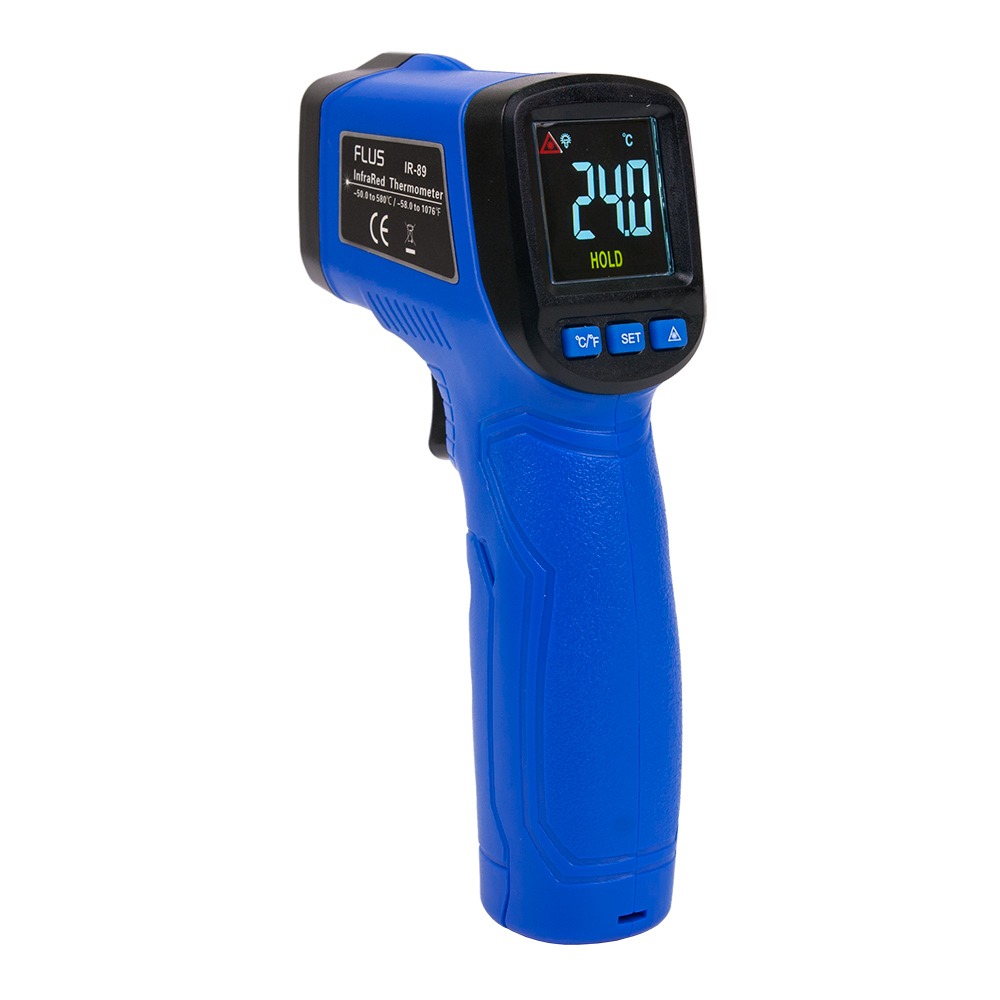
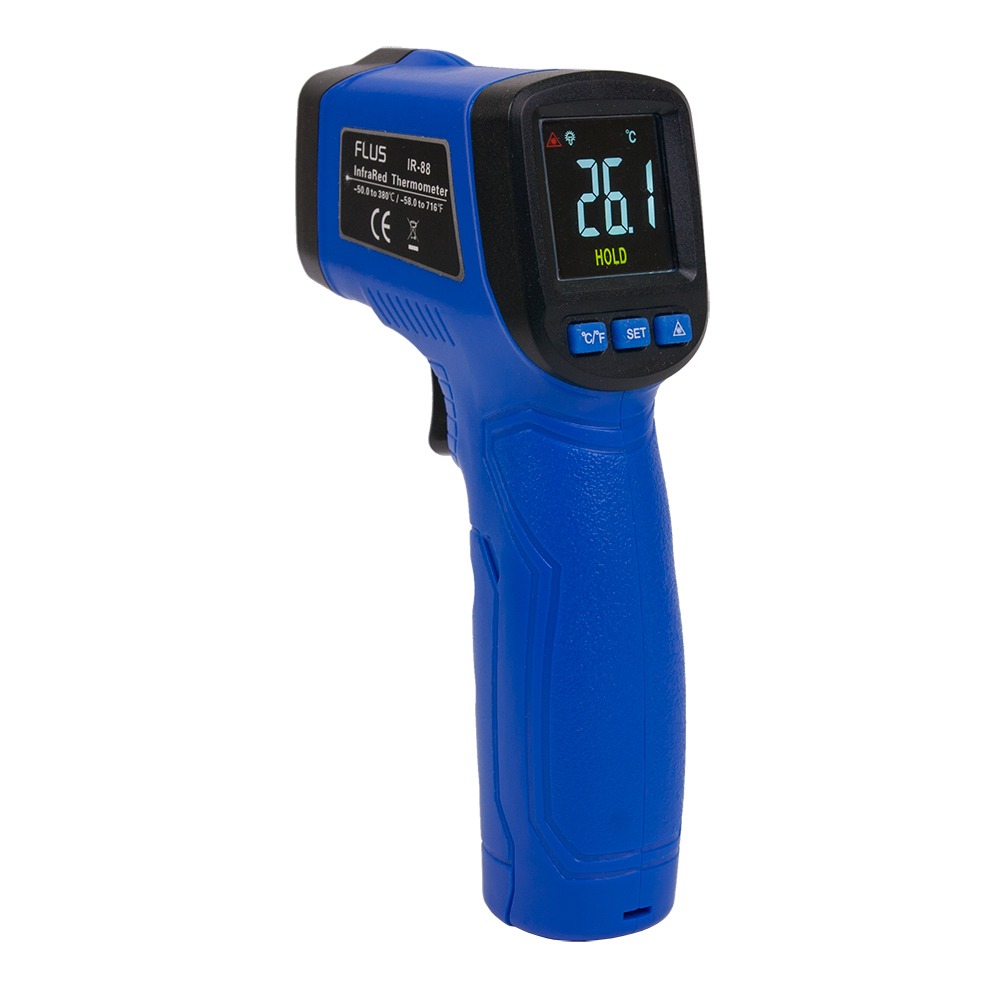
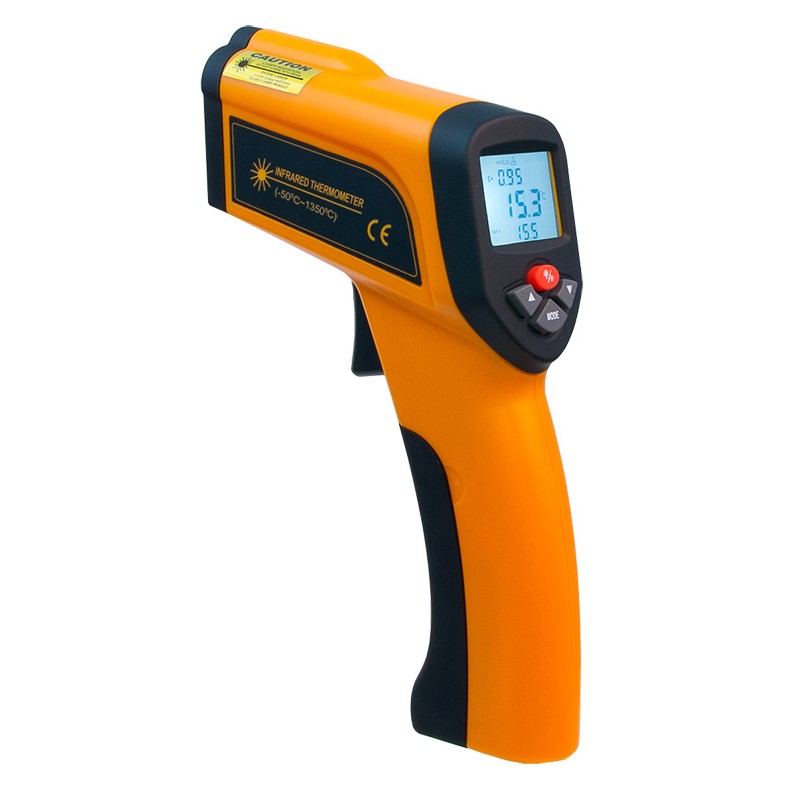
Flus IR-829
Pros
- Range up to 950 °C
- 30:1 optics for measurements at a distance
- Adjustable emissivity from 0.1–1.0
- Fast response < 0.5 s
- MAX/MIN and backlight
Cons
- Doesn't work well with shiny metal
- No Bluetooth or logging
- Auto power-off after 20 s
Flus IR-829: a point-and-measure pyrometer with a few caveats
The Flus IR-829 is a non-contact infrared pyrometer in a pistol-style design that measures surface temperature (not the temperature inside an object, a person's body temperature, or the air temperature in a room). Its strengths are a wide range from -30 to 950 °C, capable D:S = 30:1 optics, and the ability to adjust emissivity for the material to get reasonably accurate readings.
This is the kind of tool that comes in handy when you need quick answers to questions like “Is this overheating?”, “Where's the hot spot?”, or “How hot is this shaft, bearing, radiator, or furnace?” without putting your hands near it.

What matters most: range, optics, and emissivity
1) Range: -30…950 °C. Most household IR thermometers top out at 380–550 °C. This model has a much higher limit, making the IR-829 a common choice for technical work involving machinery, electrical systems, furnaces and boilers, dryers, plastic, asphalt, and more.
2) D:S = 30:1. This describes how narrowly the device sees. Put simply, the higher the number, the easier it is to measure a specific area from a distance rather than the average temperature of everything around it.
3) Adjustable emissivity from 0.1–1.0. This is critical. An infrared pyrometer doesn't read degrees directly; it estimates the radiation emitted by a surface. If the surface is glossy or mirror-like, you'll get some highly creative numbers, often influenced by reflected heat from the surroundings.
Laser sight: see the measurement spot
This model's aiming system is more useful than a single red dot. In practice, it helps you understand exactly which area is included in the reading, especially at a distance or on small parts.

Important: the laser is for aiming, not measuring. It doesn't heat the target or scan its temperature with the beam.
How to measure correctly with D:S 30:1 (and why it matters more than the “SCAN” button)
The D:S = 30:1 ratio means the diameter of the measurement spot is approximately the distance divided by 30.
Examples:
— 0.3 m to the object → spot ≈ 0.01 m (10 mm)
— 1 m → spot ≈ 0.033 m (33 mm)
— 3 m → spot ≈ 0.10 m (100 mm)
So if you want to measure, say, a screw or a thin terminal from a meter away, forget it: the device will average the temperature of the screw and everything else inside the spot. A practical rule: the target should be noticeably larger than the spot. If you need a more targeted reading, move closer.
Accuracy: when readings will be close to the truth
According to the specifications, accuracy is:
— in the -30…0 °C range: ±3 °C
— above 0 °C: ±(1.5% of the reading + 2 °C)
In real life, accuracy depends on three things:
1) The material's emissivity. Matte painted surfaces, plaster, wood, and rubber are usually easy to measure. Polished stainless steel, aluminum, and chrome often give unreliable readings.
2) Reflections and external heat. A glossy part may show the temperature of a furnace reflected in it rather than its own temperature.
3) Obstacles between you and the target. Glass is a classic source of misleading readings: you can't measure reliably through it. Steam, smoke, and dust can also affect the result.
Tip for metal: if you need a reasonably reliable reading from shiny metal, stick on a small square of matte black electrical tape (or apply matte paint or marker if appropriate), wait a few minutes for the temperatures to equalize, and then measure the patch. This replaces a difficult surface with a predictable one.
Controls, display, MAX/MIN: straightforward to use
The IR-829 is very simple to operate: pull the trigger to enter measurement mode (SCAN), then release it to hold the reading (HOLD) for a few seconds. It has a display backlight, °C/°F switching, a low-battery indicator, and MAX/MIN readings, useful when sweeping an area to find the hottest spot.


Power and everyday details that can please or frustrate
The device runs on a 9 V battery and has auto power-off after approximately 20 seconds of inactivity. That's good for battery life, but if you're slowly adjusting the emissivity or recording measurements in a notebook, you may sometimes wish it were more patient.
On the plus side, its response is fast (less than 0.5 s), so you don't have to wait forever between readings.
Who the Flus IR-829 is for
Technicians and service professionals: checking the temperature of bearings, motors, brakes, radiators, pipes, boilers, heat exchangers, and electrical panel equipment.
Electricians and power engineers: finding overheated connections, circuit breakers, and busbars, with due consideration for emissivity and a safe distance.
Manufacturing: checking the surfaces of molds, dryers, plastic, asphalt, and production lines where quick, non-invasive checks are needed.
Not the best fit if you need a documented measurement history (logging), data transfer to an app, or contact measurement of liquids or a product's core temperature.
Safety and common sense (brief but important)
The laser is Class 2. Don't point it into anyone's eyes or play with reflections on mirror-like surfaces. Also, don't measure through glass or expect miracles on polished metals without preparing the surface.
Documentation
If you want to check the specified parameters or quickly find button combinations, it's useful to have the manual handy: IR-829 User Manual (PDF).
Verdict
The Flus IR-829 is a solid working pyrometer for anyone who needs to measure high temperatures up to 950 °C, with decent 30:1 optics and emissivity adjustment. It's not about smart features or analytics; it's about quick on-site diagnostics. Keep the measurement spot and emissivity in mind, especially on metal, and your readings will be useful as well as fast.