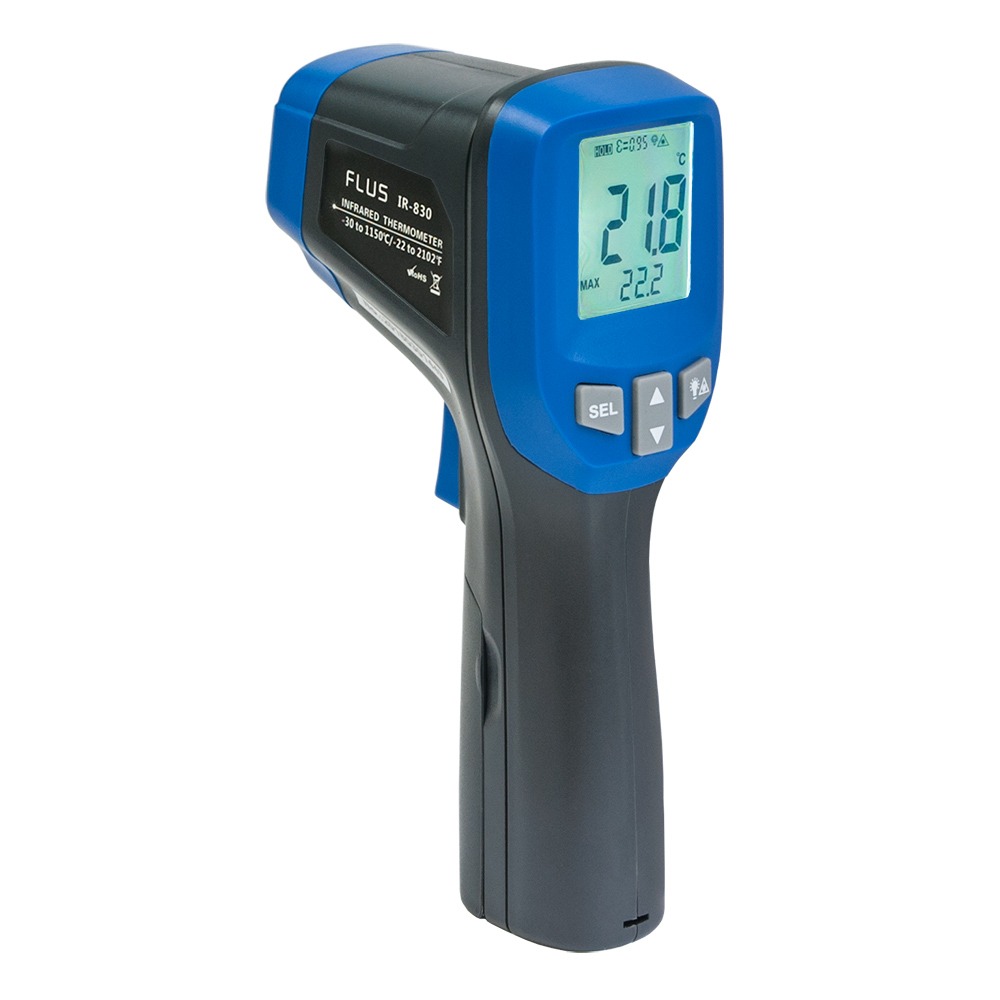
Flus IR-830
Delivery and payment
Choose your city or town to see the price with delivery there and when you can get it.
Pickup points
- Branch
- Parcel locker
Pros
- Range up to +1150 °C
- 30:1 optics for measuring from a distance
- 13-beam laser ring
- Adjustable emissivity from 0.10–1.00
- Fast response: 0.5 s
Cons
- Surface temperature only
- Shiny metal is trickier to measure
- Auto power-off after ~20 seconds
Flus IR-830 is a temperature gun for when you don't want to touch
The Flus IR-830 is a non-contact infrared thermometer (pyrometer) that reads surface temperature using radiation in the 8–14 µm range. It's useful where a contact thermometer would be inconvenient or dangerous: hot parts, live electrical equipment, moving components, furnaces/boilers, automotive components, heating, ventilation, and more.

Key features that really matter
- Range: -30…+1150 °C, enough for both household use and high-temperature industrial tasks.
- D:S 30:1 means that at a distance of 1 m, the device measures a spot approximately ~3.3 cm in diameter. The farther away you are, the larger the spot and the easier it is to accidentally include unwanted areas.
- Measurement time: 0.5 s, so you can quickly check multiple points on an object.
- Adjustable emissivity 0.10–1.00 is a must-have if you measure different materials, not just matte walls.
An honest look at accuracy
The stated accuracy is up to 0 °C: ±3 °C and above 0 °C: ±(1.5% of reading + 2 °C). That's a reasonable level for industrial and household use: enough for diagnostics, monitoring overheating, before-and-after comparisons, and finding problem areas. But it isn't a laboratory reference or a replacement for a contact sensor when you need absolute accuracy to the degree on shiny steel.
Another often-overlooked detail: resolution is 0.1 °C up to 1000 °C and 1 °C above 1000 °C. So don't expect hundredths of a degree at very high temperatures, and that's OK.
13-beam laser: impressive and, more importantly, useful
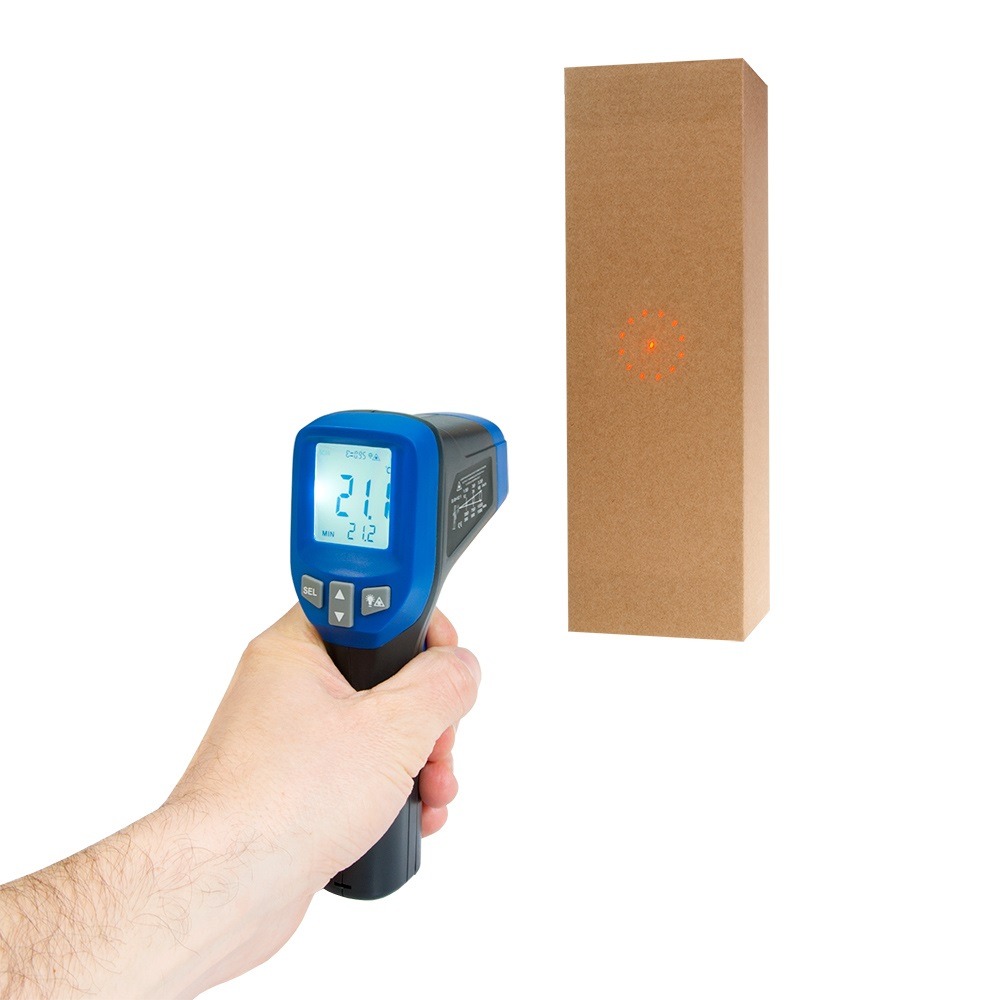
Rather than a single dot, there's a ring of 13 beams to help you identify the measurement area. That's handy when working with small objects or from a distance and you don't want to guess exactly where the device is looking. The laser, like the backlight, can usually be switched off to avoid shining it where it isn't needed and to save battery power.
Emissivity: why a pyrometer gives misleading readings on shiny metal and how to fix it
A pyrometer detects infrared radiation, and different surfaces emit it differently. Matte, dark surfaces are almost always easier to measure. Shiny, polished surfaces (stainless steel, chrome, aluminum) can produce significant errors because they reflect more than they emit.
Practical tips:
- for metal, apply a small piece of matte black electrical tape or matte black paint (if possible), then measure that spot;
- give the mark or tape 1–2 minutes to reach the same temperature as the part;
- adjust the emissivity setting until the readings match a contact sensor, if you can compare them.
Controls and display
The Flus IR-830 has a large three-line LCD with a backlight, making it easy to see the current reading and MAX/MIN at the same time. It offers °C/°F switching, an out-of-range indication (Hi/Lo), and a low battery indicator. It also has auto power-off after approximately 20 seconds of inactivity to save the 9 V battery, though it can sometimes make you feel rushed.
Power and use in the field
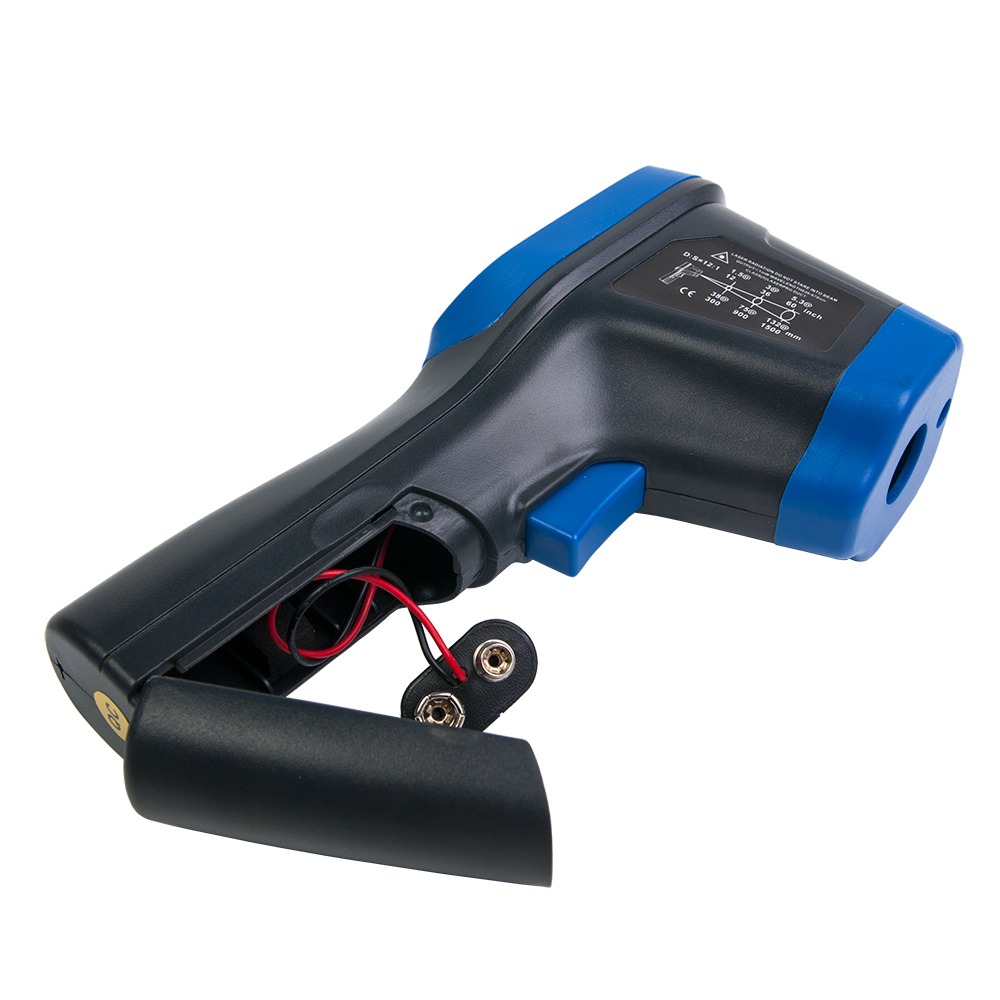
The device runs on a 9 V battery (PP3 / 6F22). It's a convenient format for a tool: the battery is easy to find and takes a minute to replace.

What's included: ready to use out of the box
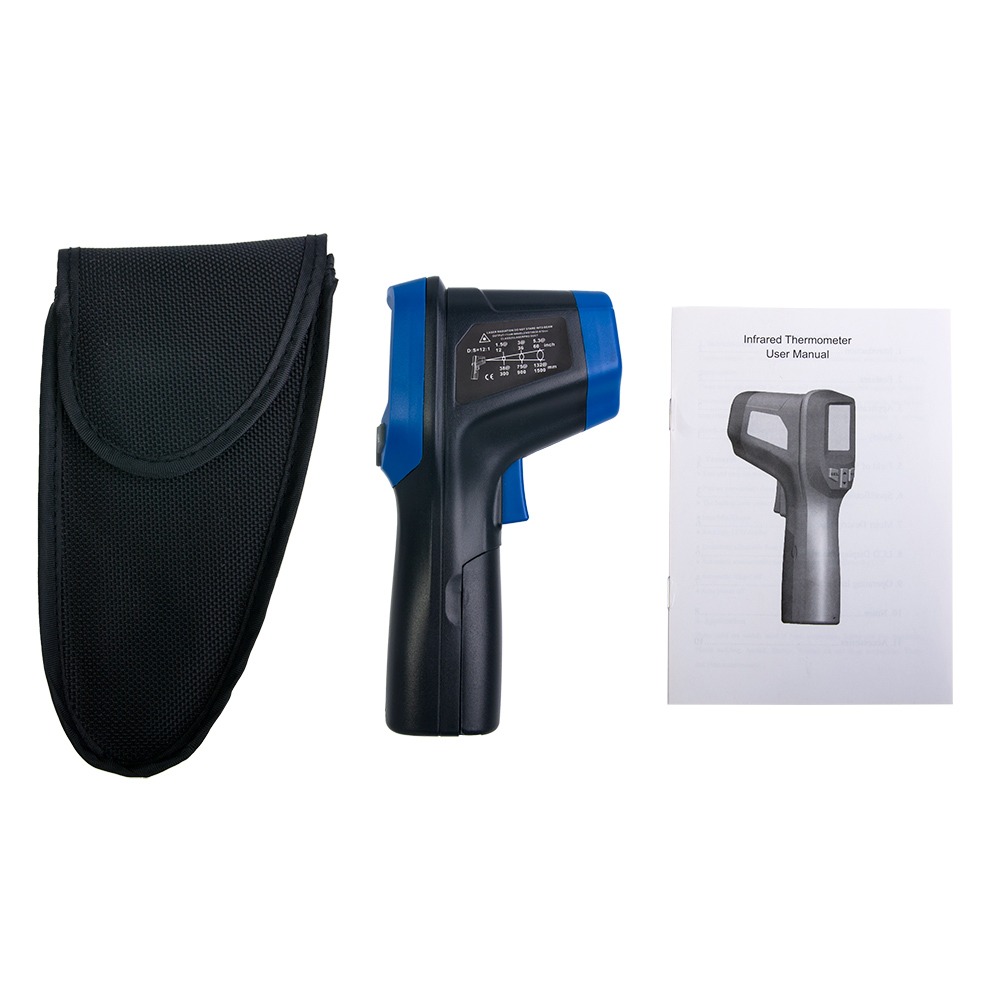
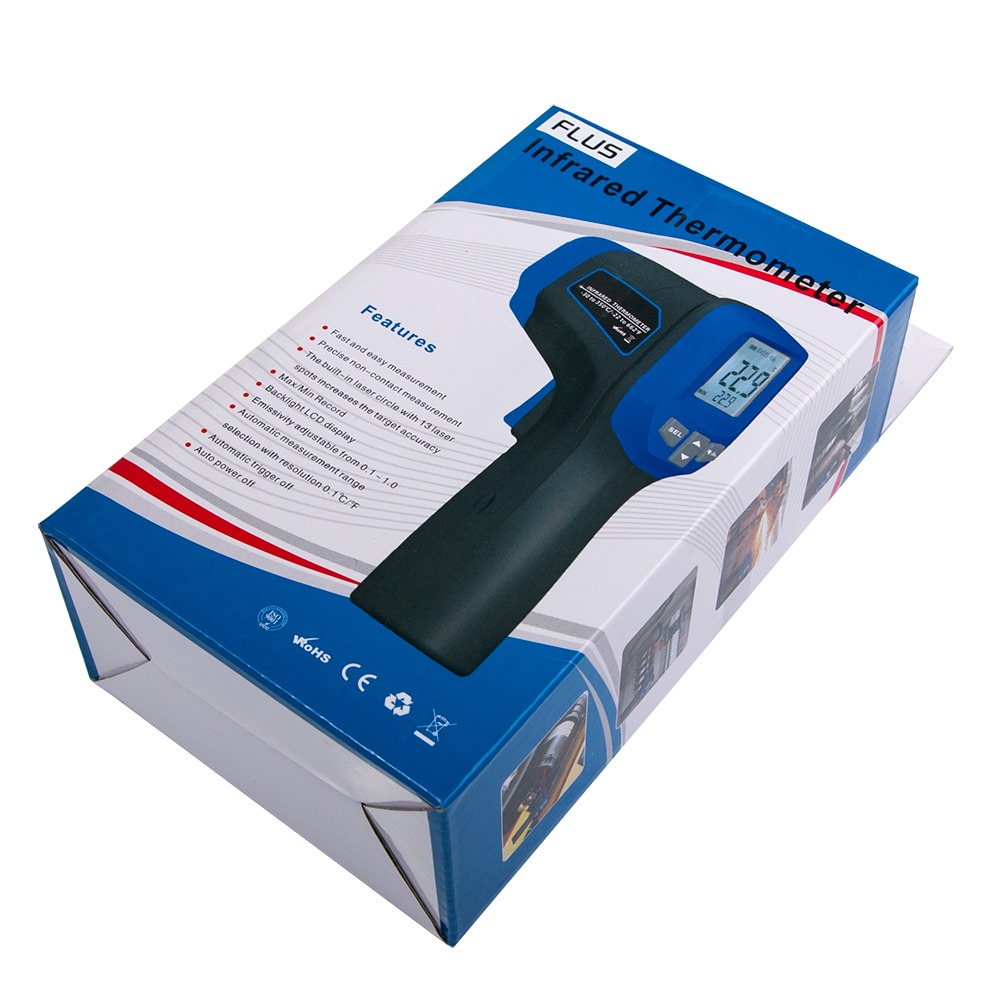
The package usually includes the pyrometer, a carrying holster, a manual, and a battery. The holster is a small but welcome addition: it keeps the device from rattling around in a bag with keys and picking up scratches.


Who it's for and who should look elsewhere
- A good fit: electricians, HVAC technicians, auto mechanics, service technicians, and DIYers who want to quickly find overheating, heat loss, or hot spots.
- Not a good fit: if you need the temperature inside food, liquid, or material (you'll need a probe for that), or if you plan to measure a person's body temperature. Pyrometers of this type aren't designed for that.