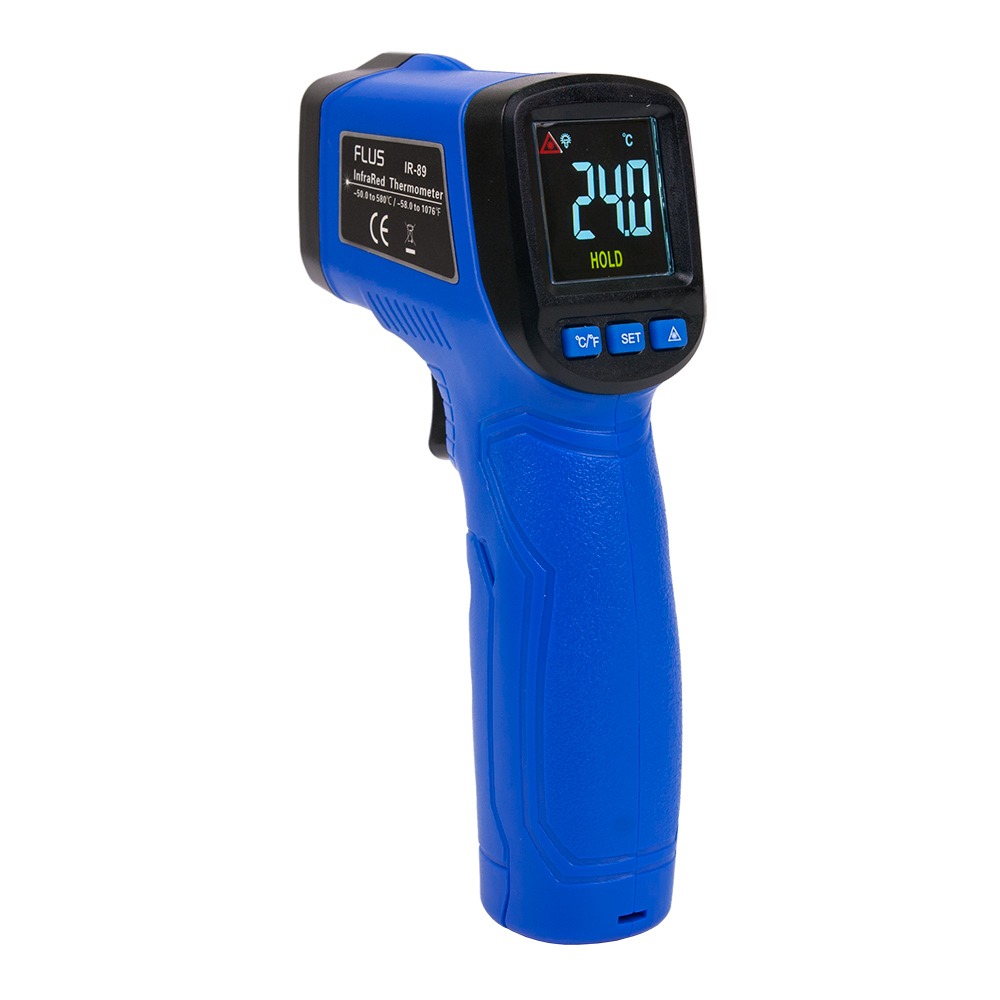
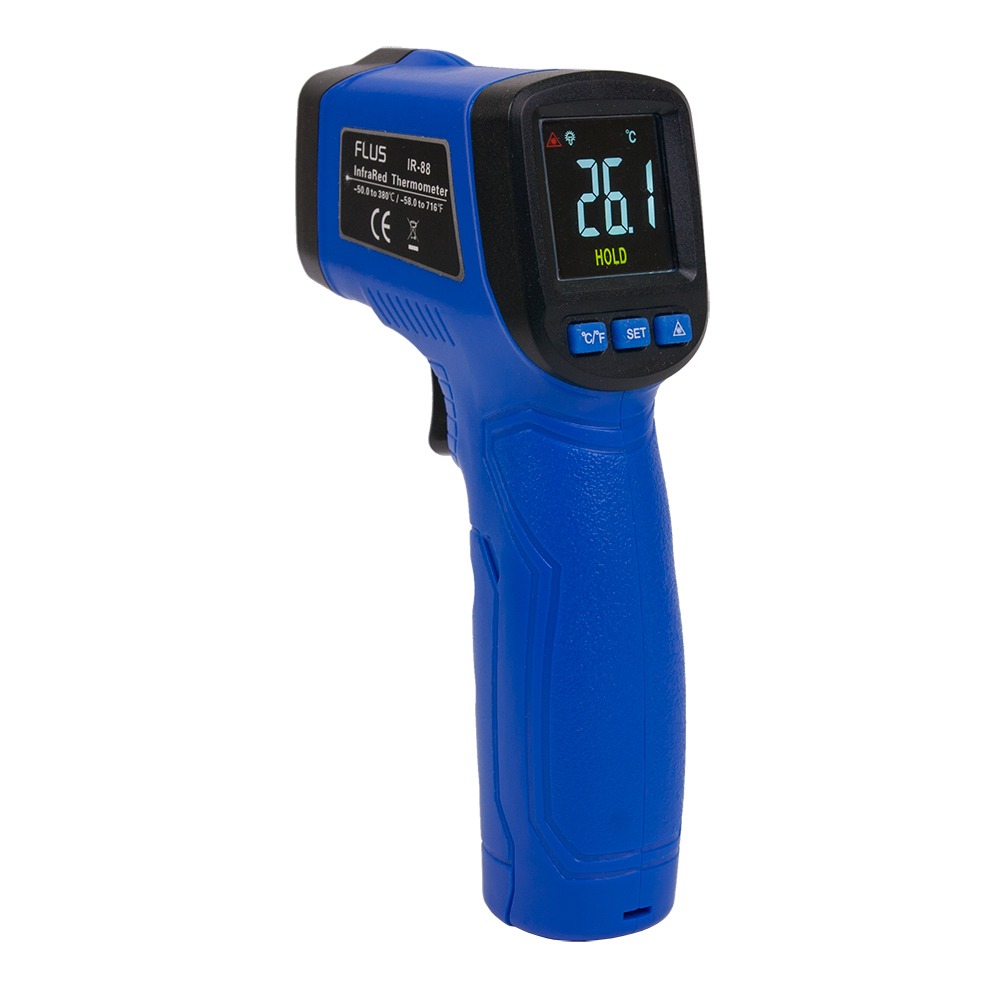
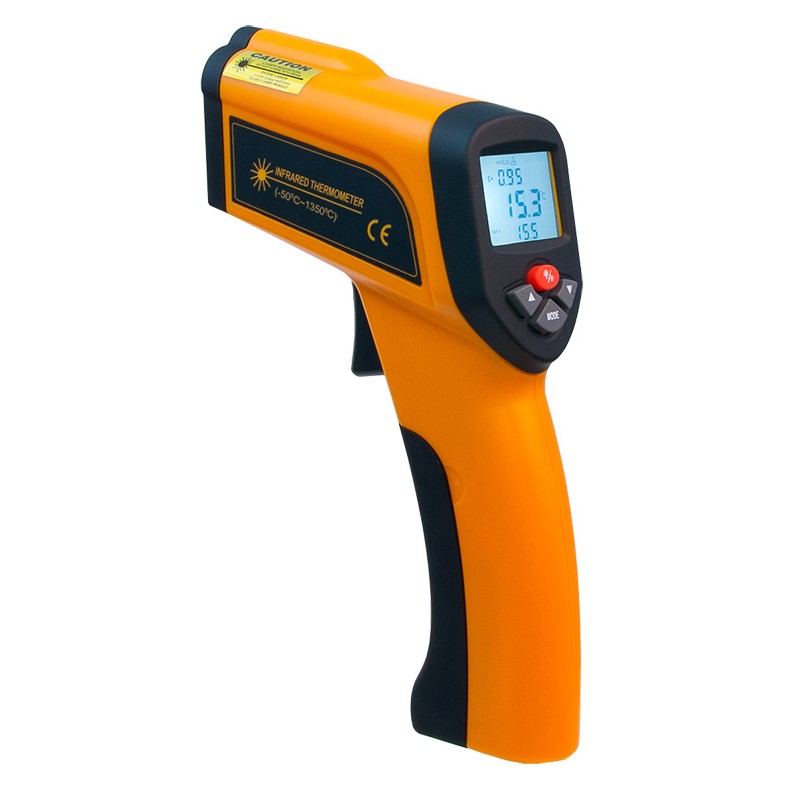
Flus IR-866U
Pros
- Range up to 2250 °C
- 50:1 optics for distance measurement
- USB logging to a PC
- Emissivity 0.10–1.00
- Fast response <0.25 s
Cons
- Measures surface temperature only
- Shiny metal can throw off readings
- Auto power-off is too quick
FLUS IR-866U USB: A pyrometer that likes it hot (and makes graphs on your PC)
The FLUS IR-866U USB is a non-contact infrared pyrometer (also called a “temperature gun”) that reads surface temperature using infrared radiation. It is not a “medical thermometer,” but a working tool for workshops, manufacturing, service work, HVAC, ovens and furnaces—anywhere touching the surface is unsafe or inconvenient.

The key numbers: Range, speed, emissivity
The IR-866U excels at high temperatures: its stated measurement range is -50 to 2250 °C. Its response is fast (under 0.25 s), making it easy to “scan” a surface and catch peaks.
Another advantage is adjustable emissivity of 0.10–1.00. This is critical when measuring different materials (painted metal, concrete, wood, ceramics, stainless steel, aluminum, and so on). Inexpensive pyrometers often have fixed emissivity, so accuracy suffers when surfaces get shiny.
50:1 distance-to-spot ratio: How to stay on target
The IR-866U has a distance-to-spot ratio of D:S = 50:1 (distance to measurement spot diameter). As a practical rule:
At a distance of 1 m, you measure approximately a ~2 cm spot, not a “point.” At 5 m, the spot is about 10 cm. That works for ovens, pipes, bearings, electrical panels, and large parts, but not for an SMD resistor or a thin wire, because you also read the surrounding background.
The USB feature: Real-time monitoring and logging
The IR-866U version stands out for its USB connection, which lets it send readings to a computer for monitoring and recording. This is useful when you need to:
— capture a process temperature profile (heating/cooling);
— keep a log for quality control;
— capture peaks (MAX) in data rather than by eye;
— have a graph to settle arguments with a colleague based on “feel.”


Features that really work: MAX/MIN/AVG/DIF, HOLD, and alarms
In practice, it is not just the “up to 2250 °C” range that matters, but also the little features that save time:
HOLD freezes the reading on the display; MAX/MIN captures peaks and lows; AVG averages readings; DIF shows the difference between values. There is also a high/low alarm (Hi/Lo alarm), useful for keeping a process within its target range.
The display is backlit, and a laser pointer (Class II) helps with aiming. The laser does not measure temperature; it is an aiming aid. The IR sensor measures the temperature.
Important warning: IR pyrometers do not “measure everything”
To avoid disappointment after buying, keep these 3 simple rules in mind:
1) It measures surface temperature, not the air temperature or the temperature “inside” a material.
2) Shiny surfaces (polished stainless steel, aluminum) can cause significant errors due to low or unstable emissivity and reflections. Tip: A small piece of matte heat-resistant tape or a spot of matte heat-resistant paint used as a “target” often makes the reading more reliable.
3) Follow D:S: Do not measure small objects from a distance, as you will also read the background.
Who is it for?
The IR-866U USB is worth considering if you need high temperatures plus PC logging: ovens and furnaces, blacksmithing and foundry work, maintenance, mechanical and electrical work, monitoring component heating, spot-checking thermal insulation, and so on. If you are looking for a device for the kitchen or pizza, it will certainly do the job, but that would be like hammering nails with a lathe: possible, but of questionable value.