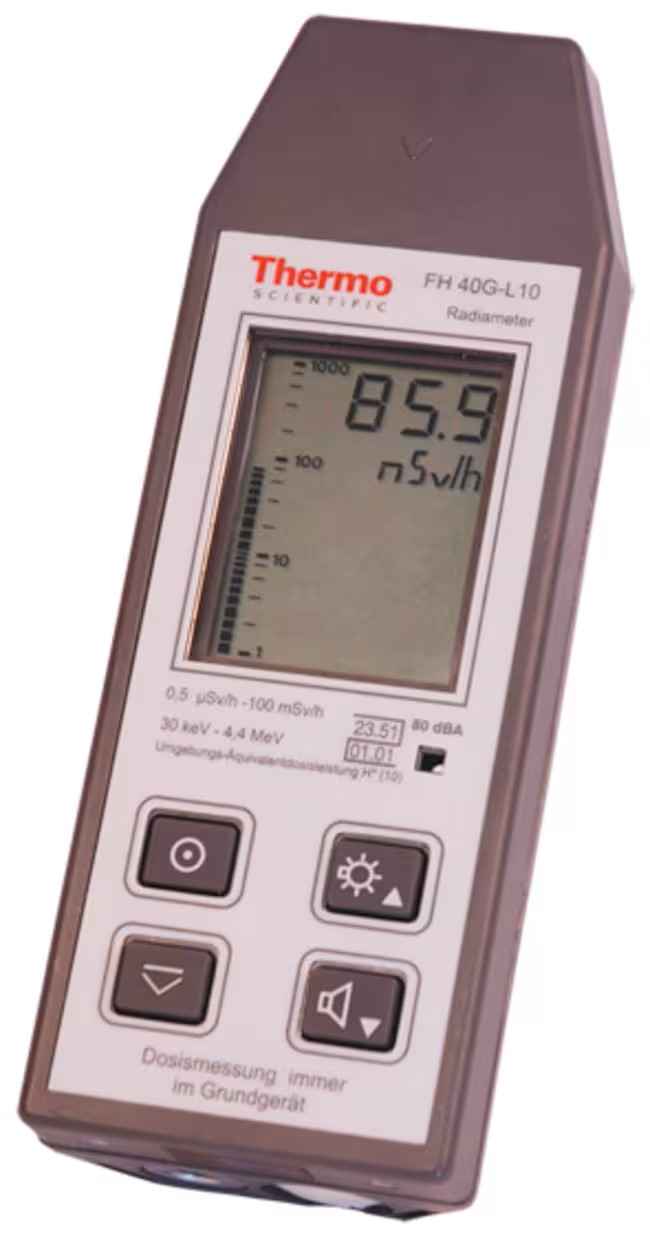
RadEye G Search Dosimeter
Pros
- Energy-compensated GM tube
- Quickly shows changes in background radiation
- Durable IP65-rated housing
- Very long runtime on AAA batteries
- Vibration alerts and earphone option
Cons
- Readings in R, not Sv
- Does not identify isotopes
- Not for alpha/beta wipe tests
What is the RadEye G and why is it called a search dosimeter?
The Thermo Scientific RadEye G is a pocket-sized gamma survey dosimeter/radiometer for fast, reliable dose rate measurements. It excels in the field: surveying areas, making an initial assessment of conditions, finding where background radiation is rising, checking suspicious objects, and supporting emergency response and industrial work.
The key idea is simple: the instrument should show changes immediately without jumping around due to random fluctuations. The RadEye G uses an intelligent ratemeter algorithm (ADF mode) to quickly highlight real trends and filter out noise, so you can see the picture rather than a strobe of numbers while searching.
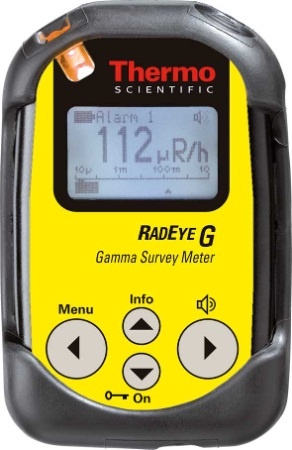
Detector: energy-compensated Geiger-Muller tube
The RadEye G uses an energy-compensated GM tube. In practice, this means a more accurate assessment of dose and dose rate across a wide range of gamma and X-ray energies. A cheap counter may sometimes be good enough to show a count, but not to provide a proper dose assessment. That is why instruments like this are often chosen for professional work rather than as a hobby.
The energy range for the RadEye G version is 45 keV–1.3 MeV (according to IEC 60846-1). Sensitivity (for Cs-137, 662 keV) is specified as 17 cps per 1 mR/h, enough to reliably detect changes in background radiation and follow them to a source.
Measurement ranges: from background to emergency levels
The RadEye G covers typical search and assessment tasks, from background levels up to 10 R/h. When radiation levels are extremely high, the instrument still alerts you: it has an overrange indication up to 1000 R/h. That means you will not be left without a warning when you need it most.
One important detail: the RadEye G displays values in R and R/h. If your processes, documentation, and reports use SI units (Sv, Sv/h), consider the similar RadEye G-10, which has an H*(10) sievert response.
Alarms and fieldwork: when it is noisy or dark, or you are wearing gloves
The RadEye G is designed for situations where a quiet beep is not enough. It has a bright LED for use in smoke or darkness, plus several alarm options: audible and vibration alerts and the ability to connect an earphone, useful both in quiet environments and in very noisy places. The alarm LED is visible even when the instrument is in a belt holster.
The menu-driven controls are paired with a large backlit display. Frequently used functions are close at hand, and access to settings can be tailored to the task or partially or completely locked to prevent accidental changes in the field.
Housing, protection, and battery life: pocket-sized but not delicate
This is a device that feels professional in your hands: an impact-resistant design, IP65 protection against dust and water jets, compact dimensions of 9.6 × 6.1 × 3.1 cm, and a weight of about 160 g. It runs on two AAA batteries, with a stated battery life of up to 900 hours. In other words, you are likely to tire of it before it runs out of power.
Memory and analysis: retrieve past readings
Optional Windows software and a reader are available for incident analysis and training. The instrument stores events such as configuration changes, alarms, and errors in a logbook, along with the last 1600 dose rate values for retrospective analysis. The average and maximum values are stored for each interval, making it easy not only to see what happened but also to document it with numbers afterward.
Who is it for, and who should look elsewhere?
The RadEye G is an excellent choice if you need a compact search dosimeter for gamma and X-ray radiation with good ergonomics, a durable housing, and serious battery life. But it is not a spectrometer and cannot identify isotopes, nor is it designed to check for alpha/beta contamination using wipe tests or on surfaces. Those tasks require different detectors or probes.
Official series page: Thermo Scientific RadEye G Series.