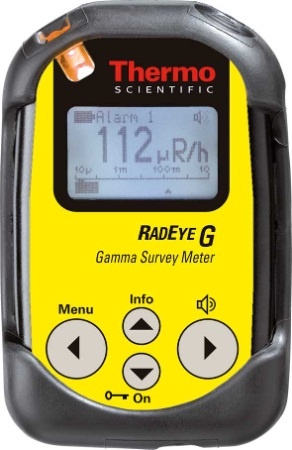
Thermo Scientific FH 40 G
Pros
- Professional H*(10) readings
- IP67: rain, dirt, and field conditions
- Plug-and-play “smart” probes
- 256 records + transfer to a PC
- 2×AA batteries and up to 250 h of operation
Cons
- IR/COM interface, not USB-C
- Probes are usually purchased separately
- Calibration must be kept up to date
Thermo Scientific FH 40 G: a field survey meter that grows with your needs
The Thermo Scientific FH 40 G is a professional portable dosimeter and survey meter for radiation monitoring, from a simple background check to finding a source, monitoring workplaces, fieldwork, and use with additional probes for contamination, search, neutron detection, and more.
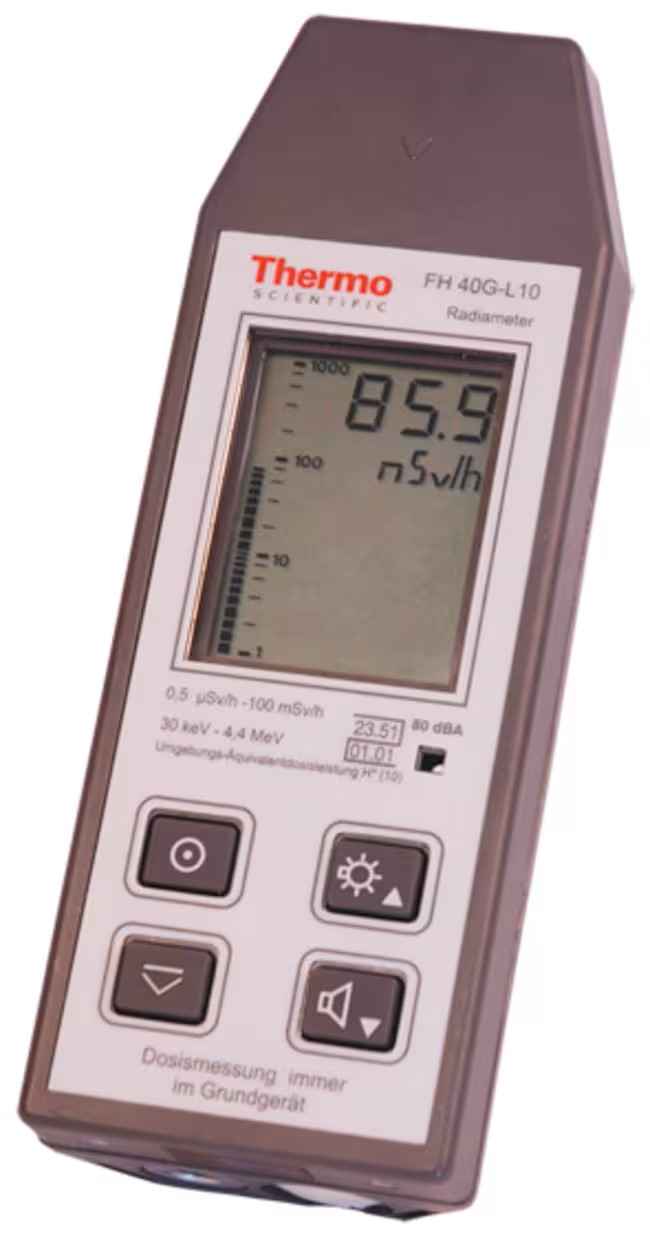
The photo shows the FH 40 G-L10 version (as marked on the front panel) with readings in nSv/h, meaning it displays H*(10) in SI units.

Don't mix up the versions: suffixes matter
“FH 40 G” refers to an entire family. The instruments look very similar, but their units and measurement ranges can differ. Before buying, check the marking:
- -10 / -L10 uses SI units for H*(10) (Sv/h), with energy response suited to modern requirements.
- -L usually means a lower upper limit than the non-L versions.
- -X is a display unit without an internal detector (it works only with external probes).
- -LΩ denotes special versions for additional connections (e.g., an earphone or relay options).
The official product line page, with its list of versions and probes, is a useful reference before buying: Thermo Scientific FH 40 G (catalog/description).
What it measures out of the box
Most FH 40 G versions (except the FH 40 G-X) have an internal energy-compensated proportional counter, which measures gamma/X-ray dose rate without any cables or “pancake” probes.
For the FH 40 G-L10, the primary measurements are ambient dose equivalent rate H*(10) (Sv/h) and accumulated dose (Sv). Rather than “clicks/min,” the instrument provides a meaningful engineering metric for radiation protection.
Operating modes: more than just a number
The FH 40 G can operate in ratemeter mode (real-time dose rate) or counter mode (counting pulses over a set time). The latter is especially useful with external contamination probes when you need statistics rather than a rapidly fluctuating reading.
The display is easy to read: a numeric value + a logarithmic bar graph. In the field, this works better than you might expect: you can catch an increase out of the corner of your eye, even before you've read all the zeros.
Alarms and audible search indication
The instrument has dose rate alarms and accumulated dose alarms with a loud audible signal (approximately up to 80 dB(A) at close range). You can also turn on audible pulse indication, a mode that lets you literally “hear” the field and makes finding a source much faster.
An important practical detail: when an external probe is connected, the instrument simultaneously monitors the internal and external channels, and you can set separate alarm thresholds for each.
External probes: from alpha/beta to neutrons (optional)
A key feature of the FH 40 G is its interface for one external plug-and-play probe. Once connected, the instrument automatically retrieves the probe's parameters and calibration data, which are stored in the probe itself. In many probes, high voltage is generated inside the probe, so cable length has less effect on calibration stability.
Typical classes of compatible solutions (depending on configuration and market):
- Gamma dose rate probes (including wide-range, proportional, and other types).
- Gamma search probes (e.g., NaI/BGO scintillation probes) for quickly finding a source.
- Contamination probes for α/β (including separate versions with α indication during β measurements).
- NBR probe for distinguishing artificial gamma radiation from natural background radiation (useful in “noisy” natural fields).
- Neutron solutions (using suitable external probes/systems).
In other words, the FH 40 G unit itself is the “brain and display.” The particles you measure depend on the probe you connect to it.
Battery life and durability in the field
Power is simple and practical: 2 AA batteries. Typical stated runtime is over 250 h with quality alkaline batteries and over 500 h with lithium batteries. For temperatures below approximately −20 °C, lithium AA batteries are recommended because they maintain their voltage in freezing conditions.
The housing is made of polycarbonate and rated IP67, offering protection against dust and water within appropriate limits. The instrument is designed for use with gloves: the buttons are large and the display is backlit.
Memory, logging, and PC connectivity: old-school but effective
The FH 40 G has data logging and internal memory for approximately 256 records (history). Records can include the measurement number, date/time, values from the internal and external channels, status, and barcode information when available.
Data transfer and configuration are handled through a serial infrared interface (a suitable adapter/cable is required). It isn't a flashy Bluetooth setup, but in industrial environments this approach often works for years: stable, predictable, and free of “update the app” prompts.
What to check before buying (especially if the instrument isn't new)
- The exact version on the nameplate: FH 40 G-L10, FH 40 G-10, etc.
- Whether a calibration certificate is available and valid for your intended use.
- Whether an IR cable/adapter is included (often sold separately).
- The condition of the battery compartment and seals (IP67 protection depends on proper maintenance).
- Which probe you need: α/β contamination measurement won't magically appear without one.
Conclusion
The Thermo Scientific FH 40 G, including the FH 40 G-L10, isn't a home meter for peace of mind; it's a professional working tool. Its strength is the versatility of the platform: measure gamma radiation with the internal detector today, connect a contamination probe tomorrow, and a scintillation search probe the day after. If you need a reliable field standard with IP67 protection and a capable probe system, this is one of the most practical options in its class.