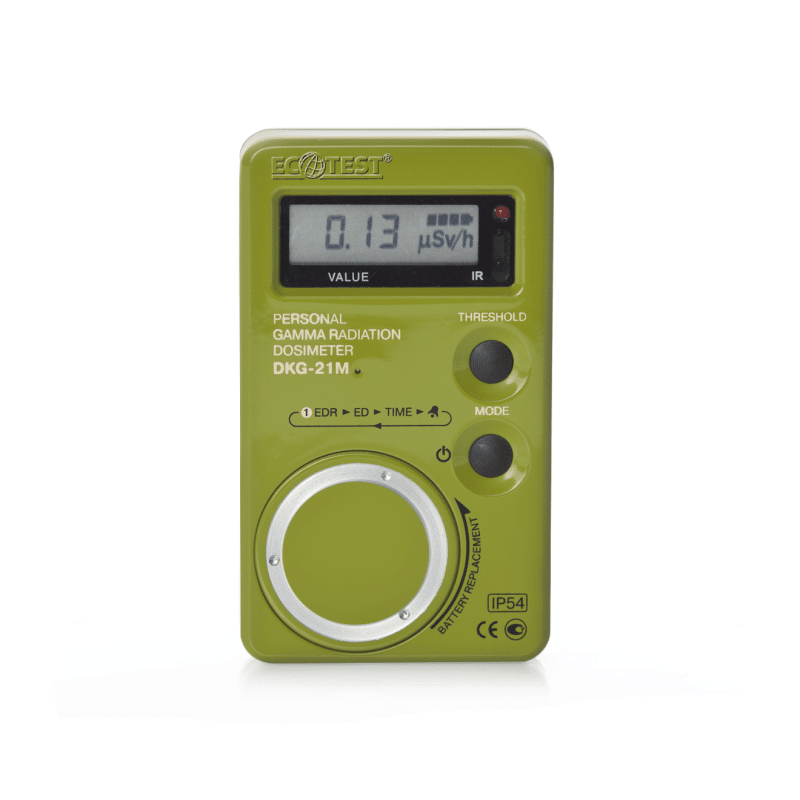
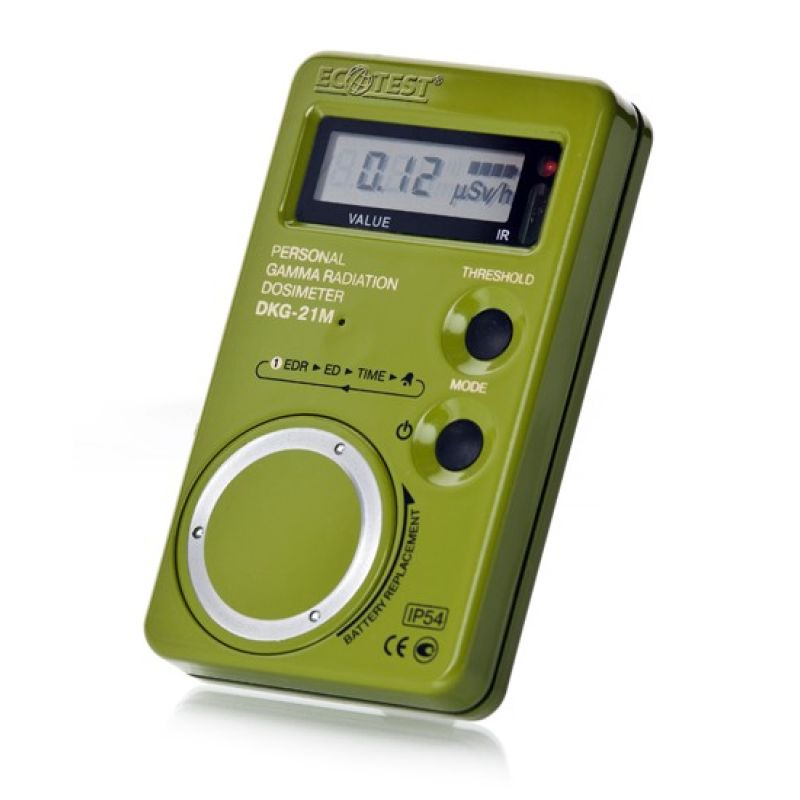
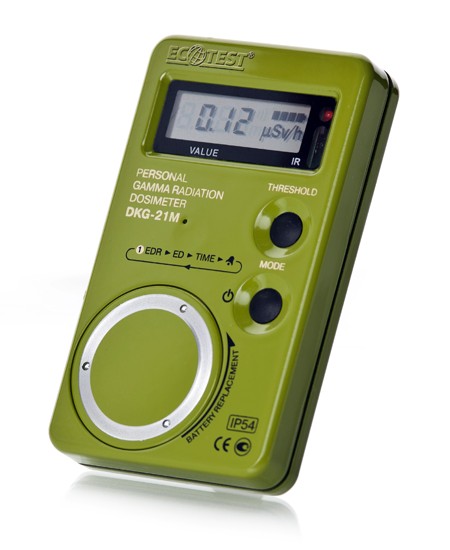
Ecotest DKG-21M Dosimeter
Delivery and payment
Choose your city or town to see the price with delivery there and when you can get it.
Pickup points
- Branch
- Parcel locker
Pros
- Wide range up to 1 Sv/h
- Dose history memory
- IP54 protection against dust and splashes
- Threshold alerts with audio and LED
- Very long battery life
Cons
- Does not measure alpha/beta radiation
- IR adapter required for PC connection
- Slow to average readings at background levels
DKG-21M: a “personal” dosimeter without the drama
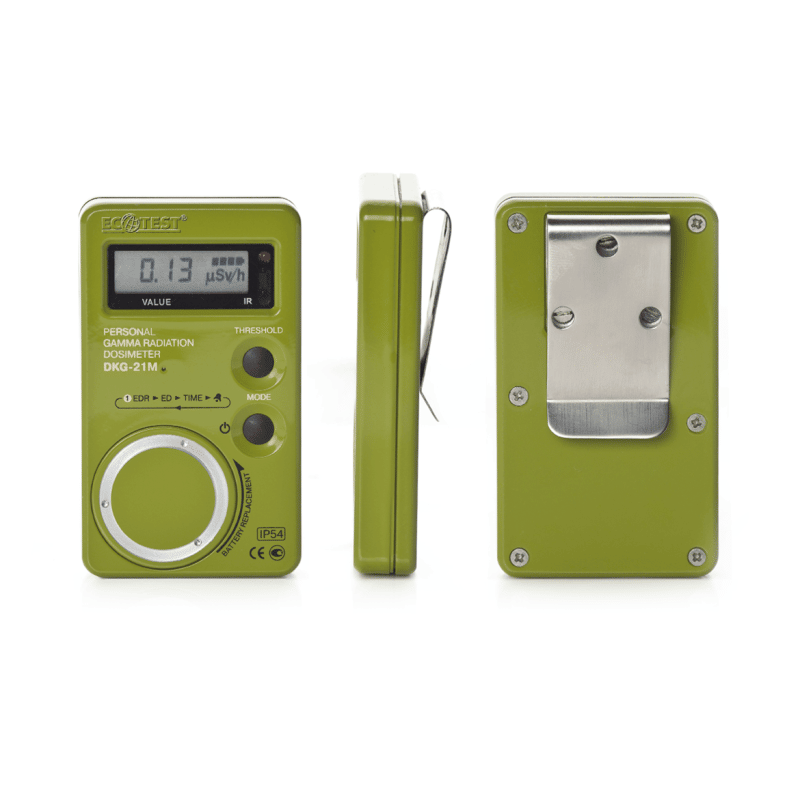
The DKG-21M (Ecotest) is a personal dosimeter for monitoring personal dose equivalent Hp(10) and dose rate from gamma and X-ray radiation. It is designed to be worn on clothing (a clip is included), used over work shifts, record dose accumulation history, and raise an alarm when a threshold is exceeded.
If you need a search instrument for hunting down hot spots that responds instantly like a counter in a sci-fi movie, that is a different category. The DKG-21M can also display background radiation, but it behaves more appropriately as a dosimeter: it averages and stabilizes readings rather than pretending to know everything in 1 second.
What it measures and in which units
The device has two key modes:
- Personal dose equivalent rate (DER) is measured in µSv/h, mSv/h, or Sv/h (what is commonly called “background radiation” or “dose rate”).
- Personal dose equivalent (DE) is the accumulated dose in mSv.
Use the MODE button to switch modes and the THRESHOLD button for thresholds and settings.
Ranges, accuracy, and reading behavior
DER: from 0.1 µSv/h to 1 Sv/h. DE: from 0.001 to 9 999 mSv. The photon detection energy range is 0.05…6 MeV (gamma + X-ray).
One important detail: at levels close to natural background radiation, the device takes longer to average readings (the display typically updates once every 10 seconds; for a more reliable estimate, the manufacturer recommends waiting a few minutes). As the radiation level rises, updates become much faster (down to a few seconds). It is not “lagging”; it is reducing statistical error where there are few pulses.
Alerts so you don't have to watch the screen every 10 seconds
The DKG-21M can provide visual and audible alerts when set thresholds are exceeded for both dose rate (DER) and accumulated dose (DE). When a threshold is triggered, you get a combination of an on-screen indication, a red LED, and a two-tone audible signal.
Thresholds can be programmed using the buttons or a PC (via the IR interface). The typical factory-set DER threshold is 1.0 µSv/h (it is easy to change to suit your procedures).
Sensor and reliability
Inside is an energy-compensated gas-discharge Geiger–Müller counter. This is a classic solution for personal dosimetry: compact, power-efficient, and capable of covering a wide dose rate range.
Worth knowing: this is not a spectrometer. It will not tell you which isotope is present or replace an instrument for identifying sources, but it reliably monitors dose and thresholds.
Housing, protection, and wear
The plastic housing has a clip for attaching the device to clothing. Its protection rating is IP54 (dust + splashes). The battery compartment has a sealed cover, and a screwdriver is included, so replacing the battery does not turn into a search for something to pry it open.
Memory, dose history, and PC operation
The DKG-21M can store dose accumulation history in nonvolatile memory. The history recording interval can be set from 5…255 min (linked to real time). Data can be transferred to a PC via the infrared port, but this requires an infrared port adapter (IRPA); the operating communication distance is approximately 0.1…0.3 m.
Official manufacturer resources: DKG-21M product page and manual (PDF).
Who it's for
- Personnel working with gamma/X-ray sources (manufacturing, laboratories, access control).
- Organizations that need to track personal doses and dose history.
- Users who want a compact dosimeter they can carry at all times, with thresholds and IP54 protection.
Who it's not for (or who needs a different class of instrument)
- Those who want to measure alpha/beta surface contamination.
- Those who need isotope identification (spectrometry).
- Those who plan to transfer data to a PC frequently but do not want a separate IR adapter.