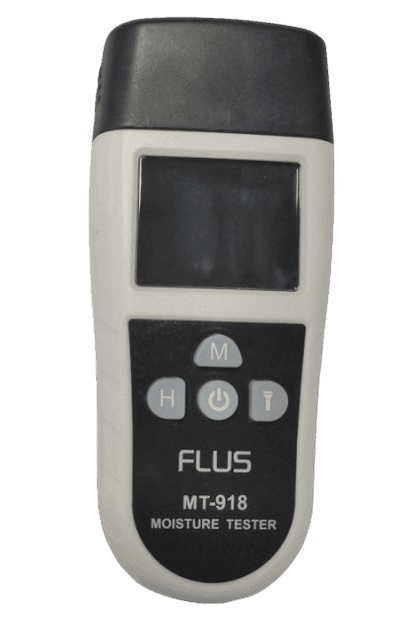
Flus MT-918
Delivery and payment
Choose your city or town to see the price with delivery there and when you can get it.
Pickup points
- Branch
- Parcel locker
Pros
- Measures moisture in wood and building materials
- Large color display
- Four calibration groups
- Thermometer and flashlight
- Compact body weighing 92 g
Cons
- Pins leave puncture marks
- Does not replace laboratory measurements
- Accuracy decreases on very wet wood
Flus MT-918: a quick answer to “is it dry yet?”
The Flus MT-918 is a compact pin-type moisture meter for wood and common building materials, including concrete, screed, plaster, gypsum and brick, as well as cardboard and paper. It is a practical tool for a carpenter, repair professional, firewood seller or homeowner who doesn't want to judge whether a material is ready by touch, smell or the age-old “looks about right” method.
The meter measures moisture by direct contact: two metal pins complete an electrical circuit through the material, and the meter estimates moisture from its electrical conductivity. The result appears immediately, so you can check several boards, logs or areas of screed in succession without complicated preparation.
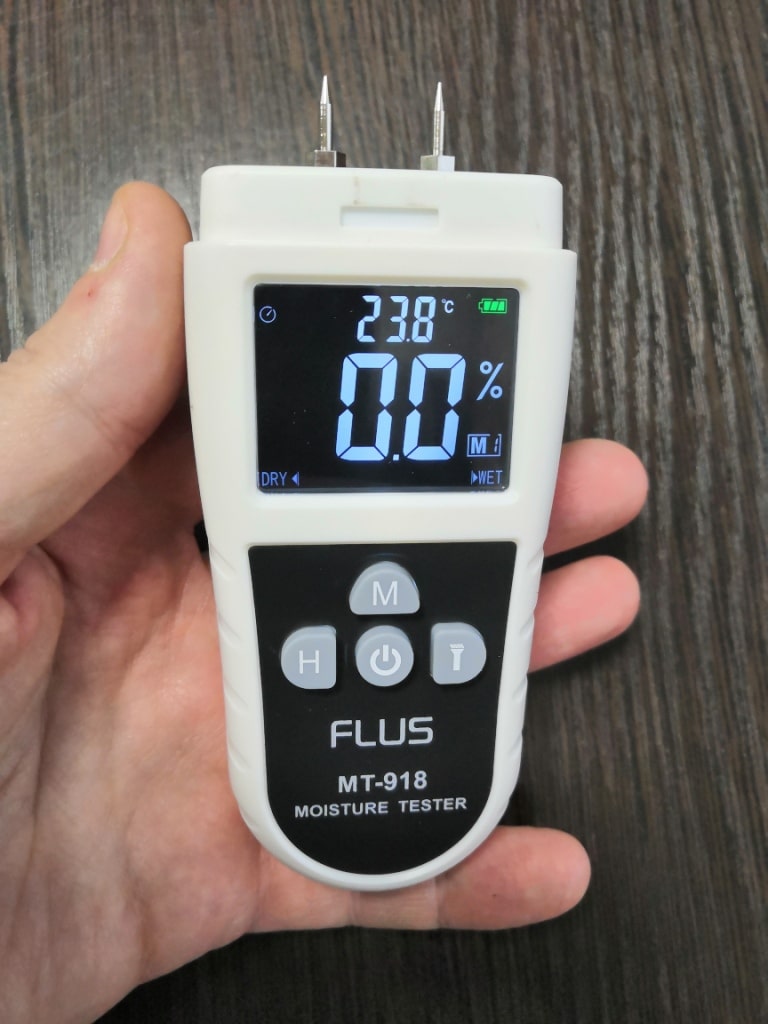
The right mode for wood, firewood and building materials
Three material groups are available for wood, accounting for differences in density between species. The fourth group is intended for building materials. Use the M button to switch between them; the active mode appears on the screen as M1, M2, M3 or M4.
The range is 5–70% for wood and 0.1–2.4% for building materials. This is sufficient for checking dry boards, lumber before processing, furniture blanks, firewood or the moisture level of a substrate before finishing. At the same time, the MT-918 should be treated as a tool for quick checks: official acceptance of a concrete substrate or critical technical work may require prescribed measurement methods.
A screen that's easy to read
The color display is large and high-contrast: the moisture value appears in the center, air temperature and battery level at the top, and the selected material mode alongside. A DRY/WET scale at the bottom helps you quickly assess the result without constantly comparing the reading to a reference value.
In wood modes, the green zone covers values up to 22%, yellow covers 22.1–51%, and red covers values above 51%. The thresholds are lower for building materials: green is up to 0.8%, yellow is 0.9–2.0%, and red is above 2.0%. This is a useful guide, but the final assessment should always take the specific material and planned work into account.
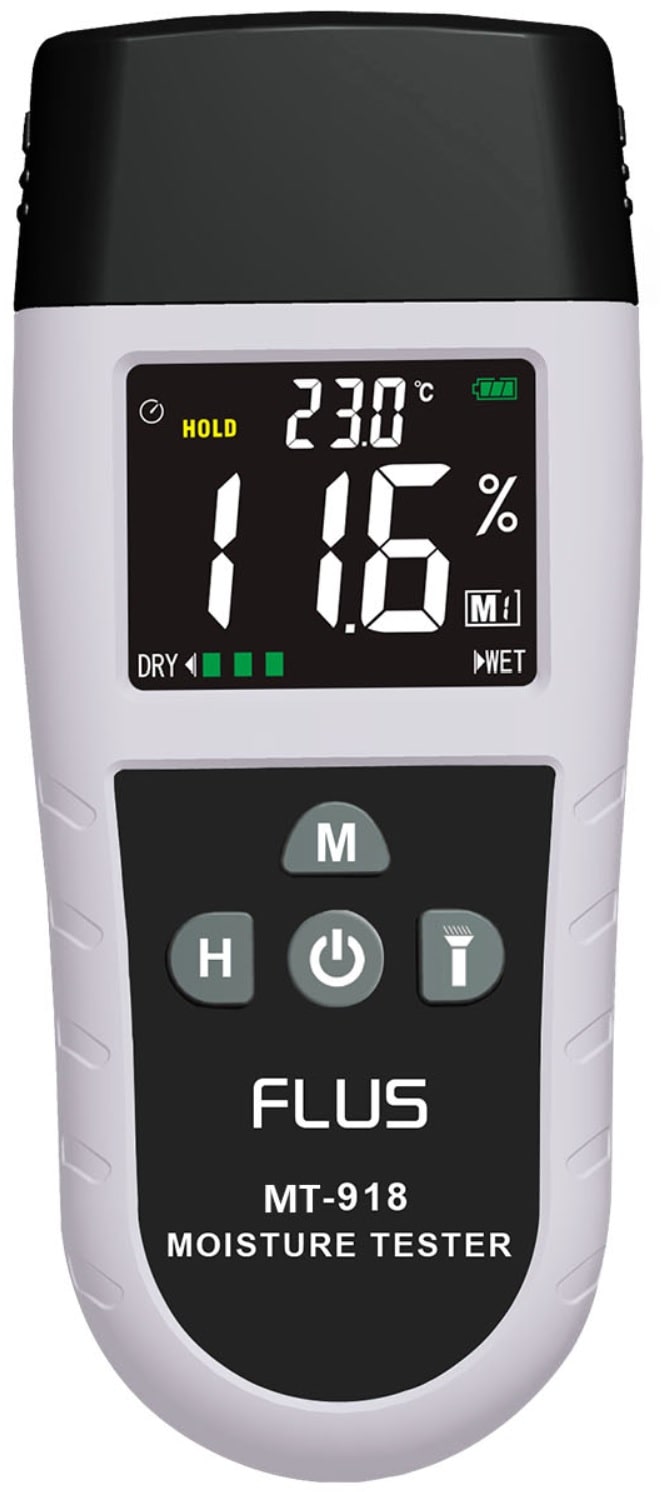
More than moisture: temperature, HOLD and illumination
The MT-918 also displays air temperature from -20 to 70°C; you can switch between °C and °F. The HOLD button freezes the reading on the screen, which is useful when you have to press the meter against a surface in an awkward spot. The maximum value can also be displayed.
An LED flashlight is mounted above the pins. It won't turn the meter into a searchlight for basement adventures, but it illuminates the measurement spot well in a storage room, attic, workshop or next to a dark wall.
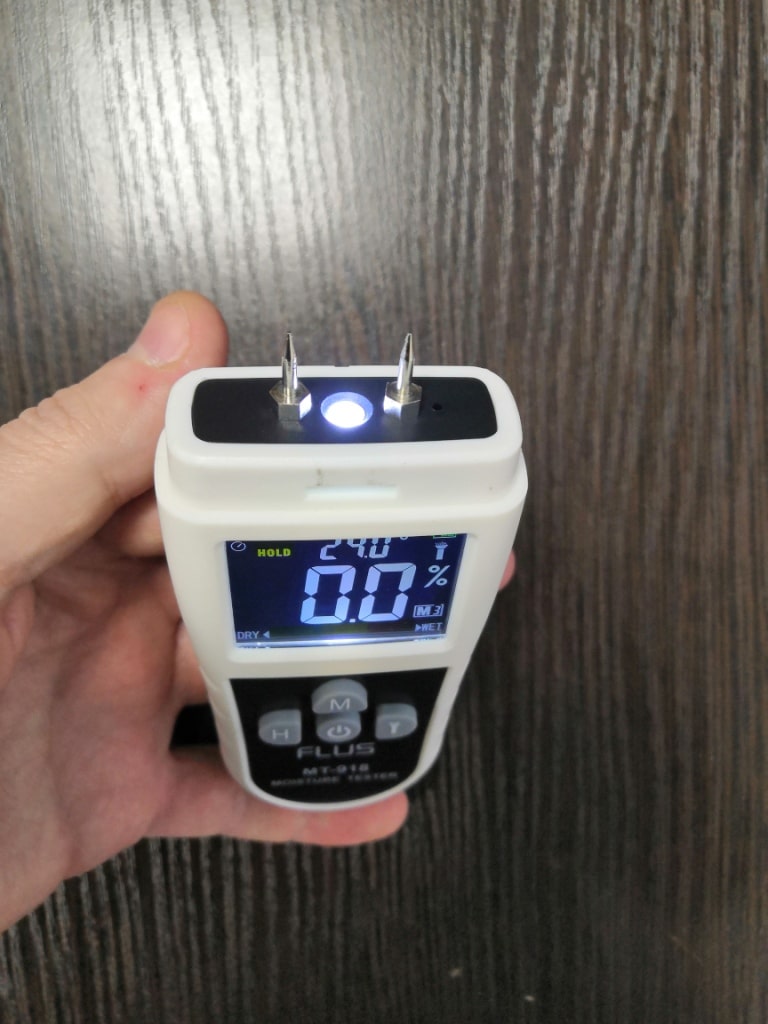
A compact tool for regular checks
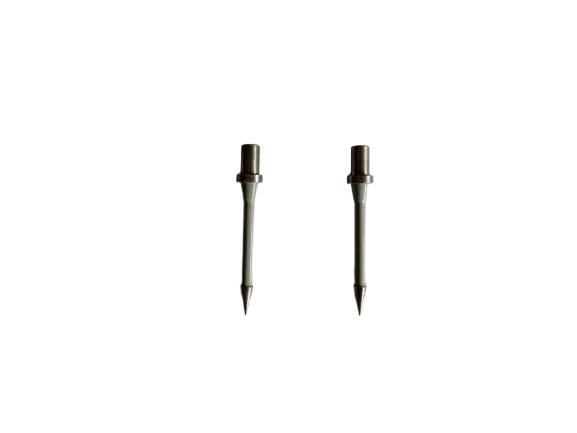
About 13 cm long and weighing 92 g, the meter fits easily into a workwear pocket or tool bag. A protective cap covers the sharp electrodes during transport, and the pins can be replaced. Two AAA batteries provide power, while automatic shutoff after 2 minutes of inactivity helps prevent them from draining if you forget to turn the meter off.
For a reliable result, measure at several points across the face of a board rather than at its edge; avoid touching metal fasteners, knots or a surface wet from rain with the pins. For wood, it is also important to select the appropriate material group. The meter gives you a number instantly, but choosing the right measurement point is what makes that number useful.
Conclusion
The Flus MT-918 is a capable pocket moisture meter for quick checks of wood and building materials. Its strengths include an easy-to-read color screen, modes for different materials, a thermometer, a flashlight and straightforward operation using readily available AAA batteries. It is especially useful for checking firewood, boards, blanks, pallets and the condition of building surfaces when a quick decision matters more than a laboratory protocol.