FNIRSI GC-01 Original
Delivery and payment
Choose your city or town to see the price with delivery there and when you can get it.
Pickup points
- Branch
- Parcel locker
Pros
- Sensitive energy-compensated GM tube
- Measures γ, X-ray and β radiation
- Graph, maximum, average and accumulated dose
- Visual, audible and vibration alarms
- 1100 mAh battery, Type-C charging
Cons
- Does not identify radionuclides
- Stated error of up to ±30%
- Menu available only in English or Chinese
A compact Geiger counter without the fuss
The FNIRSI GC-01 Original is a portable ionizing radiation detector for those who want to see numbers rather than guess based on alarming news or the color of a stone at a flea market. Inside is an energy-compensated Geiger-Muller tube that detects γ radiation, X-rays and β particles. The device displays the current equivalent dose rate, calculates the accumulated dose and alerts you when a set threshold is exceeded.
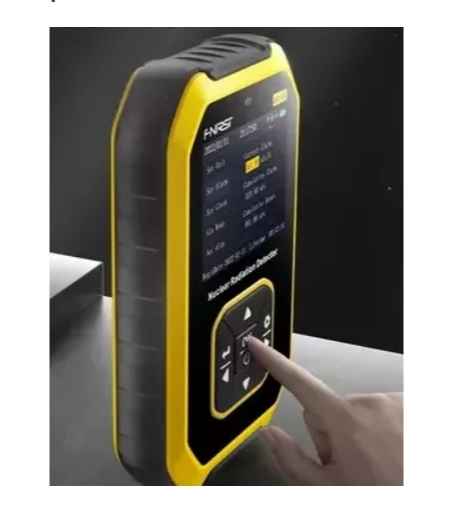
Measuring 120 × 78 × 27 mm, the device fits easily in a jacket pocket, backpack or toolbox. Large physical buttons are more convenient than touch controls when you need to change modes quickly without turning a measurement into a mini quest.

What the GC-01 measures
The device operates over an energy range of 48 keV–1.5 MeV, with a stated sensitivity of 80 CPM/µSv for cobalt-60. It measures dose rates from 0.00 to 10 000 µSv/h and accumulated doses from 0.00 µSv to 500.0 mSv. Units can be switched between µSv/h, µGy/h, mR/h, CPS and CPM.
In practice, the FNIRSI GC-01 is useful for monitoring natural background radiation and checking minerals, old ceramics, metal finds, building materials or objects with an unknown history. It is good at answering the question “Is there a noticeable deviation from background radiation here?” but it does not identify the isotope, show the composition of the radiation or replace laboratory analysis.
Screen: more than just the current reading
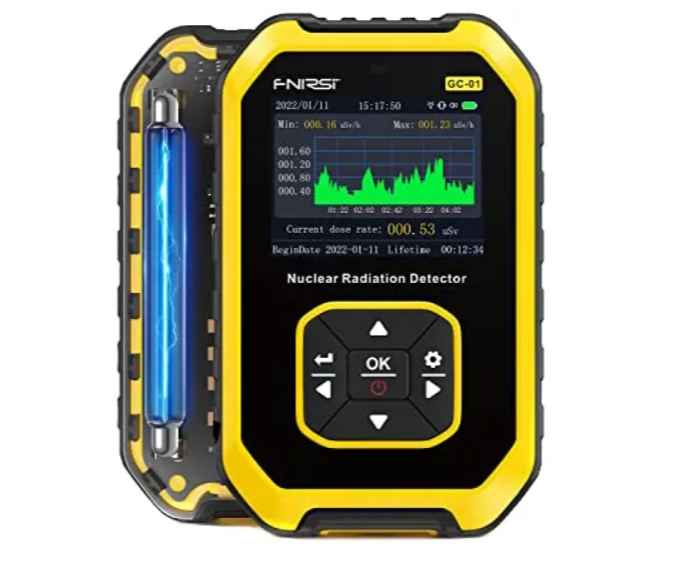
The main screen displays the current dose rate, average and maximum values, the set alarm threshold and the accumulated dose. A separate graph page lets you track readings over time and see minimum and maximum values. This is more useful than a single number on the display: natural background radiation fluctuates, so it is worth giving the device some time for the readings to stabilize.
There is also a real-time clock, and data is saved after the device is turned off. The interface can be switched between English and Chinese. There is no Ukrainian localization, but the labels and menu structure are fairly straightforward.

Alarms you can adjust to the situation
Separate thresholds can be set for dose rate and accumulated dose. When a value exceeds the set limit, the GC-01 can provide visual, audible and vibration alerts. Each can be turned on or off independently: for example, you can leave only vibration on for discreet monitoring or enable all alert types when working in a noisy room.
An important point: the number on the screen is not a verdict and should not be read without context. When comparing objects, keep the same distance from each one, measure for long enough and first note the local background level. If a reading rises sharply, do not try to “check even closer”: increase your distance, limit contact and contact the appropriate authorities.
Battery and operating conditions
The FNIRSI GC-01 has a 1100 mAh lithium rechargeable battery and charges via Type-C. A cable, manual and storage box are included. The device is designed to operate at temperatures from −5 to +40 °C and relative humidity up to 80%.
This is not a water-resistant field dosimeter: the manufacturer advises against using it in rain or fog, and recommends protecting it from strong impacts and storing it in a dry place. Its capabilities are sufficient for household monitoring, mineral collecting and checking interesting finds; regulated measurements require professional calibrated equipment.
Conclusion
The FNIRSI GC-01 Original is a solid basic Geiger counter for personal background radiation monitoring. It is compact and easy to understand, displays not only the current reading but also statistics and a graph, and offers accumulated dose tracking and flexible alarms. It is best chosen as a practical indicator and search tool, not as a device for identifying radionuclides or making a final determination about the safety of objects or food.