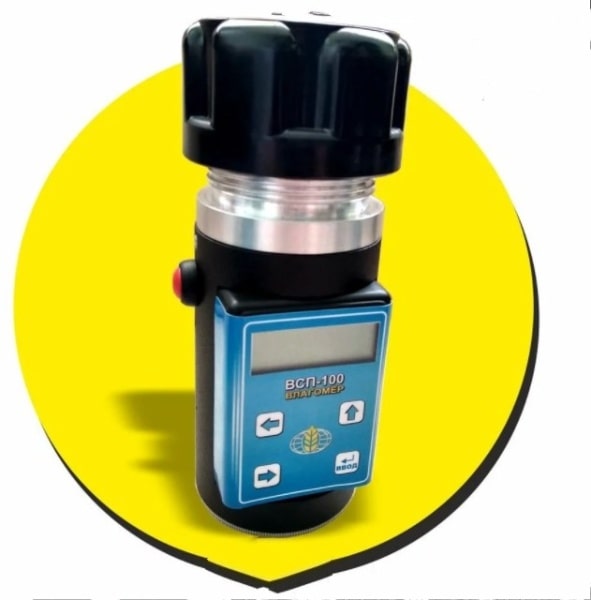
Agrolix VSP-100 Grain Moisture Meter (Wile-55 equivalent)
Delivery and payment
Choose your city or town to see the price with delivery there and when you can get it.
Pickup points
- Branch
- Parcel locker
Pros
- Quick moisture checks in the field
- No grinding needed for most crops
- 99 calibration channels
- Separate reading correction for each crop
- Runs on a standard 9V battery
Cons
- Does not replace laboratory oven-drying analysis
- Requires a clean, representative sample
- Menu labels are in Russian
VSP-100: a moisture meter that doesn't like to wait
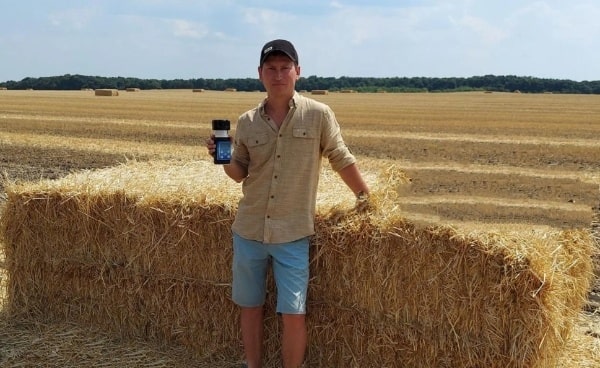
The VSP-100 is a portable chamber moisture meter for grain, seeds, and some other bulk materials. It's called a Wile-55 equivalent for good reason: it works on a similar principle. Pour a sample into the chamber, compress it with the press lid, select the crop, and get a moisture reading on the LCD. It's a practical tool for the field, threshing floor, grain storage facility, or truck bed when you need to decide on drying, storage, or shipment now, rather than after a visit to the lab.
The VSP-100's main strength isn't flashy design, but speed. It helps you quickly check wheat, barley, corn, sunflower, soy, peas, rapeseed, oats, rye, buckwheat, millet, and other crops. The device can also work with certain bulk products and materials, including flour, bran, starch, sawdust, seed hulls, and walnuts, provided the appropriate calibration is available.
How it measures moisture
The VSP-100 uses a capacitive sensor to assess changes in the material's dielectric properties: the more moisture the grain contains, the differently the sample behaves in an electric field. It sounds complicated, but for the user it's much simpler: select the crop and the device displays moisture as a percentage.
The measuring chamber's screw-on lid does more than keep grain from spilling. It compresses the sample to a specified density, reducing variation between measurements. Screw the lid down until the central metal screw is level with its surface; this is the correct position for measurement.
Easy operation
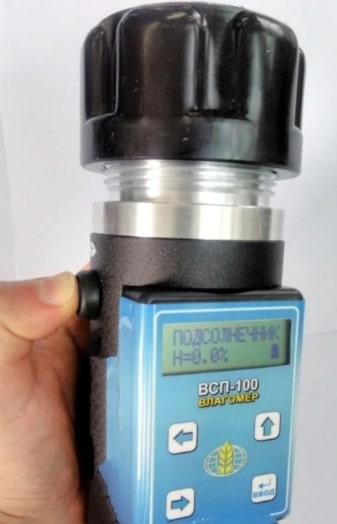
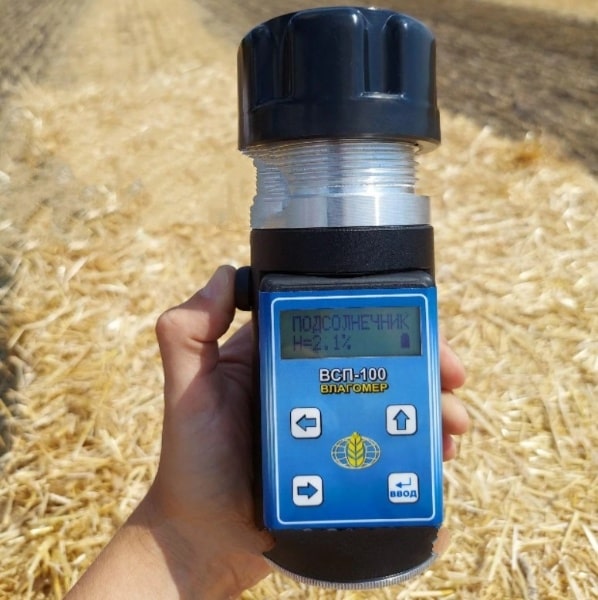
The process is straightforward even without pages of training: remove debris and straw from the sample, fill the chamber, screw on the press lid, turn on the device, use the arrows to select the crop, and confirm with the Ввод (Enter) button. The display shows the product name, moisture level, and battery status.
The calculation itself takes a few seconds, and the whole procedure takes less than a minute. For an important decision, it's best not to rely on a single measurement: test the same sample three times, refilling the chamber each time, and average the results. Grain isn't stamped out in a factory, so a small difference in how the kernels settle is perfectly normal.
Calibration: not just for standard grains
The VSP-100 has memory for 99 calibration channels. Some may contain standard settings for common crops, while free channels can be used for your own materials. The device lets you change calibration names, apply corrections to readings, and create a new calibration curve using several reference samples with known moisture levels.
The correction is saved separately for each channel, so adjusting sunflower readings won't affect wheat or soy. This is useful when a particular variety, particle size, or storage condition causes a consistent deviation from a reference laboratory analysis. But it's important to understand the limits: custom calibration should be based only on reliable laboratory values, not on what you think the reading ought to be.
Temperature, sample cleanliness, and real-world accuracy
The VSP-100 has temperature compensation, but it can't override the laws of physics. Grain that is too hot or cold can gain or lose surface moisture as it cools or warms, and condensation in the chamber can noticeably inflate the reading. The most consistent results are obtained when both the grain and the device are close to normal room temperature.
The device is intended for quick checks, not as a replacement for a laboratory drying oven. Its specified error is up to ±0.8%, so before selling a large batch, adjusting a dryer, or resolving a dispute, the result should be checked against a reference method. For regular field monitoring, however, the VSP-100 provides exactly what's needed: a quick indication of whether the grain is ready for storage.
Who it's for
The VSP-100 is a good choice for farmers, agronomists, grain elevators, or small processing operations that need to check moisture frequently in different locations. The device is compact, runs on a 9V battery, and requires no outlet, smartphone, or internet connection. It's a dependable working tool: not particularly glamorous, but ready to go out into the field with you.