BSI GWD Liquid Nitrogen-Cooled Gamma Spectrometer
Delivery and payment
Choose your city or town to see the price with delivery there and when you can get it.
Pickup points
- Branch
- Parcel locker
Pros
- Near 4π measurement geometry
- High efficiency for small samples
- Range starting at 20 keV
- Thin detector dead layer
- High-voltage protection when the detector warms up
Cons
- Requires regular nitrogen refills
- Suitable only for small samples
- Shielding and MCA are selected separately
GWD: when the sample needs to be inside the detector
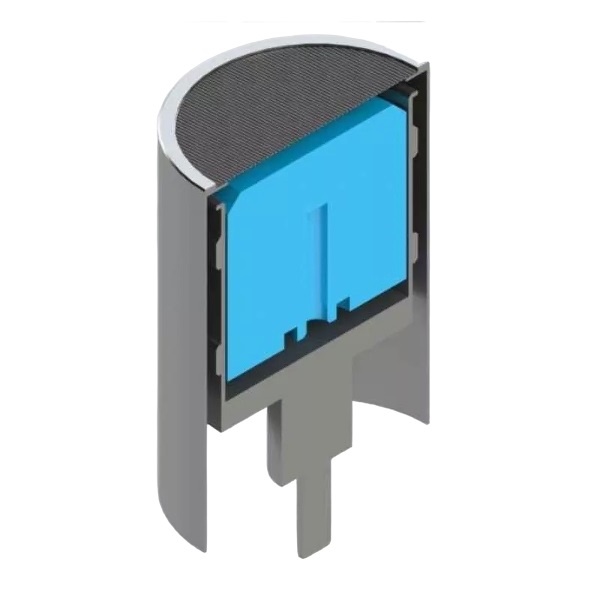
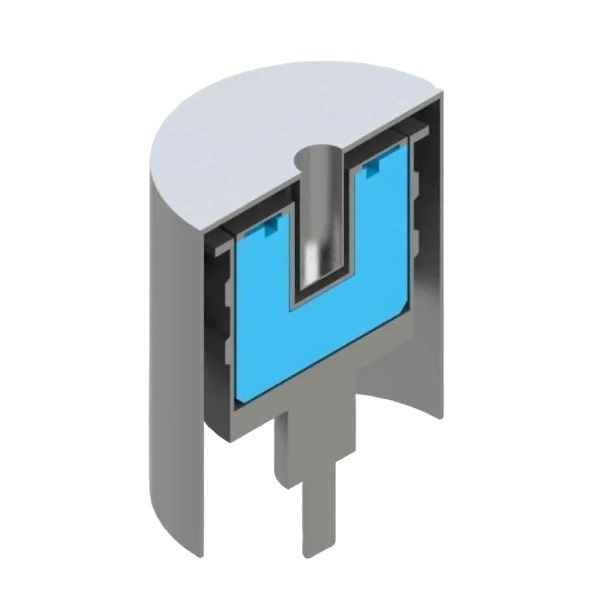
GWD is a series of gamma spectrometry systems based on a liquid-nitrogen-cooled well-type HPGe detector. Its defining feature is an aluminum well that holds a small sample. Unlike a conventional coaxial detector, where the sample sits in front of the crystal face, here the sensitive germanium surrounds it on almost all sides.
This makes GWD especially effective for small volumes of material: water, soil and food samples, biological specimens, radiopharmaceuticals and other materials where extracting the maximum information from every gamma photon matters. This is not a device for a quick check of whether something is radioactive; it is a laboratory instrument for precise qualitative and quantitative radionuclide analysis.

Nearly complete sample coverage
The well geometry provides a measurement configuration close to 4π: gamma radiation from the sample is detected from more than one direction. This gives GWD a significant efficiency advantage over conventional coaxial HPGe solutions when analyzing small samples.
The crystal's thin dead layer reduces losses of low-energy gamma photons, while the operating energy range from 20 keV to 10 MeV covers a broad spectrum of practical applications. From environmental monitoring and materials control to nuclear power, scientific research and nuclear medicine, GWD is designed for applications where a compromise between sensitivity and resolution is undesirable.
Germanium likes the cold, very cold
The HPGe crystal operates only at cryogenic temperatures, so GWD uses liquid nitrogen cooling. The system consists of a detector, a cryostat and a Dewar vessel or another compatible cooling configuration. Liquid nitrogen is not a decorative detail or an excuse to put on a vapor show in the lab: it is essential for stable, low-noise operation of the germanium detector.
The series has high-voltage power supply protection when the detector warms up. This is an important safeguard for an expensive, sensitive component, but it does not replace basic good practice: monitoring the nitrogen level, maintaining proper cooling and ensuring that personnel know how to handle cryogenic liquids.


Choose the configuration for the sample, not the other way around
GWD is available in several versions with different well diameters, nominal germanium crystal volumes and energy resolution specifications. The series offers wells with diameters of 10 or 16 mm, so before ordering, it is important to determine the container type, sample geometry, activity required for measurement and calibration method.
GWD models offer relative efficiency from 15 % to 70 % and higher. The energy resolution of a specific version depends on the crystal parameters, which is why the model number matters more than the color of the stripe on the housing. Choose the system with a specialist who understands your sources, background conditions and detection limit requirements.

What the system includes and what you can add
The basic configuration includes a well-type HPGe detector, an SHP preamplifier with a cooled input stage, a cryostat, a cooling system and a cable set. To build a complete measurement system, a multichannel analyzer (MCA), GammaPRO software or the advanced MCC-MT package, and lead shielding are available.
Shielding for GWD is more than just a useful accessory. At low activities, external background radiation often determines how convincing the result will be. The detector, analyzer, software, measurement container, calibration and background shielding should therefore be considered as one system, not as a collection of random expensive boxes.
Conclusion
GWD is a specialized well-type HPGe detector for laboratories that need high efficiency in detecting gamma radiation from small samples. Its strengths include nearly complete sample coverage, a wide energy range, high resolution and flexible cryostat configurations. In return, it requires liquid nitrogen, well-planned infrastructure and a properly selected method. For serious gamma spectrometry, that is not a drawback but the usual price of precision.