WALCOM LX-1010BS 100,000 Lux Light Meter with External Sensor
Delivery and payment
Choose your city or town to see the price with delivery there and when you can get it.
Pickup points
- Branch
- Parcel locker
Pros
- Remote sensor on a cable
- Up to 100 000 lux
- Large, easy-to-read display
- Manual ranges x1/x10/x100
- HOLD to freeze the reading
Cons
- No auto-ranging
- No PC connectivity
- Lux ≠ PPFD for plants
WALCOM LX-1010BS Light Meter: reaches light where others give up
The WALCOM LX-1010BS is a portable light meter with a remote sensor that measures illuminance in lux (lx) across three ranges up to 100 000 lx. It can handle everything from 300–700 lx in an office to very bright lamps, daylight near a window, and even direct sunlight (yes, that's close to 100 000).
Its philosophy is simple: minimal menus, maximum practicality. With two switches, a large screen, and a remote sensor, you can quickly collect readings for a workplace safety report or adjust the lighting in your workshop.

Remote sensor: why it's more convenient than a built-in one
A light meter with a built-in sensor has one tricky problem: to point the sensor at a light fixture, you often have to turn the entire unit along with the display. And, as luck would have it, the display ends up at an angle, catching glare or simply becoming unreadable.
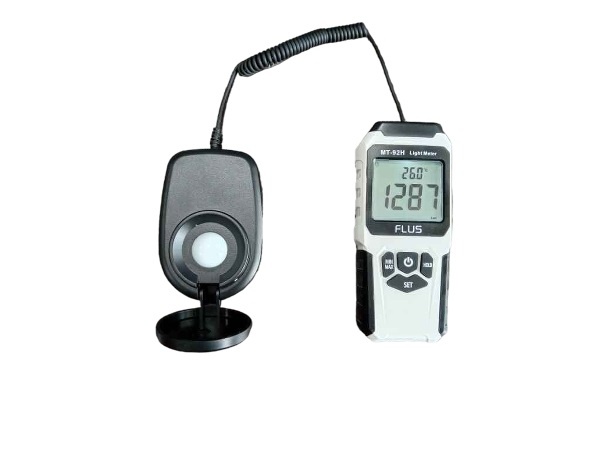
The LX-1010BS sensor is attached by a coiled cable. You can place the sensor wherever you need to measure while holding the main unit in a comfortable position. This is especially useful for:
Taking measurements near the ceiling (light fixtures and spotlights);
Measuring in tight spaces (cabinets, alcoves, and warehouse shelving);
Taking measurements at multiple points when it's important not to move the display or main unit unnecessarily.

2 000 / 20 000 / 100 000 lx ranges: how to read the results
The unit has a three-position range switch: 2000 / 20000 / 100000. The principle is simple: the lower the range, the finer the increments and the more useful the readings.
The key rule is to choose the lowest range that does not show an overrange indication. If one appears on the screen, switch to a higher range.
One more practical detail: on the higher ranges, a multiplier (x10 or x100) may appear on the display. This is not an instrument error; it indicates that the reading must be interpreted with the selected range in mind.
Accuracy, spectral response, and an honest caveat about lux
The LX-1010BS is a photometric instrument: it tries to “see the world” much like the human eye does (the CIE photopic curve, V(λ)). That's exactly what's needed to check lighting in workplaces, classrooms, hallways, warehouses, and production areas.
But if you're measuring LED grow lights for plants, remember that lux is not the same as PPFD/μmol·m²·s. For plants, a light meter can be useful for comparing whether things have improved or worsened, but it cannot replace a quantum PAR meter when you need agronomically accurate data.
How to get reliable measurements: 7 quick tips
- Remove the sensor cap (seriously).
- Keep the sensor level and facing upward.
- Don't shade the sensor with your hand or the unit.
- Start with a lower range.
- Allow 1–2 s for the reading to stabilize.
- For a report, measure several points and calculate the average.
- Wipe the white diffuser periodically.
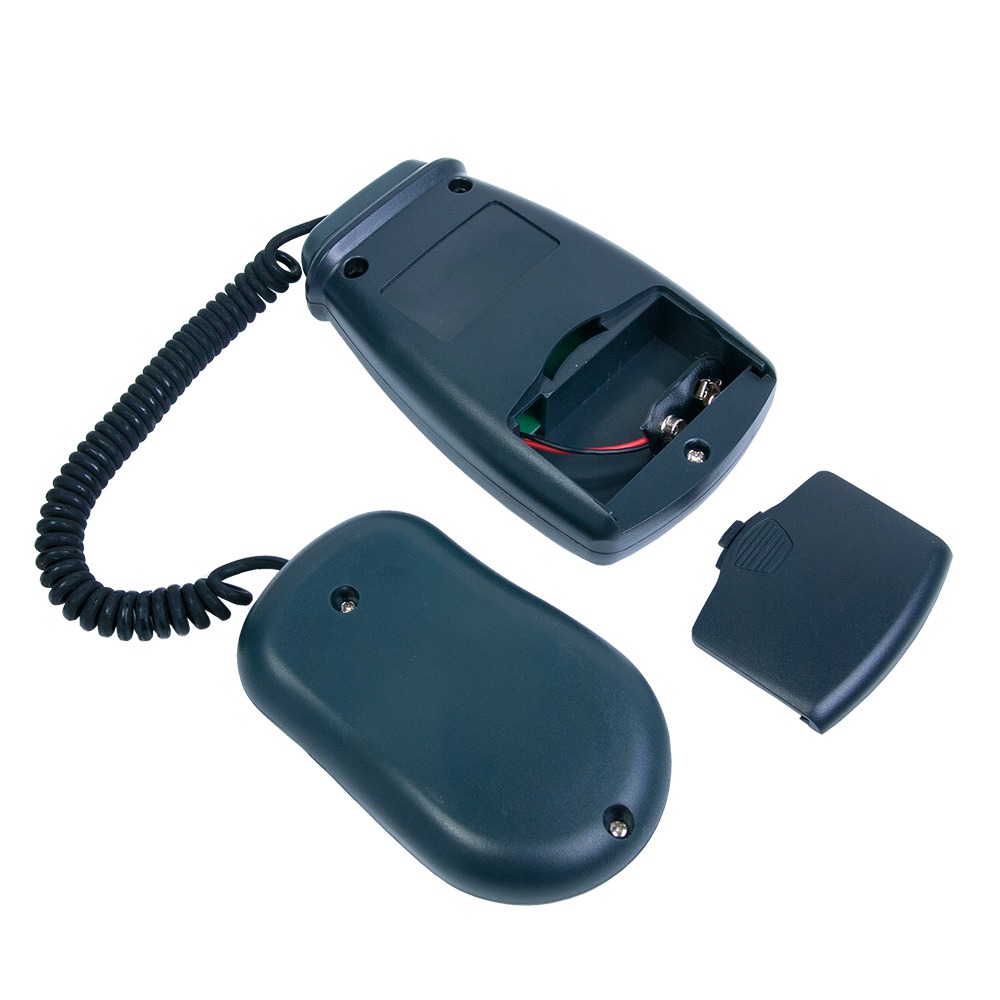
What's included, storage, and what's in the photos
The box usually contains the meter with its remote sensor, a manual, and a protective sensor cap. The cap is a useful detail: it's best to protect the sensor's white diffuser from dust and scratches, as these directly affect the repeatability of readings.


Who is the WALCOM LX-1010BS for?
This is a good choice if you need a practical, affordable light meter for everyday use: workplace safety and lighting compliance checks, adjusting lighting in a workshop, garage, or office, basic illuminance checks for photography and video, or home experiments with light without paying extra for features you'll use once a year.
If you want automatic range selection, measurement memory, Bluetooth/USB, and graphs, that's a different class of device (and a different budget). This one focuses on simplicity, speed, and a remote sensor.
The datasheet (brief technical specifications) is available as a PDF: LX-1010BS Portable Digital Light Meter (PDF).