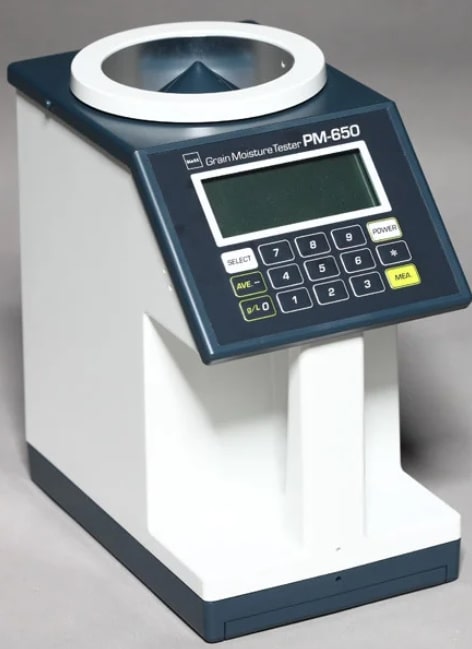
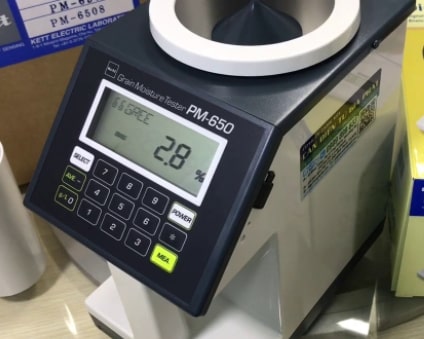
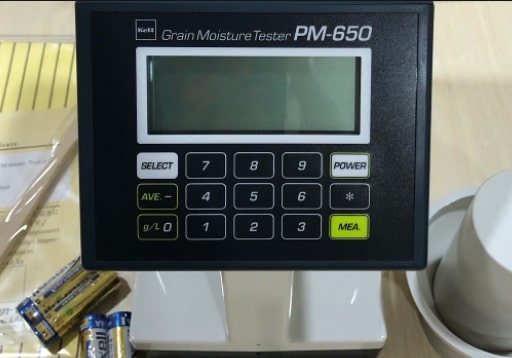
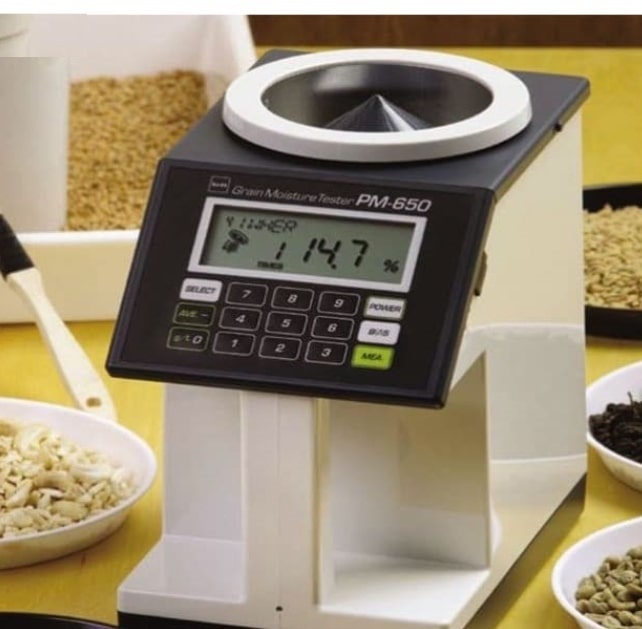
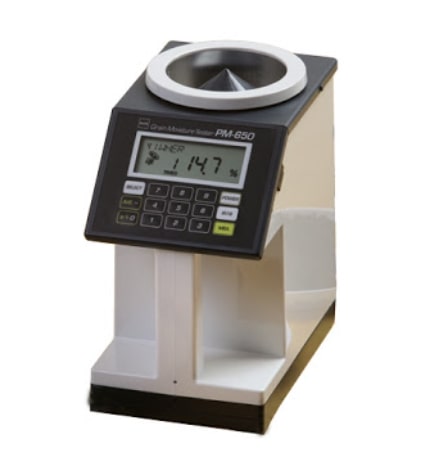
KETT PM-650 Grain Moisture Meter
Delivery and payment
Choose your city or town to see the price with delivery there and when you can get it.
Pickup points
- Branch
- Parcel locker
Pros
- Moisture and test weight in one device
- Simply pour in the sample
- Automatic weight and temperature compensation
- Up to ~150 crop calibrations
- RS-232C for a PC or printer
Cons
- Requires a level, stable surface
- Powered by AA batteries, not a rechargeable battery
- Crop list depends on the version
What is the KETT PM-650 and who is it for?
The KETT PM-650 is a benchtop (but readily portable) grain and seed moisture meter that also calculates test weight (bulk density). It delivers quick, repeatable results without a laboratory drying oven when decisions need to be made now: receiving grain at an elevator, checking batches in storage, testing before drying or shipping, or working in a seed processing facility.
What sets the PM-650 apart is that it does more than display moisture %: it accounts for two things that often cause problems for capacitive moisture meters, namely differences in fill density and sample temperature. Both are handled automatically.

How it measures moisture and test weight, in plain English
The PM-650 uses a high-frequency capacitive (dielectric) method: it reads the electrical properties of a fixed-volume sample and converts them into a moisture reading using built-in calibration curves for the specific crop.
The sample has a fixed volume of 240 ml. The meter then:
— weighs the sample on its built-in scale to compensate for differences in density/bulk density;
— measures the temperature with a thermistor for temperature compensation;
— displays moisture in % and, when needed, bulk density (test weight) in g/L (kg/hL is also used in some settings or interpretations).
Test weight is calculated simply: sample weight / 240 ml. For a quick conversion, kg/hL = (g/L) / 10 (for example, 760 g/L ≈ 76 kg/hL).
How to measure correctly: a short, no-magic protocol
1) Stability. Place the meter on a level, firm surface. This matters because it has a scale inside, and vibration or tilting means additional errors.
2) Select the crop. Select the product/crop number from the “Product list” (the list depends on the meter version).
3) Measure out the sample. Pour it into the funnel above the measuring cup/hopper to about 1/3 of its depth. Remove the funnel to clear away excess material and level the sample. Important: do not scoop the sample directly with the hopper without the funnel, as this is more likely to result in inconsistent fill density.
4) Start the measurement. Press MEA. The meter tares itself (at this point, do not move the meter).
5) Pour in the sample. When “sample in” appears, pour the sample evenly into the center of the measuring chamber, usually over 5–6 seconds. The sample should form an even layer.
6) Result. After a few seconds, you will get a moisture reading. Press the bulk density display key to see the test weight in g/L.
7) Empty the sample. When “sample out” appears, empty the sample and prepare for the next measurement.
Practical tip: take 2–5 measurements from different subsamples and look at the average. This helps account for variation within the batch rather than leaving you wondering about the meter.
Accuracy: what the numbers mean and what affects the result
The stated moisture accuracy is a standard error of ≤0.5% relative to the oven-drying method for samples with moisture content up to 20% (and it may vary by product/crop). At high moisture levels, the variation between individual kernels is usually greater, so the best strategy is not to rely on a single reading but to take a series and use the average (the AVG function calculates the average for 2–9 tests).
Two more important factors for real-world accuracy:
— sample temperature: the meter compensates for it, but if grain has come in from freezing conditions or straight from a hot dryer, give it at least some time to stabilize;
— representativeness: collect the sample properly, rather than taking it from the top of the bag just because it is closer.
Calibrations and crops: not all PM-650 versions are the same
The PM-650 is a series with different versions, each with its own set of crop calibrations. In general, the meter can be equipped with up to approximately 150 applications (curves). Grain versions typically cover wheat, corn, soybeans, barley, rye, oats, sorghum, rapeseed/canola, sunflower, rice/paddy, as well as certain legumes, seeds, nuts, coffee, flour, fish meal and more.
Before buying, take a moment to check that your configuration includes the specific crops and moisture ranges you work with every day.
Data, printer and PC: when you need a record of measurements
The PM-650 has RS-232C for outputting data to a PC or an optional thermal printer. This is useful for monitoring, logging, receiving records, or simply avoiding the need to copy readings from a screen into a notebook in the rain.
Official product page with links to brochures, manuals and software: KETT PM-650 (official).
Power and operation
The meter is powered by 4 AA batteries. It automatically shuts off after approximately 3 minutes of inactivity (this can be disabled when working with a logger or PC). The meter's operating temperature range is 0–40 °C.
If you regularly measure test weight and want to keep the internal scale in good shape, a useful option is a standard 200 g weight for checking weighing accuracy before use.
Conclusion
The KETT PM-650 is a fast tool for on-site grain quality control. It has an advantage over simpler moisture meters because it provides both moisture and test weight readings while automatically compensating for weight and temperature. If you make decisions about drying, storage or batch pricing, this is the kind of instrument that can pay for itself not someday, but the moment it helps you avoid an error of a few percentage points in moisture content.