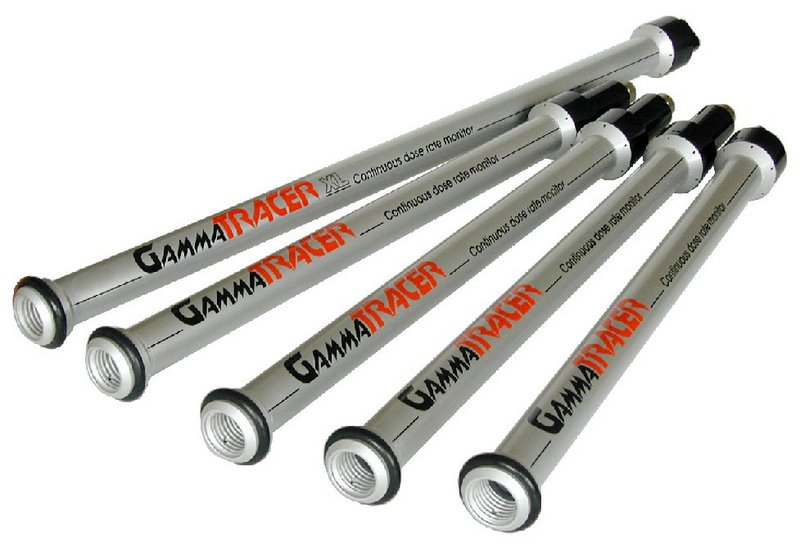
Ecotest BDBG-15S Gamma Radiation Detection Unit
Pros
- Up to 1 Sv/h (-09/-23 versions)
- CsI(Tl) scintillator + spectrum
- Metal housing, IP65
- RS-485, sensor addressing
- 7–32 V power supply
Cons
- Requires a controller/indicator
- Integration requires firmware
- No screen or buttons
BDBG-15S: what it is and why you need it
The BDBG-15S is not a household dosimeter for checking mushrooms. It is an intelligent gamma radiation detection unit designed for integration into systems such as stationary radiation monitoring stations, mobile systems, robotic platforms, and UAVs. Inside are detector(s), a microcontroller, power conditioning circuits, a temperature sensor, and a digital interface that provides a ready-to-use DER (ambient dose equivalent rate) reading and, when needed, an amplitude spectrum.

Three versions: -09, -23, -90, with different strengths and applications
The BDBG-15S family comes in several versions that differ in scintillator volume, dimensions, and sensitivity:
- BDBG-15S-09 is the most compact and lightweight, for UAVs and light robotic platforms.
- BDBG-15S-23 is the middle ground, offering more sensitivity without excessive weight.
- BDBG-15S-90 offers maximum sensitivity at low dose rates (and has the largest dimensions).
An important detail: the -09/-23 versions typically use two channels: a highly sensitive scintillation channel for low levels and a low-sensitivity channel based on an energy-compensated Geiger-Muller tube to prevent readings from going off-scale at high levels. The -90 emphasizes the high sensitivity of its scintillation channel.
Measurement range and accuracy: the numbers
For the BDBG-15S-09/-23, the overall DER range reaches 1 Sv/h through the GM channel, while the scintillation channel covers the low dose rate range. For the BDBG-15S-90, the high-sensitivity measurement range extends to 150 µSv/h.
The error limit when calibrated with 137Cs is up to 15% (with a probability of 0.95). Energy dependence over the 0.05…1.25 MeV range is ±25%. The detectable gamma radiation energy range is 0.05…3.0 MeV.
“Intelligent” also means a spectrum (1024 channels)
The BDBG-15S can output an amplitude spectrum (1024 channels). This is useful when you need more than just a reading in µSv/h and want data for more advanced processing, from filtering interference and checking stability to building your own algorithms for recognizing or comparing spectral shapes (if your software supports it).
Connection and integration: RS-485 with no surprises (but with a protocol)
The unit communicates with external systems through a digital interface: RS-485 (and, in some versions, UART with 3.3 V levels). In a typical setup, your controller (or PC via a converter) polls the sensor and receives frames containing DER, temperature, and diagnostic data. The protocol supports addressing and broadcast requests, which is convenient when building a bus with several sensors.
RS-485 communication settings: half-duplex, 19200 bps, 8N1. There are requirements for pauses between bytes and frames, so it is not simply a matter of connecting it and forgetting about it, but there is nothing unusual for an embedded systems engineer.
Power, housing, and field use
The unit runs on an external regulated 7–32 V power supply and draws up to 30 mA (depending on the version and operating mode). Warm-up time is up to 1 min.
The metal housing is protected against dust and water, with an IP65 rating. A “+” mark on the base of the housing indicates the geometric center of the detector. It is a small detail, but useful when setting up repeatable measurement geometry, especially on a robot or drone.
Connection is made through a 4-pin circular HR10A-7R-4P connector (the matching cable connector is HR10A-7P-4S): RS-485 lines (A/B), power, and ground.
Who should choose the -09 or -23, and when to consider the -90
- UAVs / drones: the -09 is often chosen for its minimal weight and dimensions.
- Ground robot / vehicle / stationary installation: the -23 provides noticeably better sensitivity without a brick-sized housing.
- Maximum sensitivity at low levels needed: consider the -90, but keep its dimensions and weight in mind, as well as its different intended application.
Where to find primary sources
Description and summary specifications on the manufacturer's website: ECOTEST GROUP — BDBG-15S.
Official operating manual for the BDBG-15S-09 / BDBG-15S-23: Operating manual (PDF).
Manual for the BDBG-15S-90 (in Ukrainian): Operating manual (PDF).