DOSEman
Pros
- Personal radon dosimetry
- Fast response (fast mode)
- Runs for up to 12 days
- Single-button control
- Memory for long shifts
Cons
- Not for gamma or beta monitoring
- Data is read via an IR adapter
- Accurate readings take time
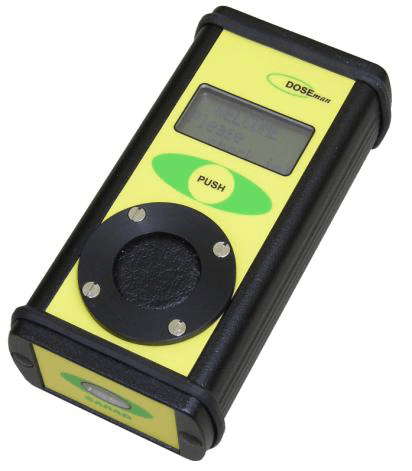
DOSEman is not a “radiation counter,” but a personal radon dosimeter
DOSEman (SARAD, Germany) is a personal radon exposure meter: a device worn on the body to assess radon exposure in real-world conditions (workplaces, basements, tunnels, industrial facilities, building inspections). Rather than measuring “outdoor background radiation,” it focuses on what matters for risk: radon and its short-lived decay products in the air.
If you are looking for a device to “measure Chernobyl in mushrooms,” this is not it. But if you need a realistic picture of what a person breathes in radon-hazard areas, that is exactly what DOSEman is for.
How it measures: alpha spectroscopy, electrostatics and radon “dust”
Inside is a high-voltage measurement chamber with a diffusion air inlet. Radon decay products formed in the chamber are electrostatically deposited on a semiconductor detector and then analyzed spectroscopically (alpha particles). This allows the device to respond quickly to changes and provide informative personal exposure data.
Modes and response speed: when you need “here and now” or accuracy
DOSEman offers fast and slow measurement modes (fast/slow). Fast mode is better at picking up sudden changes, while slow mode accumulates statistics more steadily.
Typical response time (to 95% of the final value) is 12 minutes in fast mode or 120 minutes in slow mode. This is normal physics for radon measurements: the shorter the window, the more noise; the longer the window, the more reliable the result.
What the screen shows and how to control it
The controls are designed for field use: one button, plus a lock to prevent accidental changes to a measurement while the device is in a pocket or on a belt. The backlit display has 3 lines of 12 characters and shows the mode/status, radon concentration, exposure time and calculated dose/exposure indicators (depending on settings).
Alerts and the “human factor”: don't miss a problem
The device has visual and audible alarms. The idea is simple: if concentrations become dangerous (according to your thresholds or those set for the project), the device can alert you immediately rather than “after the shift, when it's too late.”
Memory, data transfer and Radon Vision
DOSEman stores measurement history in nonvolatile memory (up to 720 records). A contactless infrared (IR) interface is used to read data and configure settings. In practice, this means you need an IR adapter (USB–IR) and a PC with Radon Vision software to work with the data.
Radon Vision is the manufacturer's software for transferring data, setting the measurement interval, viewing graphs and analyzing results. Official product page: Radon Vision on the SARAD website.
Battery life: 12 days away from an outlet is a strong advantage
The built-in Ni-MH rechargeable battery pack (based on 3 AA cells) provides up to approximately 12 days of continuous operation. A full charge takes about 2 hours. For personal wear and long shifts, this is one of its most practical advantages: you can issue the device and leave it running until the scheduled data readout.
Who will benefit most from DOSEman
DOSEman is most useful for personal exposure monitoring: employees at radon-hazard sites, basement and crawl space inspections, ventilation and radon mitigation work, and industrial and natural underground environments. It is also useful when actual changes throughout the workday matter more than a broad annual average.
What to know before buying
1) DOSEman is a specialized radon device; it does not replace a general-purpose gamma radiation dosimeter.
2) A reliable reading takes time to accumulate: do not expect laboratory accuracy in 2–3 minutes.
3) Phone integration is not via Bluetooth: data exchange uses IR and a PC with Radon Vision (a professional approach, but not the most convenient for casual users).