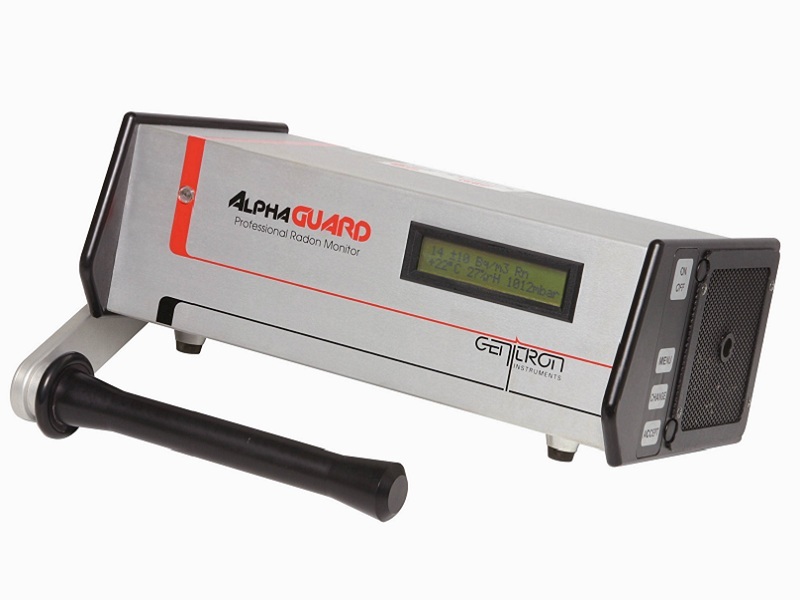
Saphymo AlphaGUARD PQ2000 Radon Monitor
Pros
- Reference-class instrument
- 2…2 000 000 Bq/m³
- Radon + T/RH/pressure
- Diffusion or pumped sampling
- Logging and DataEXPERT
Cons
- Expensive servicing and calibration
- 10/60 min cycle
- Rather heavy: 4.5 kg
AlphaGUARD PQ2000: when a “household” radon detector is no longer a laughing matter
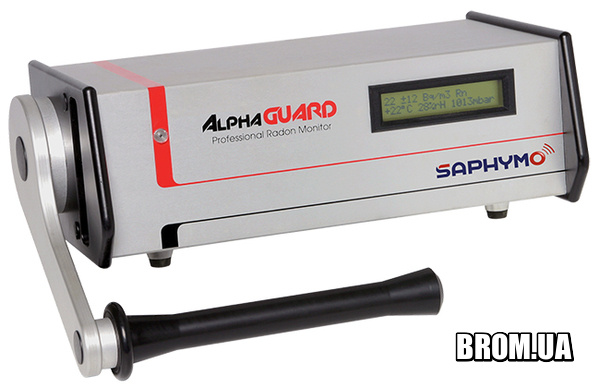
The AlphaGUARD PQ2000 is a professional multiparameter radon monitor based on a pulse ionization chamber. It's chosen not just to “show a number on a screen,” but for work that requires traceability, predictable measurement error, long measurement series and results you can explain in a report (rather than in YouTube comments).

How it measures radon and why it matters
Inside is an ionization chamber with an active volume of 0.56 L and a filter that blocks radon decay products. The instrument operates in two modes:
- Pulse mode at low concentrations (alpha spectrometry).
- Current mode at high concentrations, so it doesn't get overwhelmed by events.
In practice, this provides a very wide operating range and stable measurements at both residential levels and in laboratory or industrial settings.
Range, sensitivity, and error: the hard numbers that make all the difference
The key radon (Rn-222) specifications:
- Linear range: 2…2 000 000 Bq/m³ (metrology documents often specify measurements starting at 10 Bq/m³).
- Sensitivity: 1 count/min at 20 Bq/m³.
- Measurement error: ±15% (10…100 Bq/m³) and ±6% (100…2 000 000 Bq/m³).
- Intrinsic background: no more than 1 Bq/m³.
Now for “speed.” In its basic operation, the PQ2000 has an integration time of 10 or 60 min. That's not a drawback but an honest engineering choice: at low radon levels, statistics matter more than a “30-second response.”
Multiparameter monitoring: not a bonus, but part of the diagnosis
The PQ2000 also logs environmental conditions, making it much easier to explain why radon levels spiked at a particular time:
- Pressure: 800…1050 hPa, resolution 3 Pa, initial uncertainty ±3 hPa.
- Temperature: -15…+60 °C, resolution 0.2 °C, initial uncertainty ±1.5 °C.
- Relative humidity: 0…99 %RH, resolution 0.2 %RH, initial uncertainty ±3 %RH.
For radon mitigation, this is invaluable: you can see correlations with airing out a space, ventilation system operation, pressure changes, and more.
Sampling: diffusion or forced pumping
The AlphaGUARD PQ2000 can sample air in two ways:
- Diffusion through a filter, for long-term indoor monitoring.
- Forced pumping through a flow adapter and external pump (AlphaPUMP is typically used for soil gas, exhalation chambers or containers, water degassing modules, and similar applications).
It's this second option that makes the PQ2000 a field instrument, not just a stationary logger.
Data, interfaces, and software
The instrument is designed for PC connectivity and processing measurement series in professional software (typically DataEXPERT). It connects via RS-232 (an RS-232/USB adapter is often included for compatibility with modern laptops).
As for memory, in a typical mode the PQ2000 can store approximately 20 days of measurements at a 10 min cycle or up to 4 months at a 60 min cycle (before data is downloaded).
Dimensions, hardware, and handling
This isn't a pocket-sized device, and that's normal for a reference-class instrument:
- Weight: up to 4.5 kg.
- Case dimensions: 175 × 315 × 120 mm (up to 175 × 340 × 120 mm with handle).

What's typically included (and what to check before buying)
Packages vary by supplier, but the PQ2000 often comes with the following items:
- mains power supply / charger;
- RS-232 cable + RS-232/USB adapter;
- carrying case, dust-protection bag (Tyvek), small spare parts;
- cable for external sensors;
- flow adapter for AlphaPUMP, hose, pump control cable, mounting strap.
The advice is simple: if you need more than just “room graphs” and plan to measure soil gas / exhalation / water, check right away whether the flow adapter, pump, and compatible modules are included. Otherwise, it's like buying a Ferrari and finding out the wheels are optional.
Who it's best for
- radon survey professionals and those checking mitigation effectiveness;
- laboratories and industrial sites that need to monitor radon as a risk factor;
- researchers (trends, correlations with pressure/ventilation, exhalation methods);
- anyone who needs a reference instrument to compare and validate other sensors.
Official product line and accessories
AlphaGUARD has historically been sold under different brands and owners (Saphymo/Genitron, followed by the Bertin product line). For an overview of the accessory ecosystem (water modules, soil probes, exhalation boxes, and more), it's worth checking the current product line page on the manufacturer's website: Bertin Technologies — AlphaGUARD.