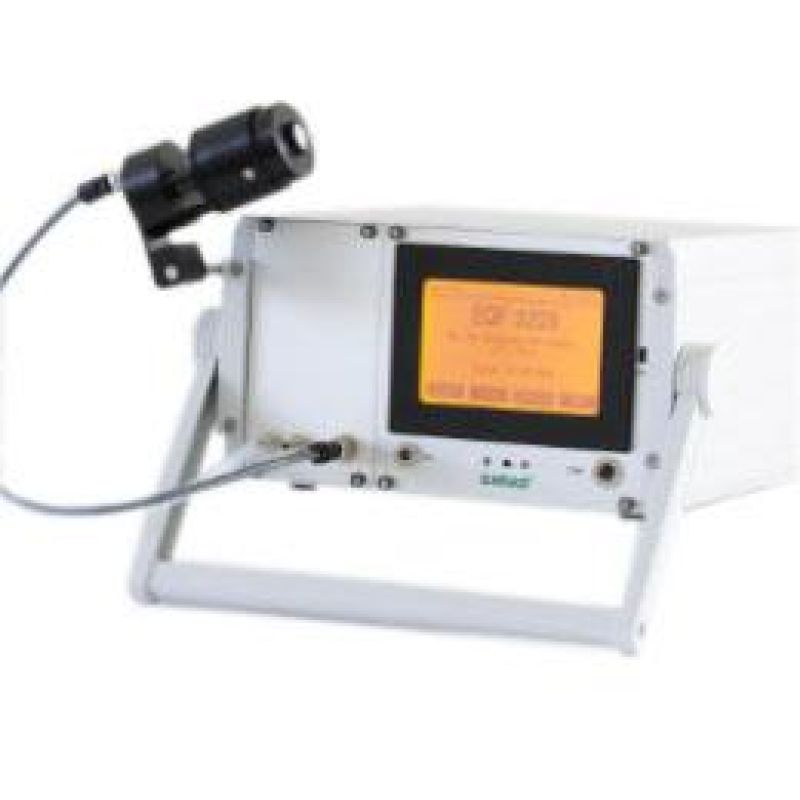
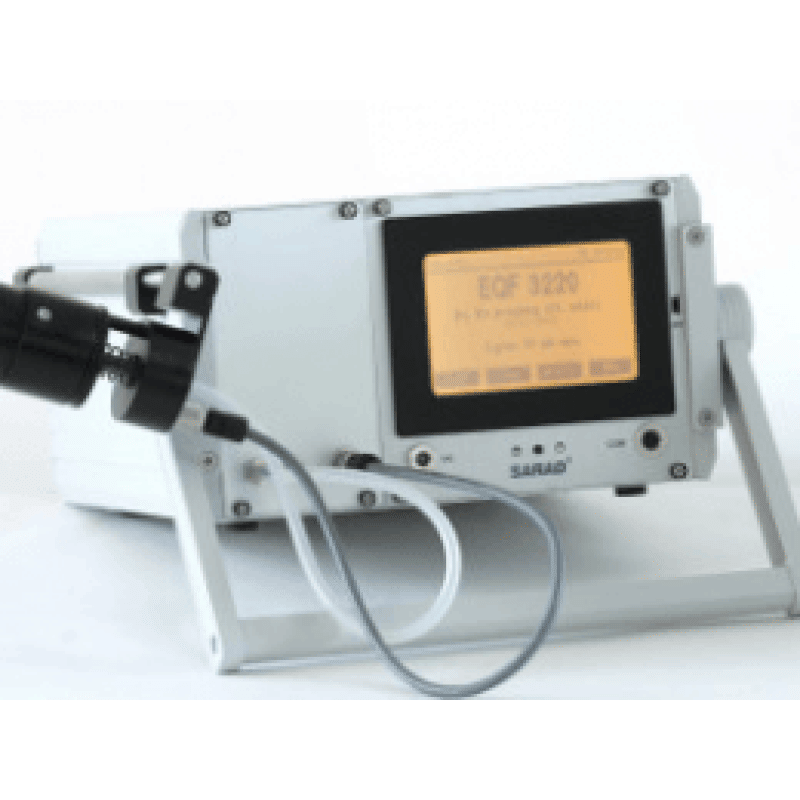
SARAD EQF 3220 Radon/Thoron Monitor
Pros
- Radon/thoron + decay products
- Separation by aerosol fraction
- Full alpha spectrometry
- Detachable head, up to 5 m
- Over 100 hours of battery life
Cons
- Professional instrument, not intended for home use
- Requires consumable filters
- Not for use in explosive atmospheres
EQF 3220: when “radon in Bq/m³” isn't enough
The EQF 3220 is a portable scientific and applied measurement station from SARAD for simultaneously measuring radon (²²²Rn) and thoron (²²⁰Rn) in air and their decay products in relation to aerosol particle size. If you need to know not just “how much radon,” but the actual dose from the air (through EEC/PAEC and the equilibrium factor), this is the class of instrument you need.

What it measures: gases, decay products and equilibrium
Gas components: Radon and thoron are measured in a dedicated radon chamber with semiconductor Si detectors. Two calculation modes are available for radon: Fast (faster response, without the contribution of ²¹⁴Po) and Slow (higher sensitivity, accounting for ²¹⁴Po).
Decay products: The EQF 3220 calculates EEC (equilibrium equivalent concentration) and PAEC (potential alpha energy concentration) separately for radon and thoron and for different aerosol fractions. This is critical for accurately assessing exposure in workplaces, mines, underground structures, facilities with NORM and more.
The EQF 3220's standout feature: size selection (free / cluster / attached)
Most instruments either measure gas or combine all the decay products. The EQF 3220 goes further: it distinguishes what the decay product nuclides are carried on:
• Free (free fraction): particles up to approximately 5 nm
• Cluster: nanofraction (approximately ~20…100 nm, with actual deposition in the “few nm” range), characteristic of air affected by combustion processes, among other conditions
• Attached (attached fraction): particles over 100 nm
The detachable measuring head uses a mesh screen and a filter, along with the geometry of the sampling path (distances to the detector), to separate the contributions from deposition on the screen and on the tube walls, allowing it to assess the cluster component. The result: you can see not only “how much EEC,” but also which fraction is responsible for the risk.
Full alpha spectrometry: quality control, not magic
The instrument stores the full alpha spectrum for each measurement interval. This means:
• you can check that peaks are separated correctly instead of simply trusting the number on the screen
• auditing, reporting and reanalyzing data are easier
• the risk of long-term bias from contamination is reduced (in particular, full spectrometry is noted as eliminating problems with long-term ²¹⁰Pb contamination)
Sampling and practical field use
Inside is a processor-controlled rotary vane pump with a nominal flow rate of 1.65 L/min for the decay product head. Importantly, flow parameters must be stable for correct free/attached selection, so the system is designed to work like a laboratory in a portable format.
The decay product head is telescopic and detachable and can be positioned where needed; the cable and hose can be extended to 5 m if necessary. This is useful when the instrument itself needs to stay somewhere safe and dry, while sampling takes place where a person actually breathes or where air flows.
Interfaces, memory and measurement cycles
The EQF 3220 is designed as a standalone logger: a 2 GB SD card, a 6 × 9 cm touchscreen, intervals from 1 second to several weeks, and up to 16 programs (cycles) with up to 32 steps each. Connections include USB and RS-232, with remote communication options also available, including an LTE modem.
SARAD software packages are used for data handling and control: dVISION (control/visualization/data management), dCONFIG (configuration and cycles), and dLIBRARY (nuclide library for the optional gamma probe).
Battery life and environmental sensors
Power comes from a 12 V NiMH rechargeable battery with a stated continuous operating time of >100 h, or from a 100–240 V, 50/60 Hz power adapter. Built-in sensors for temperature, relative humidity, barometric pressure and flow rate are standard, making them useful for both monitoring conditions and technical diagnostics.
Maintenance: filters, indicators and pump protection
The filter in the head is a consumable. The good news is that replacement is tool-free, and the system monitors its condition, including through flow changes or restrictions, and issues warnings. For a reliable seal and spectrometric resolution, use filters specified by the manufacturer.
Options for a little more radiation monitoring
The instrument can be expanded with a NaI(Tl) gamma probe (dose rate and spectrometry), GPS with export to *.kml, additional gas analysis modules (CO/CO₂/CH₄, etc.), process and weather sensors, and internal analog/counter inputs and control outputs for integration into monitoring systems.
If you need the manufacturer's hard numbers, here is the official EQF 3220 datasheet.